
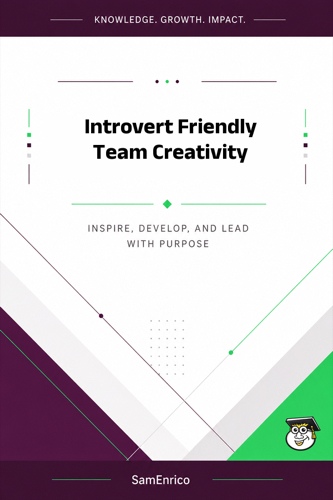
Introvert Friendly Team Creativity eBook
Include quiet voices in group innovation using the
Include quiet voices in group innovation using these practical collaboration techniques.
Formats
Free sample
Chapter 1: The Extrovert Trap--For most of her career, Sarah considered herself a good manager. She ran weekly brainstorming sessions that crackled with energy. Her team laughed, argued, and built on each other’s ideas in real time. She took pride in the fact that no one dominated—she called on people who hadn’t spoken, she encouraged the quiet ones to “just throw something out there,” she made the room feel safe.Then her company almost lost two million dollars because of a problem everyone should have seen.The flaw was in a critical piece of safety hardware—a connector that, under specific stress conditions, would fail catastrophically. The engineering team had discussed the product for six months.
They had held three “innovation summits” where whiteboards filled with ideas. They had debated materials, tolerances, manufacturing processes. Not once had anyone mentioned the stress condition that would later cause the failure.After the near-miss, Sarah pulled the team aside for a post-mortem. “Why didn’t anyone flag this?” she asked.The room went quiet. Then a junior engineer named Priya spoke up.
“I saw it,” she said quietly. “I wrote about it in my notes after the first brainstorming session. But by the time I figured out how to say it out loud, the conversation had moved on. And then it felt too late.”Sarah asked to see the notes. Priya pulled up a document on her laptop—fifteen pages of meticulous observations, including a detailed analysis of the exact stress condition that had nearly caused a disaster.
The notes were dated the day of the first brainstorming session, timestamped thirty minutes after the meeting ended.“Why didn’t you just say something?” Sarah asked, trying to keep the frustration out of her voice.Priya looked at her like she had asked why water wasn’t dry. “Because I don’t think that way,” she said. “I think alone. I think in writing. I think slowly.
By the time I had processed what I was hearing and formed a response, the group was already two topics ahead.”Sarah sat back in her chair. She had been managing teams for twelve years. She had read the leadership books, attended the training sessions, practiced the inclusive facilitation techniques. And she had been blind to the fact that her “collaborative” process was systematically filtering out the very insights she needed most.This book exists because of Sarah and Priya and the thousands of teams like them. It exists because the way most organizations generate ideas is not just inefficient—it is fundamentally biased against a third to a half of the workforce.
And it exists because the cost of that bias is not just hurt feelings or low engagement scores. The cost is missed opportunities, undetected risks, and breakthroughs that never happen.The Extrovert Ideal Let us name the problem. Sociologists and organizational psychologists have documented a powerful cultural force that shapes everything from how we hire to how we run meetings to who we promote. Susan Cain, whose landmark book Quiet brought this issue into mainstream conversation, calls it the Extrovert Ideal.The Extrovert Ideal is the pervasive, largely unexamined belief that the ideal self is gregarious, alpha, and comfortable in the spotlight. It is the assumption that people who speak easily and often are smarter, more capable, and more trustworthy than those who don’t.
It is the bias baked into phrases like “she really contributes in meetings” (translation: she talks a lot) and “he needs to come out of his shell” (translation: his natural processing style makes me uncomfortable).This ideal has not always existed. In fact, it is a relatively recent invention.The Great Character-to-Personality Shift Before the twentieth century, American culture prized what historians call the “Culture of Character.” The ideal self was reserved, honorable, and disciplined. Virtues like restraint, integrity, and a quiet moral seriousness were held up as the highest human achievements. When Abraham Lincoln and Frederick Douglass met for the first time, Douglass later wrote that Lincoln spoke so quietly he could barely hear him—and this was offered as a compliment.But somewhere between the rise of industrial cities and the explosion of mass media, the Culture of Character gave way to the “Culture of Personality.” Dale Carnegie’s How to Win Friends and Influence People (1936) became a sensation not because it taught integrity, but because it taught charm. The new ideal was magnetic, fast-talking, and socially fluid.
Salesmanship became a model for personhood. The phrase “personality test” entered the lexicon in the 1920s, and by the 1950s, American schools were grading children on “emotional adjustment” and “ability to mix well with others.”The Extrovert Ideal was not born in corporate America, but it found its most powerful expression there. The rise of open offices, the worship of the charismatic CEO, the insistence on “collaborative culture” as an unqualified good—these are all manifestations of a cultural story that says the best thinkers are the loudest thinkers.The Hidden Majority Here is the number that should shock every leader into action: introverts make up between 30 and 50 percent of the population.The range exists because introversion-extroversion is not a binary but a spectrum, and different studies use different cutoffs. What is not in dispute is that a substantial minority—many researchers say a near-majority—of people are wired to process information more slowly, more deeply, and more quietly than the extrovert ideal celebrates.But these numbers are likely underestimates in professional settings. Why?
Because many introverts have learned to perform extroversion at work. They force themselves to speak up in brainstorms. They nod along in meetings while their real thoughts remain unspoken. They go home exhausted, collapse on the couch, and wonder why a day of “collaboration” left them feeling like they had run a marathon.These individuals are sometimes called masked introverts—a term that avoids the faint shaming of older phrases like “closet introverts.” Masked introverts are not hiding because they are ashamed of who they are. They are masking because the professional consequences of being perceived as “quiet” can be severe.The Cost of the Bias What are those consequences?
The research is sobering.Multiple studies have shown that talkative people are consistently rated as smarter, more competent, and more desirable as colleagues than their quieter peers—even when objective measures show no difference in the quality of their ideas. One study placed participants in mock hiring committees and found that candidates who spoke more (regardless of the content of their speech) were more likely to be hired. Another study tracked engineering teams and found that the most verbally dominant members were perceived as the most technically competent—even when their actual contribution to the team’s success was measured as below average.Let that land. The loudest person in the room is statistically no more likely to have the best idea. But they are perceived as smarter and more capable.
This is not a meritocracy. This is a cognitive bias dressed up as a management principle.The costs ripple outward. Teams that operate under the Extrovert Ideal generate fewer novel ideas (Chapter 3 will examine the research on why brainstorming fails). They miss…
This is the end of the free sample. Get the eBook to keep going. Buy now
About this book
Details
- Author
- Coppola Mickie
- Publisher
- SamEnrico
- Language
- English
- Genre
- Non-Fiction, Self-Help, Introversion
- Released
- 2026-06-06
- Pages (approx.)
- 150
- Available as
- eBook, Audiobook

Read better in the ZLOADR app
Your eBooks on your phone or tablet. Sign in with your SamEnrico account and start reading.
More by Coppola Mickie
 EQ Grief Support GuideCoppola Mickie$11.99
 Workaholism In Solo EntrepreneursCoppola Mickie$11.99
 The 5 Whys Anger MethodCoppola Mickie$11.99
 SAS Counter Terror OperatorCoppola Mickie$11.99
 The Silk Road's Forgotten Cartographer: Xuanzang's Epic Journey to the Heart of AsiaCoppola Mickie$11.99
 Anansi and the Weaver’s Vow: A Spider’s Web of Love and DeceitCoppola Mickie$11.99
 Monthly Runway Tracker WorkbookCoppola Mickie$12.99
 Business English to ChineseCoppola Mickie$12.99
 Understanding Furlong–kurczynski–hennessy SyndromeCoppola Mickie$17.99
 Claw Machine StockerCoppola Mickie$11.99
 How to Start a Software Publishing BusinessCoppola Mickie$11.99
You may also like
 Stress Communication for IntrovertsMccormick Loren$11.99
 Small Talk for Introverts WorkbookLarsen Ludie$11.99
 Anger Management for IntrovertsKovach Stanton$11.99
 Loneliness And Introversion GuideLugo Marcelo$11.99
 Self Esteem For Quiet ProfessionalsKeaton Darius$11.99
 Remote Work Introvert GuideZimmer Delilah$11.99
 Lonely Introvert Connection PlanHartman Son$11.99
 Introvert Listening AdvantageBivins Dorris$11.99