
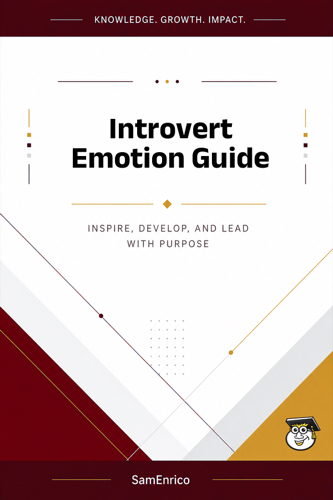
Introvert Emotion Guide eBook
undefined
undefined
Formats
Free sample
Chapter 1: The Quiet Architecture--Let me begin with a confession: For most of my life, I believed something was wrong with me.Not because I was sad or anxious in any clinical sense. Because I would leave parties feeling like I had run a marathon in wet clothes. Because I would sit in meetings with brilliant ideas fully formed in my head, watch the extroverts speak first, and then stay silent because the moment had passed. Because I would feel emotions—other people's emotions—so deeply that I would come home exhausted without having said more than ten words. I assumed this meant I was broken.
Too sensitive. Too slow. Too much and not enough at the same time.I was wrong. And if you are reading this book, you have probably been wrong about yourself, too.This chapter is not a collection of tips or a list of coping strategies. Before we can build anything useful, we have to clear the ground.
We have to look at the actual architecture of your brain and nervous system and understand why you process emotions the way you do. Because once you see the blueprint, everything else changes. The exhaustion makes sense. The depth makes sense. The silence makes sense.
And the question stops being "What is wrong with me?" and becomes "What have I been missing about how I work?"The Myth of the Emotional Deficit Western culture has a default setting for how a healthy person should express emotion. You should react quickly but not too quickly. You should show enthusiasm visibly. You should process feelings out loud, preferably in conversation with others. You should recover from upsets rapidly and move on without dwelling.
You should want to share your emotional state with the group. And you should definitely not need to disappear into a quiet room after a social gathering to feel like yourself again.This default setting describes one temperament. It describes approximately forty to fifty percent of the population. The rest of us have been measured against this standard and found wanting.The most damaging consequence of this mismatch is not the practical difficulties of living in an extrovert-designed world. It is the internal story we absorb.
When you consistently fail to perform emotion the way your culture expects, you do not blame the culture. You blame yourself. You tell yourself you are shy when you are simply processing. You tell yourself you are antisocial when you are simply saturated. You tell yourself you need to try harder when your nervous system is already working twice as hard as everyone else's just to stay upright in a crowded room.Here is what the research actually shows: introverts do not have less emotional capacity.
They have a different emotional architecture. And that architecture is not a defect. It is a design feature optimized for depth, discernment, and sustained internal processing rather than rapid external response.The Neuroscience of the Introverted Brain To understand why you feel emotions the way you do, we have to look at two different neural pathways. Think of them as two different fuel systems in the same body.The first system runs on dopamine. Dopamine is the neurotransmitter associated with reward, novelty, and approach behavior.
When you see something exciting, when you hear a surprising piece of news, when you walk into a room full of new people, your brain releases dopamine. It feels good. It makes you want more stimulation. This system is more active in extroverts. Their brains are wired to seek out novelty, to thrive on quick feedback loops, and to feel energized by external rewards.The second system runs on acetylcholine.
Acetylcholine is a different kind of neurotransmitter. It is associated with calm focus, sustained attention, long-term memory consolidation, and what neuroscientists call "the resting state" of the brain. This is not rest in the sense of sleeping or zoning out. It is rest in the sense of internal processing—the state in which your brain connects new information to old memories, generates insights, and makes meaning out of experience. Acetylcholine makes you feel alert but not agitated, focused but not frantic.
And here is the critical fact: introverts rely more heavily on the acetylcholine pathway than the dopamine pathway.This is not a choice. It is not a habit you can break with enough willpower. It is the basic architecture of your nervous system.What does this mean in practice? When you enter a stimulating environment, your brain does not primarily release dopamine to propel you forward into engagement. It releases acetylcholine to help you focus internally, to process what is happening at a deeper level, and to compare the present moment with your existing store of memories and knowledge.
While the extrovert is thinking "What's next?" your brain is asking "How does this fit with what I already know?" While the extrovert is scanning for new rewards, your brain is consolidating information into long-term understanding.This is not slowness. It is depth. It is the difference between taking a hundred shallow breaths and one deep breath that fully oxygenates your blood. The extrovert processes emotions quickly and moves on. You process emotions thoroughly, and that takes time.
But what you gain is a richness of emotional data that the faster system simply cannot access.Why Quiet Environments Produce Louder Internal Clarity One of the most common complaints I hear from introverts is that they feel "boring" in quiet environments. They sit in silence and worry that nothing is happening. They look around at extroverts generating energy and assume their own internal stillness is emptiness.This is exactly backwards.Imagine you are in a room with a hundred people all talking at once. You cannot hear any single conversation clearly. The noise overwhelms the signal.
Now imagine you are in a room with one person speaking softly. You can hear every word. You can hear the pauses between words. You can hear the breath before the next sentence. You can hear the meaning beneath the meaning.Your brain in a quiet environment is the second room.
The absence of external stimulation is not emptiness. It is the condition under which your acetylcholine pathway can do its best work. When you are not being bombarded by new inputs, your brain can process the inputs you already have. It can connect yesterday's conversation to last week's feeling to a memory from childhood that suddenly makes sense. It can generate insights that never would have appeared in a louder setting.I have worked with introverts who described their own quiet thinking as "nothing happening." When we tracked what was actually occurring in their minds, we found constant activity—subtle, layered, non-linear activity that simply did not announce itself the way an extrovert's thoughts do.
They were not bored. They were processing at high resolution. They just did not recognize it as processing because it did not look like the model they had been taught.A quiet environment does not create emptiness. It amplifies internal clarity. The quieter the room, the louder your inner voice becomes.
And that inner voice is not chaos. It is data. High-resolution, deeply nuanced, exquisitely detailed emotional data.The Distinction That Changes…
This is the end of the free sample. Get the eBook to keep going. Buy now
About this book
Details
- Author
- Hutchens Cicely
- Publisher
- SamEnrico
- Language
- English
- Genre
- Non-Fiction, Self-Help
- Released
- 2026-06-10
- Pages (approx.)
- 136
- Available as
- eBook, Audiobook

Read better in the ZLOADR app
Your eBooks on your phone or tablet. Sign in with your SamEnrico account and start reading.
More by Hutchens Cicely
 The Stress Reactivity WorkbookHutchens Cicely$11.99
 Elderly Parent Caregiver Stress GuideHutchens Cicely$11.99
 United Nations DecolonizationHutchens Cicely$11.99
 Empathy for VeteransHutchens Cicely$11.99
 Maulvi Ahmadullah ShahHutchens Cicely$11.99
 Finding the Right Mentor GuideHutchens Cicely$11.99
 Weber Fechner Law PricingHutchens Cicely$11.99
 Harvard Extension vs LSE Student SupportHutchens Cicely$12.99
 I Statement Communication GuideHutchens Cicely$11.99
 Quetzalcoatl's Celestial Spire: The Feathered Serpent's Skyward AscentHutchens Cicely$11.99
 Echoes of the Forgotten: The Lost Tapes of the Titanic’s Last BroadcastHutchens Cicely$11.99
 Growing Limonium (Sea Lavender)Hutchens Cicely$11.99
You may also like
 Hong Kong Handover 1997Dunn Johnnie$11.99
 Zumba For Postnatal Recovery CourseNeal Christian$11.99
 Zumba for BeginnersLadner Nikia$11.99
 YouTube Comment Mining GuideHumes Pandora$12.99
 Worry Box MeditationCarlin Rudy$11.99
 Workplace Stress MeditationNguyen Lynn$11.99
 Workplace Stress and Sleep RepairHawley Ivory$11.99
 Workplace Perfectionism CureDelaney Jeffry$11.99
 Workplace Injustice Anger GuideWallen Isabelle$11.99
 Work Addiction and Burnout LinkGreenwood Ester$11.99
 Women in Yoga and WellnessBeattie Galina$11.99
 Women in Stand Up ComedyChun Evangeline$11.99