
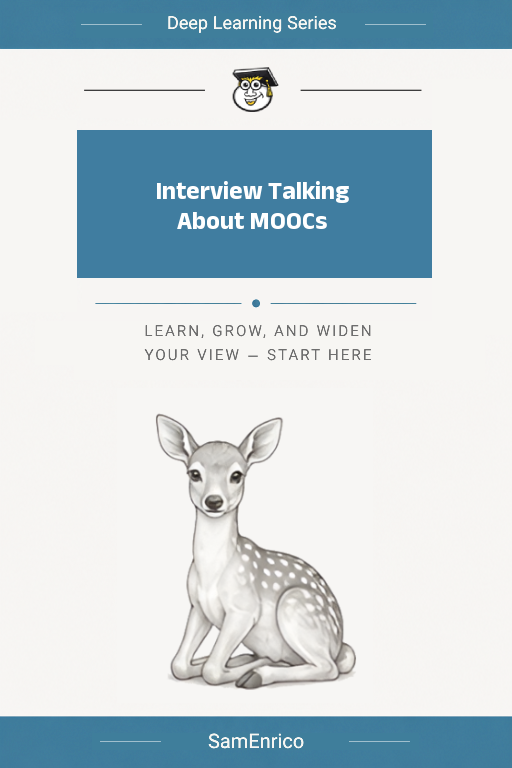
Interview Talking About MOOCs eBook
Answer interview questions about MOOC certificates
Answer interview questions about MOOC certificates with skill demonstration, project stories, and learning proof.
Formats
Free sample
Chapter 1: The Credential Paradox...–- It was 10:47 on a Tuesday morning when Priya’s video interview glitched for the third time. She was halfway through explaining how her Google Data Analytics certificate had prepared her for the role, and the hiring manager’s face had already shifted from neutral to skeptical. “That’s great,” the manager said, cutting her off mid-sentence. “But we usually hire people with degrees in statistics. Why should we consider someone with only online courses?”Priya froze.
She had completed eight MOOCs. She had spent 400 hours watching lectures, doing quizzes, and building projects. She had the certificates to prove it. But in that moment, every answer she tried felt like an apology. She talked about the syllabus.
She listed the modules. She even mentioned her grade. And when the interview ended thirty seconds later with a perfunctory “We’ll be in touch,” she knew what that really meant.Priya’s problem wasn’t a lack of skill. It was a failure of translation. She had treated her MOOC certificates like academic credentials when the interviewer was treating them like hobbies.
That mismatch—between what a certificate signals to a hiring manager and what you think it proves—is the central trap of interviewing with MOOCs. And until you understand the paradox at the heart of that trap, no amount of course completions will save you.The Signal vs. Noise Problem Every piece of information you present in an interview is either signal or noise. Signal is information that reduces uncertainty about your ability to do the job. Noise is everything else—impressive-sounding but irrelevant facts that distract from your core value proposition.
The problem with MOOC certificates is that they exist in a liminal space: they look like credentials, but they don’t carry the same weight as degrees. And weight matters because hiring managers are drowning in noise.Consider the Stanford computer science degree. When you see it on a resume, what do you infer? You infer that the candidate survived a brutal admissions process (grit). You infer that they had access to world-class faculty and peers (pedigree).
You infer that they spent four years in a structured environment that demanded persistence (discipline). And you infer that someone else—an accredited institution—has vouched for their competence. That is a dense bundle of signals compressed into three words.Now consider a Coursera certificate in machine learning. What do you infer? You might infer that the candidate is curious.
You might infer they have some self-discipline. But you also might infer that they watched videos at 2x speed, that they looked up answers for the quizzes, that they completed the peer-reviewed assignments with minimal effort, and that the certificate represents completion rather than mastery. The same hiring manager who respects a Stanford degree will often dismiss a MOOC certificate as noise—not because it’s worthless, but because they don’t know what it actually means.This is the Credential Paradox: The more accessible a credential becomes, the less it signals. Degrees are expensive and exclusive, which is exactly why they work as signals. MOOCs are cheap and open, which is exactly why they don’t.
You cannot win by arguing that your certificate is equal to a degree because the argument itself admits you’re playing someone else’s game by someone else’s rules.Why “Just an Online Course” Hurts So Much The specific phrase that kills more MOOC interviews than any other is this: “Isn’t this just an online course?” The question sounds like an inquiry, but it’s actually a verdict. What the interviewer is really saying is: “I don’t trust this credential, and I’m giving you a chance to prove me wrong.” Most candidates fail this test because they respond defensively. They list the course syllabus. They name-drop the instructor. They cite their quiz scores.
All of that is noise because it doesn’t address the underlying doubt: Can you actually do the work?Let me give you a concrete example. I once coached a candidate named Marcus who had completed a prestigious MITx micromasters in supply chain management. He had perfect grades. He had a capstone project that simulated a global logistics optimization. And in his interview for a supply chain analyst role, the hiring manager said, “I see you have an MIT certificate, but it’s not a real MIT degree.
How do I know you’re not just good at taking tests?”Marcus made the mistake of defending the certificate. He talked about proctored exams. He mentioned the rigorous grading curve. He even pulled up his transcript. And the manager smiled politely and moved on to the next candidate.
What Marcus should have done was ignore the question about the certificate entirely and pivot immediately to demonstration. He should have said, “Let me show you the optimization model I built for the capstone. I reduced simulated shipping costs by 23% using a linear programming approach that the course taught in Week 8.” That answer doesn’t defend the certificate. It replaces the certificate with evidence.The Credential Paradox has a hidden corollary: You cannot defend a certificate into credibility. You can only demonstrate your way out of doubt.The Labor Market Has Already Moved Here is the good news that most interview guides won’t tell you: hiring managers are increasingly distrustful of degrees, too.
A 2023 survey by the Society for Human Resource Management found that 45% of employers had dropped degree requirements for certain roles in the previous two years. Google, Apple, IBM, and Bank of America have all eliminated degree requirements for many positions. The reason isn’t altruism—it’s data. Studies have consistently shown that degree-based hiring screens out talented candidates without improving job performance.What has replaced degree requirements in many companies is skills-based hiring. Instead of asking “Do you have a degree?,” hiring managers are asking “Can you do the work?” And that shift creates an opening for MOOC learners who know how to answer the second question.
But—and this is crucial—the shift away from degrees does not automatically benefit MOOCs. It benefits demonstration. If you walk into an interview with a certificate and no ability to show your work, you’re worse off than the degree holder who also can’t show their work. At least their degree buys them the benefit of the doubt. Your certificate buys you nothing.I’ve seen this play out hundreds of times.
The candidate who succeeds with MOOCs is not the one with the most certificates. It’s the one who treats the interview like a workshop. They share their screen. They walk through their code. They open their Jupyter notebook and explain their thinking.
They treat the certificate as a footnote—a receipt, not a trophy. The candidate who fails is the one who treats the certificate as the main event, listing courses like achievements and expecting applause.The Two Kinds of MOOC Learners After analyzing hundreds of interview transcripts and coaching dozens of candidates, I’ve noticed that MOOC learners divide into two distinct groups. The first group treats MOOCs like college. They take notes. They complete every quiz.
They earn the certificate. And then they put that certificate on their resume and expect it to work like a…
This is the end of the free sample. Get the eBook to keep going. Buy now
About this book
Details
- Author
- Rutledge Minh
- Publisher
- SamEnrico
- Language
- English
- Genre
- Non-Fiction, Student's Shortcut
- Released
- 2026-05-28
- Pages (approx.)
- 131
- Available as
- eBook, Audiobook

Read better in the ZLOADR app
Your eBooks on your phone or tablet. Sign in with your SamEnrico account and start reading.
More by Rutledge Minh
 Humid Climate Sleep MeditationRutledge Minh$11.99
 Mindful Parenting HandbookRutledge Minh$11.99
 Widowhood Reconnection GuideRutledge Minh$11.99
 Assertive Requests That Get ResultsRutledge Minh$11.99
 The Writer's Daily Ritual GuideRutledge Minh$11.99
 The Marauders of the Atlantic: Portugal’s Golden FleetRutledge Minh$11.99
 Assistant Banquet ManagerRutledge Minh$11.99
 Product Teaser Pre LaunchRutledge Minh$12.99
 Learn to Play the ArghulRutledge Minh$11.99
 How to Start a Phonetic Printing Business (Beginners Guide)Rutledge Minh$11.99
You may also like
 LSE Online Program LengthAgee Letisha$11.99
 Harvard Extension School for Working AdultsRoush Yer$11.99
 LSE Online Reading ListAshford Ludivina$11.99
 LSE Online Language RequirementsWhitten Daphine$11.99
 LSE Online Class SizeHughey Garret$11.99
 LSE Online Alumni MentorshipWild Lyla$11.99
 London School of Economics Alumni NetworkDutton Chantal$11.99
 Harvard Extension School Student SupportCantrell Christene$11.99
 Harvard Extension School Library AccessSantana Adah$11.99
 Harvard Extension School Degree CompletionBray Wyatt$11.99
 Harvard Extension School Course AuditingAbbott Craig$11.99
 Harvard Extension School Extension DiplomaNew Joane$11.99