
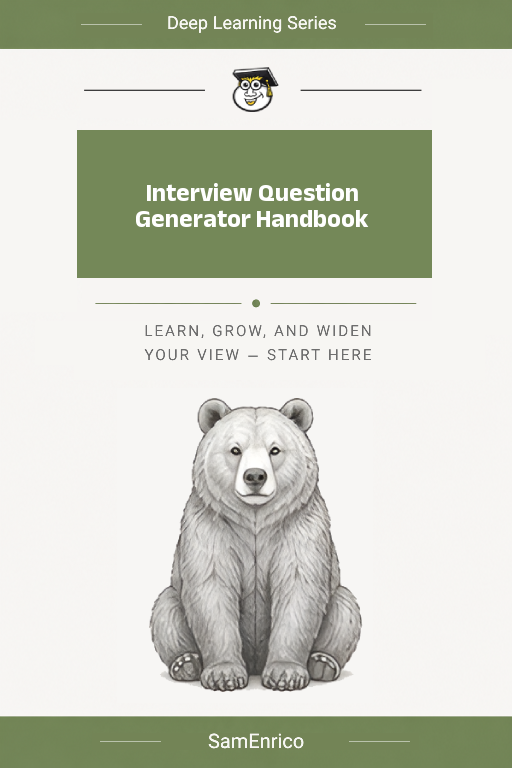
Non-FictionAI OperatorTalent Acquisition TechInterview Guide
Interview Question Generator Handbook eBook
Create role-specific, competency-based interview q
Create role-specific, competency-based interview questions from parsed resume data and job requirements using AI. Includes follow-up prompts, scoring rubrics, and fairness guidelines.
Formats
Free sample
Chapter 1: The Prediction Problem--–- In a windowless conference room in Chicago, a hiring manager named Sarah watched her third candidate of the morning walk out. She had asked the same five questions she always asked. The candidate had given the same polished answers she always heard. Forty-five minutes later, Sarah knew she liked the candidate. She could not say, with any confidence, whether the candidate could actually do the job.Six months earlier, Sarah had hired someone she genuinely liked.
The candidate was charming, confident, and told a compelling story about turning around a failing project. Within ninety days, that same candidate had alienated two key clients, missed every major deadline, and cost the company forty-seven thousand dollars in rework. The exit interview revealed what the interview never did: the candidate had never actually led the turnaround. They had been a junior contributor on a team that succeeded despite them, not because of them.Sarah is not alone. She is not a bad manager.
She is not lazy or uninformed. Sarah is the victim of a system that has been broken for nearly a century and that most organizations continue to use despite overwhelming evidence that it does not work.The Broken Foundation of Modern Hiring The unstructured interview—the casual, conversational, "let's just chat and see if you feel right" approach—is the most common hiring tool in the world. It is also one of the least effective. According to the meta-analyses of Schmidt and Hunter (1998) published in Psychological Bulletin, the unstructured interview has a predictive validity of less than 0.20 for on-the-job performance. In plain language: it is barely better than random chance.To understand how astonishingly low this is, consider that a coin flip has a predictive validity of 0.00.
A structured interview—one where questions are standardized, job-relevant, and scored consistently—has a validity of approximately 0.51. The difference between 0.20 and 0.51 is not incremental. It is the difference between guessing and knowing.But the numbers tell only part of the story. The real damage of the generic interview is psychological, organizational, and financial. Every time a hiring manager asks "Tell me about yourself" or "What's your greatest weakness," they are not just wasting time.
They are actively degrading the quality of their hiring decisions.The Three Cognitive Traps of the Generic Interview Why do intelligent, well-meaning professionals continue to rely on a tool that research has repeatedly shown to fail? The answer lies not in bad intentions but in cognitive biases that every human shares. The generic interview is not merely unhelpful—it is a cognitive trap designed to produce exactly the wrong outcome.Trap One: The Halo Effect The halo effect is the tendency for one positive trait to color our perception of everything else. A candidate walks in wearing a sharp suit. They have a firm handshake.
They went to an impressive university. Without conscious awareness, the interviewer begins to assume that because the candidate is polished, they must also be competent, reliable, and hardworking.In a generic interview, the halo effect is catastrophic. The interviewer asks open-ended questions that allow the candidate to tell any story they wish. A confident storyteller can create a halo that masks a complete lack of relevant experience. Meanwhile, a nervous but highly qualified candidate—perhaps someone from a non-traditional background or someone who does not interview well—receives no halo and is judged more harshly.Trap Two: Confirmation Bias Once we form an initial impression of someone—usually within the first thirty seconds of meeting them—we spend the rest of the interaction seeking evidence that confirms that impression.
This is confirmation bias, and it is relentless.If an interviewer decides within the first minute that a candidate is promising, they will unconsciously ask easier questions, interpret ambiguous answers charitably, and remember the candidate's strengths while forgetting their weaknesses. If the initial impression is negative, the opposite occurs: harder questions, skeptical interpretation, and selective memory for flaws.The generic interview provides no guardrails against confirmation bias. The interviewer is free to ask whatever questions they wish, interpret answers however they prefer, and conclude whatever they already believed. The interview becomes not an assessment but a performance of objectivity.Trap Three: The Likeability Trap Perhaps the most insidious trap is the confusion between likeability and capability. Humans are social animals.
We evolved to prefer people who are warm, similar to us, and easy to talk to. In the context of a job interview, this evolutionary preference becomes a liability.Research by Allen and colleagues (2008) in the Journal of Applied Psychology found that likeability predicts interview outcomes more strongly than actual qualifications for many roles. In other words, interviewers systematically prefer candidates they enjoy talking to, even when those candidates are less qualified. The generic interview does not measure job performance. It measures how much the interviewer enjoyed the conversation.The Scalability Crisis Beyond cognitive biases, the generic interview suffers from a more practical problem: it does not scale.Consider Sarah, the hiring manager in Chicago.
She oversees forty open roles across six departments. Each role receives an average of sixty applicants. Even after initial screening, she conducts first-round interviews with twelve candidates per role. That is four hundred and eighty interviews per quarter. Even at thirty minutes each, that is two hundred and forty hours of interviewing—six full workweeks—just for the first round.
And that assumes she never takes a bathroom break or answers an email.Sarah cannot write unique, high-quality questions for each of those four hundred and eighty interviews. No human can. The math simply does not work. So she defaults to the same five questions she has always asked. The candidates have heard those same five questions before.
They have rehearsed answers. The interview becomes a scripted performance with no predictive power.This is not a failure of effort or intelligence. It is a failure of systems. The generic interview is a craft tool being asked to do industrial-scale work. It breaks under the load.The Predictive Assessment Alternative There is another way.
A predictive assessment is not a conversation starter. It is a targeted, evidence-based question rooted in two specific documents: the candidate's resume and the job description. Where a conversation starter asks, "Tell me about a time you led a project," a predictive assessment asks, "Your resume shows you led a three-person migration to AWS in Q3 of 2022. The timeline was cut by two weeks. Walk me through how you reprioritized tasks and communicated the changes to stakeholders."The difference is not subtle.
The conversation starter invites storytelling. The predictive assessment demands evidence. The conversation starter can be answered by anyone with a reasonable imagination. The predictive assessment can only be answered by someone who actually did the work.Predictive assessments are not new. Industrial-organizational psychologists have advocated for structured, behavior-based interviewing for decades.
What is new is the ability to generate these assessments at scale. Artificial intelligence, specifically large language models, can now parse a resume, compare it to a job description, identify gaps and discrepancies, and generate targeted questions—complete with scoring rubrics and follow-up prompts—in seconds.This book is the manual for that process.What This Book Will Teach You By the time…
This is the end of the free sample. Get the eBook to keep going. Buy now
About this book
Details
- Author
- Roderick Conchita
- Publisher
- SamEnrico
- Language
- English
- Genre
- Non-Fiction, AI Operator, Talent Acquisition Tech, Interview Guide
- Released
- 2026-05-30
- Pages (approx.)
- 146
- Available as
- eBook, Audiobook

Read better in the ZLOADR app
Your eBooks on your phone or tablet. Sign in with your SamEnrico account and start reading.
More by Roderick Conchita
 The Self Esteem for Immigrants GuideRoderick Conchita$11.99
 Pet Loss and NatureRoderick Conchita$11.99
 Long Term Travel Career PivotRoderick Conchita$11.99
 Flirting Nonverbal Signals GuideRoderick Conchita$11.99
 John Chrysostom AccountRoderick Conchita$11.99
 The Bone Collector of the Black ForestRoderick Conchita$11.99
 Understanding KyphosisRoderick Conchita$17.99
 How to Start a Steam and Air-Conditioning Supply BusinessRoderick Conchita$11.99
 EV Battery Recycling GuideRoderick Conchita$12.99
 Barback TrainingRoderick Conchita$11.99
You may also like
 Hong Kong Handover 1997Dunn Johnnie$11.99
 Zumba For Postnatal Recovery CourseNeal Christian$11.99
 Zumba for BeginnersLadner Nikia$11.99
 YouTube Comment Mining GuideHumes Pandora$12.99
 Worry Box MeditationCarlin Rudy$11.99
 Workplace Stress MeditationNguyen Lynn$11.99
 Workplace Stress and Sleep RepairHawley Ivory$11.99
 Workplace Perfectionism CureDelaney Jeffry$11.99
 Workplace Injustice Anger GuideWallen Isabelle$11.99
 Work Addiction and Burnout LinkGreenwood Ester$11.99
 Women in Yoga and WellnessBeattie Galina$11.99
 Women in Stand Up ComedyChun Evangeline$11.99