
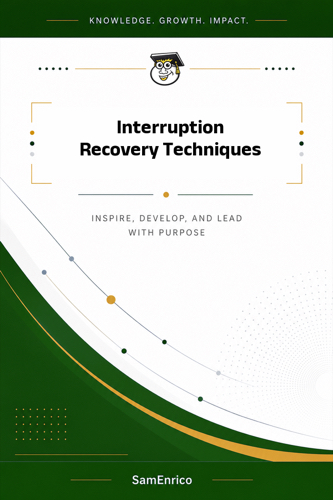
Interruption Recovery Techniques eBook
Quickly refocuses after being disrupted.
Quickly refocuses after being disrupted.
Formats
Free sample
Chapter 1: The 23-Minute Lie--–- The email arrived at 9:47 AM. You were halfway through drafting a response to your boss, your fingers moving with the kind of fluid confidence that comes only when you've finally found the right words. Then Slack pinged. A colleague needed "just one quick thing." You switched tabs, answered the question (forty-five seconds, tops), and returned to your email. And then you sat there.
Staring. The cursor blinked at the end of an incomplete sentence: "Based on the Q3 numbers, I believe we should—" Should what? You read the paragraph three times. Nothing. The thought was gone.
Evaporated. You spent the next seven minutes re-reading previous paragraphs, checking your sent folder for context, and finally—defeated—deleting the sentence and starting over. The colleague who interrupted you? They forgot they even asked. But you didn't forget.
You spent the rest of the morning feeling slightly off, slightly slower, slightly more irritated every time another notification buzzed. By lunch, you'd accomplished roughly half of what you'd planned. And you went to bed that night convinced that the problem was you. Your focus. Your discipline.
Your increasingly fragile attention span.You are not the problem.This book exists because nearly every professional on earth has been sold a lie: that interruptions are an annoyance, that willpower is the solution, and that "just getting back to work" is a reasonable expectation. The lie is seductive because it places all responsibility on your shoulders. If you can't refocus, the thinking goes, you must be lazy, or distracted, or fundamentally broken. But the research tells a very different story—one that will likely make you angrier than you've ever been at every productivity guru who told you to "just turn off your phone."The truth is that your brain is not designed to switch tasks quickly. It was never meant to.
The neural architecture that allows you to focus deeply on a single problem is the same architecture that resists being yanked in another direction. Every time you switch tasks—even for a moment—you leave a piece of your cognitive processing power behind, stuck on the previous task like a record needle in a skipping groove. And the more incomplete that previous task feels, the more of your brain stays trapped there. This is not a character flaw. This is neuroscience.By the time you finish this chapter, you will understand why your recovery time is almost certainly longer than you think, why the famous "23-minute" statistic has been misunderstood and weaponized against workers, and why "speed" is the wrong goal entirely.
You will complete a simple tracking exercise that will, for the first time, give you actual data about your own interruption patterns. And you will begin to reframe the problem in a way that makes the rest of this book possible. Because you cannot fix a problem you have been misdiagnosing for years. It is time to name the real enemy. And the real enemy is not your phone, your colleagues, or your wandering mind.
The real enemy is the gap between how you think recovery works and how it actually works.The Myth of the 23 Minutes Let us begin with the number that haunts every conversation about workplace distraction: 23. You have heard it a hundred times. "It takes 23 minutes to refocus after an interruption." The statistic appears in Forbes articles, Linked In posts, and corporate training videos. It has been cited by productivity experts, time management coaches, and your well-meaning manager who once suggested everyone put their phones in a basket during meetings. There is only one problem with the 23-minute statistic.
It is not wrong, exactly. But it is deeply, destructively misleading.The original research, conducted by Gloria Mark at the University of California, Irvine, found that when knowledge workers were interrupted, it took an average of 23 minutes and 15 seconds to return to their original task. That much is true. But here is what the popular articles never tell you: the 23 minutes included the time spent on the interruption itself, plus the time spent on "resumption activities"—everything from checking email after a call to staring blankly at a spreadsheet trying to remember where you left off. More importantly, the researchers measured only time.
They did not measure cognitive load. They did not measure the quality of the work produced after the interruption. And they certainly did not measure the invisible cost that accumulates over a day of repeated disruptions.Here is what the research actually shows, stripped of its viral misinterpretation. When you switch from Task A to Task B, your brain does not simply stop processing Task A. It continues to devote cognitive resources to the incomplete task, a phenomenon that University of Washington researcher Sophie Leroy named "attention residue." The more complex and incomplete Task A feels, the more attention residue you carry into Task B.
This means you are not fully present for the interruption itself—which is why you often forget what a colleague said immediately after a deep-focus session—and you are certainly not fully present when you return to Task A. You are, in effect, doing two things at once, and your brain is terrible at both.The real damage, however, is not the lost time. It is the lost completeness. When you rush back to a task after an interruption, you rarely pick up exactly where you left off. You pick up somewhere nearby, missing crucial context, emotional tone, or logical threads.
You produce work that is slightly worse. You make decisions that are slightly less informed. You forget ideas that were forming in the periphery of your consciousness. These costs are almost impossible to measure in a laboratory study, which is why they never make it into the headlines. But you feel them.
Every day. That vague sense that you used to be smarter, or faster, or more creative? That is not aging. That is attention residue, compounding like credit card debt.The Neurological Toll of the Switch To understand why interruption recovery is so difficult, you need to understand what is actually happening inside your skull during a task switch. This is not a metaphor.
We are talking about measurable changes in brain chemistry, electrical activity, and metabolic consumption.Your brain runs on glucose, the same fuel that powers the rest of your body. When you are engaged in focused work—what psychologist Mihaly Csikszentmihalyi called "flow"—your prefrontal cortex, the region responsible for executive function and complex decision-making, consumes glucose at an elevated rate. This is normal and sustainable for periods of ninety minutes or so, similar to how a runner can sustain a pace for a set distance. But task switching changes the equation dramatically. Every time you switch from one cognitive task to another, your brain must perform a series of operations: it must inhibit the neural networks associated with the previous task, activate the networks associated with the new task, and re-establish the contextual framework for the new task.
Each of these operations requires glucose. And each switch depletes your available fuel faster than sustained focus would.This is why you feel exhausted after a day of interruptions even if you accomplished very…
This is the end of the free sample. Get the eBook to keep going. Buy now
About this book
Details
- Author
- Pinkerton Kerstin
- Publisher
- SamEnrico
- Language
- English
- Genre
- Non-Fiction, Self-Help, Recovery
- Released
- 2026-06-05
- Pages (approx.)
- 156
- Available as
- eBook, Audiobook

Read better in the ZLOADR app
Your eBooks on your phone or tablet. Sign in with your SamEnrico account and start reading.
More by Pinkerton Kerstin
 Anki For PhysicsPinkerton Kerstin$11.99
 Forced Connections for BusinessPinkerton Kerstin$11.99
 The OKR Hope GuidePinkerton Kerstin$11.99
 Forgiving a CheaterPinkerton Kerstin$11.99
 CrossFit Mobility ManualPinkerton Kerstin$11.99
 Mindfulness for Bipolar BeginnersPinkerton Kerstin$11.99
 Colombian Jungle Cocaine TrailPinkerton Kerstin$11.99
 The Alchemists of Light: Huygens, Hooke, and the Birth of Microscopic SciencePinkerton Kerstin$11.99
 The Last Wyvern of the Black ForestPinkerton Kerstin$11.99
 How to Produce a Radar DetectorPinkerton Kerstin$11.99
 The Essential Guide to Christian RapPinkerton Kerstin$11.99
 How to Produce an Energy RegulatorPinkerton Kerstin$11.99
You may also like
 Hong Kong Handover 1997Dunn Johnnie$11.99
 Zumba For Postnatal Recovery CourseNeal Christian$11.99
 Zumba for BeginnersLadner Nikia$11.99
 YouTube Comment Mining GuideHumes Pandora$12.99
 Worry Box MeditationCarlin Rudy$11.99
 Workplace Stress MeditationNguyen Lynn$11.99
 Workplace Stress and Sleep RepairHawley Ivory$11.99
 Workplace Perfectionism CureDelaney Jeffry$11.99
 Workplace Injustice Anger GuideWallen Isabelle$11.99
 Work Addiction and Burnout LinkGreenwood Ester$11.99
 Women in Yoga and WellnessBeattie Galina$11.99
 Women in Stand Up ComedyChun Evangeline$11.99