
Non-FictionSelf-HelpRecovery Techniques
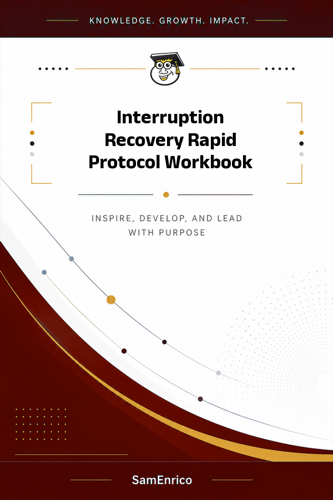
Interruption Recovery Rapid Protocol Workbook eBook
Teaches getting back on task quickly after being i
by Hoang Joeann
Teaches getting back on task quickly after being interrupted.
Formats
Free sample
Chapter 1: The 12-Hour Ghost--–- Every morning, you sit down at your desk with good intentions. You have a clear task in mind. You open the document, the spreadsheet, the email draft. Your fingers hover over the keyboard. And then it happens.
A Slack ping. A phone buzz. A colleague’s head appears around the doorframe. “Got a second?” You say yes because that is what polite professionals do. You answer the question.
You glance at the notification. You say “sure, no problem.” The interruption lasts twelve seconds. You return to your desk. You stare at the screen. And then you stare some more.
You scroll up and down trying to remember where you were. You re-read the last three paragraphs because you have already forgotten what they said. You check your email “just to clear your head.” Twenty-five minutes later, you are finally working again. But you do not remember those twenty-five minutes as lost time. You remember them as “getting back into it.” You remember them as normal.
They are not normal. They are the 12-Hour Ghost.The 12-Hour Ghost is the name this book gives to the invisible accumulation of recovery time that steals roughly twelve hours from your workweek. Here is the math. Research conducted by Gloria Mark at the University of California, Irvine, found that after an interruption, knowledge workers take an average of twenty-three minutes to return to their original task with the same cognitive intensity they had before the interruption. Other studies have found ranges from fifteen to twenty-five minutes depending on task complexity, fatigue, and environment.
For the purposes of this book, we use twenty-five minutes as the working baseline. It is a round number. It is easy to calculate. And it errs on the side of honesty because complex tasks can take even longer. Now multiply that twenty-five minutes by the number of times you are interrupted each day.
If you are a typical knowledge worker, you experience between four and eight interruptions per hour. But let us be conservative. Let us say you experience just one interruption per hour over an eight-hour workday. That is eight interruptions. Eight times twenty-five minutes is two hundred minutes.
Two hundred minutes divided by sixty is 3.3 hours lost every single day to recovery residue. Multiply that by five days. That is 16.5 hours per week. Even if you cut that estimate in half to account for easy tasks and personal variation, you land at roughly eight to twelve hours per week. That is the 12-Hour Ghost.
It is the time you lose without ever seeing it leave.You cannot feel the 12-Hour Ghost the way you feel exhaustion or hunger. You cannot see it the way you see a cluttered inbox or a missed deadline. It is invisible. That is what makes it so dangerous. If you lost twelve hours every week to a broken chair or a slow internet connection, you would fix it immediately.
But because the 12-Hour Ghost is invisible, you have never measured it. You have never named it. You have never even noticed it. This book exists to change that. Not by helping you build a fortress against interruptions.
Fortresses fail. Your phone will buzz. Your boss will knock. Your child will need you. The goal of this book is not to prevent interruptions.
The goal is to teach you what to do after they happen. Specifically, the goal is to compress that twenty-five minute recovery window into sixty seconds or less. That is the Interruption Recovery Rapid Protocol. That is the IRRP. And it starts with measurement.Chapter 1 is called The 12-Hour Ghost because you cannot fix what you cannot measure.
Before you learn a single recovery skill, you must know your personal Residue Debt. How many hours does the ghost steal from you each week? How many hours per month? Per year? This chapter provides the tools to answer those questions.
By the time you finish the workbook element at the end of this chapter, you will have a number. That number will shock you. That shock is the fuel for the remaining eleven chapters.The Science of Attention Residue The concept of attention residue was first named by Sophie Leroy, a business professor at the University of Washington Bothell, in her 2009 paper “Why Is It So Hard to Do My Work?” Leroy’s research demonstrated that when you switch from Task A to Task B, your brain does not fully release Task A. A portion of your cognitive resources remains stuck on the previous task. That stuck portion is attention residue.
It is not that you are distracted. You are not daydreaming. You are cognitively half-present, half-absent, like a radio playing two stations at once. Leroy found that this residue persists even after you complete Task B and return to Task A. In fact, the residue is worse when you are interrupted during Task A because you never had the chance to close the loop.Gloria Mark’s research at UC Irvine extended Leroy’s findings into real workplace environments.
Mark and her team observed knowledge workers in their natural settings. They found that the average interruption lasts only two minutes and eleven seconds. But the recovery time averages twenty-three minutes. Think about that asymmetry. A two-minute interruption costs twenty-three minutes of recovery.
That is a 1,150 percent cost. No business would accept that kind of inefficiency in any other domain. If your shipping department lost twenty-three minutes for every two minutes of work, you would fire the manager. But because the cost is cognitive and invisible, it goes unmanaged.Mark’s research also revealed something else. The twenty-three minute recovery window applies to the first interruption.
Subsequent interruptions have a compounding effect. If you are interrupted twice within a short period, your recovery time does not reset to twenty-three minutes. It adds. You are still recovering from the first interruption when the second one hits. The residue multiplies.
This is why some afternoons feel completely lost. You were not lazy. You were not unfocused. You were drowning in compounding residue, trying to recover from four interruptions simultaneously while a fifth one arrived.This book uses the twenty-five minute baseline for a specific reason. Simplicity breeds action.
If this book said “your recovery time varies between fifteen and thirty minutes depending on task complexity, time of day, blood glucose levels, and whether you had a good night’s sleep,” you would have nothing to calculate. You would shrug and move on. By anchoring on twenty-five minutes, we give you a clear, memorable, actionable number. You will recalculate your personal Residue Debt multiple times throughout this book. Each time, use twenty-five minutes.
If you later want to refine your estimate based on your own tracking, you can. But start with twenty-five. Consistency matters more than precision at this stage.The Willpower Map: A Hierarchy of Intervention Before we go further, we need to address a confusion that plagues most productivity books. Some books tell you that willpower is a muscle. Other books tell you that willpower is a myth.
Some books say you should rely on discipline. Others say you should design your environment so discipline is unnecessary. These…
This is the end of the free sample. Get the eBook to keep going. Buy now
About this book
Details
- Author
- Hoang Joeann
- Publisher
- SamEnrico
- Language
- English
- Genre
- Non-Fiction, Self-Help, Recovery Techniques
- Released
- 2026-06-09
- Pages (approx.)
- 145
- Available as
- eBook, Audiobook

Read better in the ZLOADR app
Your eBooks on your phone or tablet. Sign in with your SamEnrico account and start reading.
More by Hoang Joeann
 Indian Ecommerce Support GuideHoang Joeann$11.99
 Communications Essay AI GuideHoang Joeann$11.99
 Email Anger De escalation ProtocolHoang Joeann$11.99
 The Leo Strauss Political PhilosophyHoang Joeann$11.99
 The Digital Highwayman: Britain's First Cryptocurrency KillerHoang Joeann$11.99
 QuickBooks Data Backup GuideHoang Joeann$12.99
 Metal Fabrication M&AHoang Joeann$12.99
 How to Start a Operation of Ski Hills Business (Beginners Guide)Hoang Joeann$11.99
 Backroom CoordinatorHoang Joeann$11.99
 Understanding Pneumocystis Jiroveci PneumoniaHoang Joeann$17.99
You may also like
 Hong Kong Handover 1997Dunn Johnnie$11.99
 Zumba For Postnatal Recovery CourseNeal Christian$11.99
 Zumba for BeginnersLadner Nikia$11.99
 YouTube Comment Mining GuideHumes Pandora$12.99
 Worry Box MeditationCarlin Rudy$11.99
 Workplace Stress MeditationNguyen Lynn$11.99
 Workplace Stress and Sleep RepairHawley Ivory$11.99
 Workplace Perfectionism CureDelaney Jeffry$11.99
 Workplace Injustice Anger GuideWallen Isabelle$11.99
 Work Addiction and Burnout LinkGreenwood Ester$11.99
 Women in Yoga and WellnessBeattie Galina$11.99
 Women in Stand Up ComedyChun Evangeline$11.99