
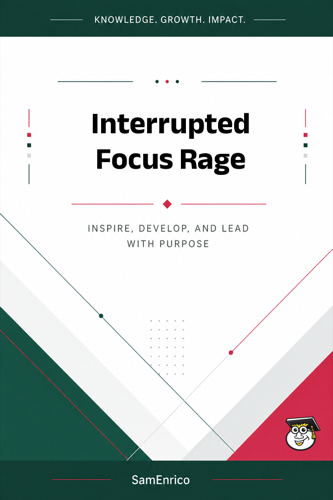
Non-FictionSelf-HelpAttention Management
Interrupted Focus Rage eBook
Teaches handling distractions and interruptions du
by Shipp Ulrike
Teaches handling distractions and interruptions during deep work without anger.
Formats
Free sample
Chapter 1: The 23-Minute Lie--–- The Slack notification arrived at 2:17 PM on a Tuesday that I no longer remember except for the sound—that sharp, digital chirp that landed like a pebble against a window already cracked. My hands were mid-sentence on a quarterly report, my prefrontal cortex fully engaged in the delicate work of translating data into narrative. The ping lasted less than a second. The rage lasted three hours. Not the explosive kind—I didn't throw my laptop or scream at anyone.
The worse kind. The seething, low-grade, background-radiation rage that poisoned every subsequent task, every email reply, every interaction with my family that evening. I wasn't angry at the person who sent the message. I wasn't even angry at the message itself. I was angry at the feeling of being yanked—violently, involuntarily—out of a state of flow that had taken me forty-seven minutes to achieve.
And no one had warned me that the real cost of that ping wasn't the ten seconds I spent reading it. It was the twenty-three minutes that followed. Twenty-three minutes of cognitive scrambling, of re-reading the same paragraph three times, of feeling my functional IQ drop by ten points while my blood pressure rose by twenty. Twenty-three minutes of what looked like work but was actually just... waiting.
Waiting for my brain to forgive the interruption enough to let me back in.This chapter reveals the hidden math of interruptions that the productivity industry has been too polite to admit. Most advice treats distractions as annoyances—minor friction in an otherwise smooth workflow. Turn off notifications. Close your door. Set boundaries.
All useful. All incomplete. Because they ignore the single most important fact about the human brain: interruptions don't just steal time. They steal cognitive restoration, and they prime your nervous system for rage. Not the cartoon version of rage with bulging eyes and steam from the ears.
The real version. The one that lives in your clenched jaw, your shortened breath, your sudden conviction that everyone around you is either incompetent or malicious. That rage is not a moral failing. It is a neurological prediction. And once you understand the math behind it, you can stop blaming yourself and start building a different response.The Mathematics of Cognitive Whiplash Let us begin with a number that will either liberate you or depress you, depending on how long you have been living with it unacknowledged: 23.
As in, it takes an average of 23 minutes to fully return to a state of deep work after a single interruption. This figure comes from a landmark study conducted at the University of California, Irvine, where researchers followed knowledge workers through their daily routines and measured the exact cost of context switching. The methodology was simple but brutal: they watched people work, noted every interruption, and then measured how long it took for those people to return to their original task with the same level of cognitive engagement. The answer, across hundreds of hours of observation, was consistently between 20 and 25 minutes.Let that land. If you are interrupted six times in a workday—a conservative estimate for most knowledge workers—you are losing more than two hours not to the interruptions themselves, but to the recovery period between them.
And that two hours does not include the time you spend actually addressing the interruption. It is pure, wasted cognitive potential. It is the productivity equivalent of a car that takes twenty minutes to restart after every red light.But the 23-minute figure, as important as it is, tells only half the story. Because those 23 minutes are not neutral. They are not a simple pause button on your productivity.
They are a physiological event—a cascade of stress hormones, neural friction, and emotional dysregulation that leaves you worse off than when you started. This is the hidden "emotional tax" of interruptions: the reason why a day with four interruptions feels so much worse than a day with eight hours of uninterrupted work, even if the total "lost time" is identical.The Neurology Briefing: Your Brain on Interruption To understand why interruptions trigger rage, you need a basic map of the territory. Consider this the only neuroscience lesson you will need for the entire book. I will not repeat it in later chapters, so read carefully.Your brain has two primary attention systems, and they do not get along. The first is the prefrontal cortex (PFC) —the seat of focused attention, logical reasoning, and impulse control.
This is your deep work engine. When you are writing a report, debugging code, analyzing a spreadsheet, or composing an email that matters, your PFC is in charge. It is slow, energy-intensive, and easily fatigued, but it is the only part of your brain capable of complex cognition. Think of your PFC as a marathon runner: capable of extraordinary endurance, but only if you do not ask it to sprint every five minutes.The second system is the amygdala —the brain's threat detector. Its job is to scan the environment for danger and, when it finds one, to hijack your entire nervous system in a fraction of a second.
The amygdala does not distinguish between a physical threat (a predator) and a social threat (an interruption that makes you look incompetent). It only distinguishes between "safe" and "not safe." And it operates on a hair trigger because, evolutionarily speaking, it is better to mistake a stick for a snake than a snake for a stick.Here is the crucial insight: The PFC and the amygdala cannot be fully active at the same time. When your amygdala is activated, it literally downregulates your PFC, diverting blood flow and glucose away from the thinking brain and toward the survival brain. This is why you cannot do calculus when you are terrified. This is also why you cannot focus when you are enraged.
The two states are neurologically incompatible.Now consider what happens during an interruption. You are deep in PFC-driven work. A notification arrives. Your brain, trained by a thousand previous notifications, treats it as a potential threat—or at least as a potential opportunity that requires immediate attention. Your amygdala flickers to life.
Your PFC begins to disengage. You switch tasks. You address the interruption. And then you try to return to your original work.But here is the betrayal: your PFC does not snap back like a rubber band. It returns slowly, reluctantly, like a teenager being dragged out of bed.
For the next twenty-three minutes, you are in a neurological limbo—neither fully focused nor fully relaxed, neither productive nor at rest. Your amygdala, having been activated once, remains on high alert, ready to trigger again at the next ping. This is why the second interruption of the day feels so much worse than the first. Your brain is already primed for rage. The first interruption pulled the pin.
The second one throws the grenade.The Rage Trigger: Why You Don't Get Mad at the Interruption (You Get Mad at the Loss)This is the point where most productivity advice gets the causality wrong. They assume that you feel angry because the interruption was annoying, or because the person who interrupted you…
This is the end of the free sample. Get the eBook to keep going. Buy now
About this book
Details
- Author
- Shipp Ulrike
- Publisher
- SamEnrico
- Language
- English
- Genre
- Non-Fiction, Self-Help, Attention Management
- Released
- 2026-06-06
- Pages (approx.)
- 150
- Available as
- eBook, Audiobook

Read better in the ZLOADR app
Your eBooks on your phone or tablet. Sign in with your SamEnrico account and start reading.
More by Shipp Ulrike
 The Divorced Parent AdultShipp Ulrike$11.99
 Sobriety Daily Maintenance PlanShipp Ulrike$11.99
 Hypnopompic State RecordingShipp Ulrike$11.99
 The Silk and Gold Dynasty: The Rise of Black Fashion InnovatorsShipp Ulrike$11.99
 Shop CoordinatorShipp Ulrike$11.99
 EU Chemical Registration for SheaShipp Ulrike$12.99
 How to Start a Cotton Broker (commission Agent) Business (Beginners Guide)Shipp Ulrike$11.99
 How to Produce Clarinet MouthpiecesShipp Ulrike$11.99
You may also like
 Hong Kong Handover 1997Dunn Johnnie$11.99
 Zumba For Postnatal Recovery CourseNeal Christian$11.99
 Zumba for BeginnersLadner Nikia$11.99
 YouTube Comment Mining GuideHumes Pandora$12.99
 Worry Box MeditationCarlin Rudy$11.99
 Workplace Stress MeditationNguyen Lynn$11.99
 Workplace Stress and Sleep RepairHawley Ivory$11.99
 Workplace Perfectionism CureDelaney Jeffry$11.99
 Workplace Injustice Anger GuideWallen Isabelle$11.99
 Work Addiction and Burnout LinkGreenwood Ester$11.99
 Women in Yoga and WellnessBeattie Galina$11.99
 Women in Stand Up ComedyChun Evangeline$11.99