
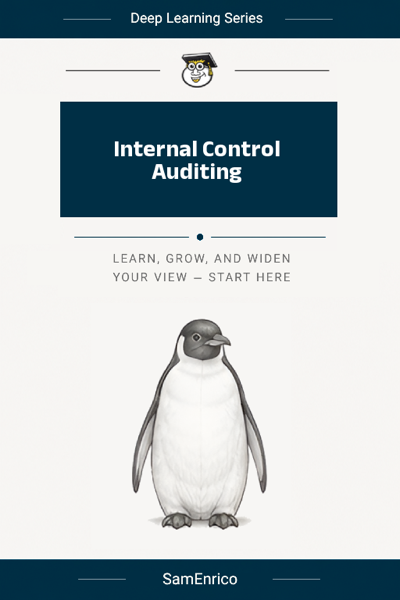
Non-FictionInformativeEducational
Internal Control Auditing eBook
A Coursebook on Internal Control Auditing
A Coursebook on Internal Control Auditing
Formats
Free sample
Chapter 1: The Hundred‑Million‑Dollar Typo--–- It began with a spreadsheet.Not a complicated one. Not a fraudulent one. Just a single cell, in a single workbook, on a single employee’s laptop. That cell was supposed to contain the formula =SUM(F2:F50). Instead, someone had typed =SUM(F2:F50)+50000000 as a temporary override during a late‑night budget revision.
Then they forgot. The override stayed. The spreadsheet was saved, emailed, uploaded to the corporate reporting system, and eventually consolidated into the company’s quarterly financial statements. Fifty million dollars appeared out of thin air.That company was a mid‑sized manufacturer with a respected brand, a clean audit history, and a CFO who had never missed an earnings target. When the error was discovered five months later, the company had already reported two more quarters based on the inflated numbers.
The stock dropped 34% in one day. Shareholders filed a class‑action lawsuit. The CFO resigned. The audit firm paid $27 million to settle negligence claims.And the most damning evidence at trial? Not fraud.
Not conspiracy. A single control failure: no independent review of spreadsheet changes before financial reporting.This is not a cautionary tale. It is a true story, anonymized to protect the innocent and the guilty alike. And it answers the most important question any professional can ask about internal control auditing: Why does this matter to me?The Invisible Shield Every organization has an invisible shield. You cannot see it, touch it, or photograph it.
But when it works, nothing happens. No scandals. No restatements. No regulatory fines. When it fails, careers end, fortunes vanish, and reputations burn.That invisible shield is internal control.Internal control is not a buzzword.
It is not a checklist that auditors force on unwilling managers. It is the collection of policies, procedures, technologies, and human behaviors that ensure an organization’s financial information is reliable, its assets are protected, and its reporting is accurate. Internal control auditing is the systematic examination of whether that shield actually works.Yet most people misunderstand what internal control auditing does. They confuse it with management consulting (giving advice on how to run the business) or forensic accounting (investigating fraud after it happens) or compliance checking (ticking boxes on regulatory forms). None of these is correct.Internal control auditing is verification, not advice.
The auditor does not design the controls, implement them, or operate them. The auditor tests them. The auditor asks: “Does this control actually prevent or detect misstatements? Or does it exist only on paper?”This distinction matters because it defines the auditor’s independence. An auditor who designs a control system cannot objectively audit it.
That would be like a student grading their own exam. The entire profession rests on the simple but radical idea that independent verification creates confidence.From Counting Beans to Preventing Catastrophe To understand internal control auditing, you must understand how we got here. The journey from simple fraud prevention to complex regulatory mandates is the story of modern capitalism learning from its own disasters.The First Era: Separation of Duties (Ancient Times – 1900s)The oldest control idea is also the simplest: do not let one person do everything. In ancient Mesopotamia, scribes recorded grain shipments, while separate officials counted the grain upon arrival. In medieval Italian banks, the person who received deposits could not also issue loans.
In 19th‑century railroads, the cashier could not also reconcile the ledger.This principle—segregation of duties—remains the foundation of internal control today. If one person initiates a transaction, authorizes it, records it, and handles the related asset, that person can both commit and conceal fraud. Separate those responsibilities, and fraud becomes a conspiracy.The Second Era: The Rise of Professional Auditing (1900s – 1970s)As corporations grew and public stock markets expanded, investors demanded assurance that financial statements were truthful. Independent public accounting firms emerged. Early audits focused on transactions: select a sample of invoices, verify the math, confirm the bank balance.But transaction testing alone missed systemic problems.
An auditor could test a hundred sales invoices, find no errors, and never notice that the company had no approval process for credit limits. The control environment—the “tone at the top”—was invisible to this approach.The Third Era: The Control Framework (1970s – 1990s)In 1977, the Foreign Corrupt Practices Act required U.S. companies to maintain “reasonable internal controls.” But what did “reasonable” mean? No one knew. The accounting profession needed a common language.That language arrived in 1992 with the COSO Framework (Committee of Sponsoring Organizations of the Treadway Commission).
For the first time, internal control was defined not as a list of procedures but as an integrated system with five components:Control Environment – The tone at the top: integrity, ethics, competence.Risk Assessment – Identifying what could go wrong.Control Activities – The specific policies and procedures.Information & Communication – Getting the right data to the right people.Monitoring – Ongoing checks that controls work.This framework transformed internal control from a vague concept into something measurable, auditable, and teachable.The Fourth Era: The Regulatory Revolution (2000 – Present)Then came the scandals.Enron. World Com. Tyco. Each was different in detail, identical in pattern: management override of controls, auditor conflicts of interest, and billions in investor losses.Enron created off‑balance‑sheet partnerships that hid debt. The board approved.
The auditor signed off. The control failure was not a missing signature on a form—it was a control environment that rewarded risk‑taking over truth‑telling.World Com capitalized $3.8 billion in operating expenses, turning quarterly losses into profits. The control failure was not a single wrong journal entry—it was the absence of independent review of adjustments made by senior executives.Tyco’s CEO and CFO looted $150 million in unauthorized bonuses and loans. The control failure was not a weak bank reconciliation—it was a board of directors that did not challenge management.In 2002, Congress responded with the Sarbanes‑Oxley Act (SOX) , the most sweeping corporate reform since the Great Depression. Section 404 required public companies to do two things: (1) management must assess the effectiveness of internal controls, and (2) the external auditor must opine on that assessment.For the first time, internal control auditing became mandatory, not optional.
And for the first time, auditors could be held directly liable for failing to detect material weaknesses.The Integrated Audit: Two Opinions, One Engagement Before SOX, an auditor issued one opinion: “The financial statements are fairly presented.” After SOX, the auditor issues two opinions in what is called an Integrated Audit:Opinion on Financial Statements – Are the numbers materially correct?Opinion on Internal Control over Financial Reporting (ICFR) – Do the controls work?These opinions are related but distinct. A company can have correct financial statements (no material misstatements) and ineffective controls (the numbers are correct despite the controls, not because of them). Conversely, a company can have effective controls and a material misstatement if management overrides them.The integrated audit recognizes a fundamental truth: reliable financial statements are the result of effective controls. Auditing controls separately provides early warning. If controls fail, the financial statements are at risk before any misstatement appears.Consider the difference:Transaction auditing asks: “Did this specific sale get recorded correctly?”Control auditing asks: “Does the system…
This is the end of the free sample. Get the eBook to keep going. Buy now
About this book
Details
- Author
- Redmon Annamarie
- Publisher
- SamEnrico
- Language
- English
- Genre
- Non-Fiction, Informative, Educational
- Released
- 2026-05-18
- Pages (approx.)
- 160
- Available as
- eBook, Audiobook

Read better in the ZLOADR app
Your eBooks on your phone or tablet. Sign in with your SamEnrico account and start reading.
More by Redmon Annamarie
 Borneo Jungle ExpeditionRedmon Annamarie$11.99
 Stimulant Child Custody GuideRedmon Annamarie$11.99
 Governor at the PrecipiceRedmon Annamarie$11.99
 Breastfeeding Body Image GuideRedmon Annamarie$11.99
 Blood and Silk: The Rise of the Empress Wu ZetianRedmon Annamarie$11.99
 The Last Ride of the Sundance Kid: A Ballad of Betrayal and GoldRedmon Annamarie$11.99
 How to Become a Trimmer OperatorRedmon Annamarie$11.99
 Dot Eu Registration ManualRedmon Annamarie$12.99Dot Eu Registration ManualRedmon Annamarie$12.99
 2026-2030 Open Source AIRedmon Annamarie$12.99
 Understanding Histiocytosis, Non-langerhans-cellRedmon Annamarie$17.99
You may also like
 Hong Kong Handover 1997Dunn Johnnie$11.99
 Zumba For Postnatal Recovery CourseNeal Christian$11.99
 Zumba for BeginnersLadner Nikia$11.99
 YouTube Comment Mining GuideHumes Pandora$12.99
 Worry Box MeditationCarlin Rudy$11.99
 Workplace Stress MeditationNguyen Lynn$11.99
 Workplace Stress and Sleep RepairHawley Ivory$11.99
 Workplace Perfectionism CureDelaney Jeffry$11.99
 Workplace Injustice Anger GuideWallen Isabelle$11.99
 Work Addiction and Burnout LinkGreenwood Ester$11.99
 Women in Yoga and WellnessBeattie Galina$11.99
 Women in Stand Up ComedyChun Evangeline$11.99