
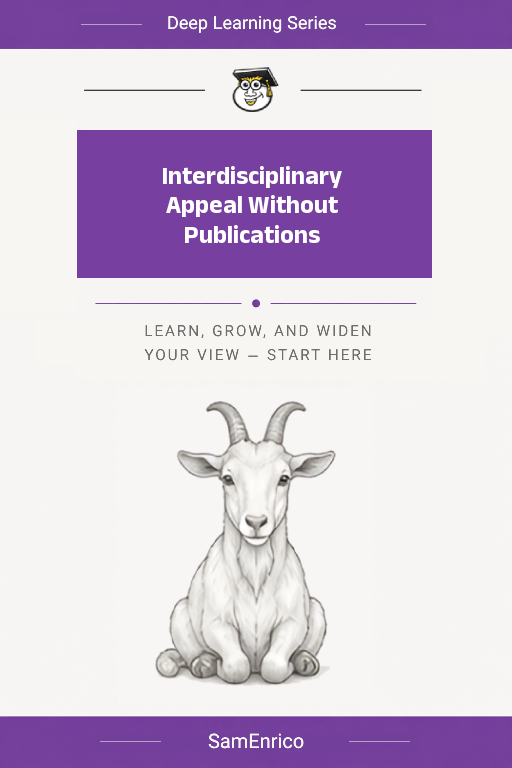
Interdisciplinary Appeal Without Publications eBook
Market your diverse methodological training as uni
Market your diverse methodological training as unique value that publication-heavy applicants lack.
Formats
Free sample
Chapter 1: The Methodology Advantage--–- The comparison started innocently enough. Dr. Maya Chen, freshly minted Ph D in cultural anthropology with a minor in network science, was scrolling through Linked In at 11 PM when she saw it. Her graduate school cohort-mate, someone who had stayed firmly in one subfield of one discipline, had just announced a new publication. Their CV, as Maya knew from whispered conversations at conferences, now listed nine first-author papers.
Maya had two.She closed the laptop. Then she opened it again. Then she closed it. Then she opened it and started counting: two articles, three conference presentations, one digital project that had been viewed forty thousand times but that her advisor called "a nice supplement to real scholarship." Forty thousand people had looked at her work, and it still did not count. Not the way nine publications counted.This is the 3 AM CV crisis.
If you are reading this book, you know it intimately. You have felt the sinking feeling when someone asks, "So, how many publications do you have?" You have rehearsed explanations that start with "Well, my work is interdisciplinary, so..." You have watched narrow specialists get interviews, campus visits, job offers—while you, with your methodological range and your ability to translate across fields and your genuinely interesting research questions, wait by the phone that never rings.Stop.Not the reading. Not the job search. Stop the comparison. Stop the apology.
Stop the assumption that your interdisciplinary training is a weakness to be explained away. It is not. It is a superpower. And this chapter will show you why.The Myth of the Perfect Pipeline The traditional academic pipeline has a clear logic, and that logic is not stupid. It is just incomplete.
Graduate students are trained to drill deep into a single subfield, master its methods, speak its language, and publish in its journals. This model produces specialists. It also produces blind spots.The logic goes like this: depth signals expertise. Expertise signals quality. Quality signals productivity.
Productivity signals a good hire. Each step in this chain has some truth to it. Depth is valuable. Expertise matters. Quality is important.
Productivity is not irrelevant.But here is what the research on faculty hiring actually shows: publication count is one of the weakest predictors of long-term success in interdisciplinary or applied roles. Study after study has found that productivity metrics like publication and citation counts do not consistently predict hiring success across all contexts. Other factors—fit, teaching ability, collaborative potential, methodological fit—matter enormously.Moreover, the emphasis on counting privileges certain kinds of scholarship over others. It advantages articles over books, established fields over emerging ones, English-language publications over others, narrow methods over hybrid approaches. It disadvantages precisely the kinds of innovative, cross-cutting work that many departments claim to want.Search committees say they want publications.
But what they actually need is scholars who can contribute to interdisciplinary collaborations, teach across multiple curricula, and adapt as their fields evolve. There is a gap between what they ask for and what they need. Your job is to bridge that gap.The Four Assets You Have That Specialists Don't Let us name what interdisciplinary training actually builds. Not the official learning outcomes from your program's website. The real, tangible, sellable assets that you have developed by working across methods and fields.
These are not soft skills. They are hard competencies that narrow specialists often lack.Asset One: Cognitive Flexibility Cognitive flexibility is the ability to switch between different modes of thinking. Qualitative to quantitative. Interpretive to positivist. Historical to predictive.
Micro to macro. You have been training this muscle every time you moved from one disciplinary seminar to another, every time you translated a concept from one field's jargon into another's, every time you sat in a room where people were speaking different intellectual languages and figured out how to follow along.Narrow specialists do not have this. They have trained themselves to think in one way, with one set of assumptions, one methodological toolkit. They are brilliant within that framework. Outside it, they are often lost.
You are not lost. You are at home in multiple frameworks. That is cognitive flexibility, and it is increasingly valuable as research problems resist single-discipline solutions.Maya discovered her cognitive flexibility during her second year of graduate school. She was presenting her qualitative findings on community adaptation to a room of epidemiologists. A senior researcher raised his hand and asked, "But how do you know your sample is representative?" The question was quantitative.
It assumed a different logic of inference. Maya could have been defensive. Instead, she said, "That is a great question. In qualitative work, we do not aim for statistical representativeness. We aim for theoretical saturation.
But let me show you how we can use my qualitative findings to generate hypotheses that you could test quantitatively."The epidemiologist nodded. He did not fully understand her methods, but he understood that she understood his. That is cognitive flexibility in action.Asset Two: Translation Competence Translation competence is the rare skill of speaking multiple academic languages and moving between them. It is not just knowing the jargon of different fields. It is knowing when to use which jargon, with whom, and how to bridge gaps when people are talking past each other.This skill is invisible on a CV.
It does not show up in publication counts. But it is gold in interdisciplinary departments, research centers, and applied settings. The scholar who can translate is the scholar who can collaborate, who can lead cross-disciplinary teams, who can write grant proposals that reviewers from multiple fields can understand and appreciate.Maya learned translation competence the hard way. She co-authored a paper with a network scientist. They wrote a draft.
The network scientist sent it back with a note: "I don't understand half of what you wrote about ethnography." Maya rewrote that half. Then she sent it back. The network scientist wrote: "Now I don't understand the other half." They went through six rounds. By the end, each had learned enough of the other's language to collaborate productively. The paper was published in an interdisciplinary journal.
It has been cited more than anything Maya has written since.That paper cost her time that could have been spent on another solo-authored publication. But it gave her something more valuable: the ability to translate between anthropology and network science, a skill that almost no one else in either field possesses.Asset Three: Integrative Capacity Integrative capacity is seeing how pieces fit together while specialists dig deeper into smaller problems. Specialists are experts at moving down—into narrower questions, more granular data, more precise methods. You are trained to move up and across—to see connections, to synthesize findings, to identify patterns that only become visible when you zoom out.This is not a lesser form of expertise. It is a different form.
And it is increasingly recognized as essential for addressing complex, real-world problems. Climate change. Public health crises. Social inequality. These problems do not respect disciplinary boundaries.
They require integrative thinking.Maya's digital project—the one her advisor called "a nice supplement to real scholarship"—was an exercise in integrative capacity. She built…
This is the end of the free sample. Get the eBook to keep going. Buy now
About this book
Details
- Author
- Sisson Vertie
- Publisher
- SamEnrico
- Language
- English
- Genre
- Non-Fiction, Student's Shortcut
- Released
- 2026-06-01
- Pages (approx.)
- 112
- Available as
- eBook, Audiobook

Read better in the ZLOADR app
Your eBooks on your phone or tablet. Sign in with your SamEnrico account and start reading.
More by Sisson Vertie
 Discrimination Stress ManagementSisson Vertie$11.99
 5 2 Diet ExplainedSisson Vertie$11.99
 HGH and Oxytocin ConnectionSisson Vertie$11.99
 TM for ComediansSisson Vertie$11.99
 The Team Creative PauseSisson Vertie$11.99
 The Self Talk Transformation GuideSisson Vertie$11.99
 Vaping Compared To Smoking FactsSisson Vertie$11.99
 Swiss Green Tax CreditsSisson Vertie$11.99
 Cosmic Harmonies: The Celestial Symphonies of Black Classical ComposersSisson Vertie$11.99
 The Ghost Fleet of the Pacific: Cocaine’s Silent SmugglersSisson Vertie$11.99
 Bones and the Bloodhound: The Great Hound of BabylonSisson Vertie$11.99
 The Dancer's Guide to Manila SwingSisson Vertie$11.99
You may also like
 Hong Kong Handover 1997Dunn Johnnie$11.99
 Zumba For Postnatal Recovery CourseNeal Christian$11.99
 Zumba for BeginnersLadner Nikia$11.99
 YouTube Comment Mining GuideHumes Pandora$12.99
 Worry Box MeditationCarlin Rudy$11.99
 Workplace Stress MeditationNguyen Lynn$11.99
 Workplace Stress and Sleep RepairHawley Ivory$11.99
 Workplace Perfectionism CureDelaney Jeffry$11.99
 Workplace Injustice Anger GuideWallen Isabelle$11.99
 Work Addiction and Burnout LinkGreenwood Ester$11.99
 Women in Yoga and WellnessBeattie Galina$11.99
 Women in Stand Up ComedyChun Evangeline$11.99