
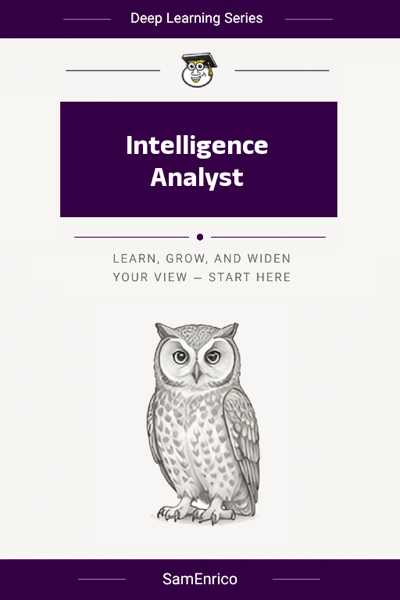
Non-FictionInformativeEducational
Intelligence Analyst eBook
A Coursebook on Intelligence Analyst
A Coursebook on Intelligence Analyst
Formats
Free sample
Chapter 1: The Analyst's Lens...–- Imagine you are sitting in a windowless conference room at 2:00 AM. Before you lies a stack of raw intelligence reports—fragmented, contradictory, and incomplete. Somewhere in that pile of intercepts, human source reports, and satellite imagery is a warning that could prevent a crisis. Your job is to find it before it's too late. This is not a movie.
This is the daily reality of an intelligence analyst.Welcome to the profession where certainty is a luxury you cannot afford, where every word you write might influence matters of war and peace, and where your greatest enemy is often your own brain. This book will transform you from someone who consumes information into someone who produces insight. But before we can teach you the advanced techniques of structured analysis, probability forecasting, or deception detection, we must first answer three fundamental questions: What is intelligence analysis? Who are you becoming when you adopt this profession? And why does the way you think matter more than what you know?The Definitive Definition: What Intelligence Actually Is (And Isn't)Let us begin by demolishing a popular myth.
Intelligence is not secret information. James Bond does not do intelligence analysis. The CIA's most classified satellite images are not intelligence. They are data. Raw, unprocessed, meaningless data until someone with training makes sense of them.Here is the definition that will govern every page of this book:Intelligence is processed information, tailored to a specific decision-maker's needs, that reduces uncertainty about an adversary's capabilities, intentions, or operating environment.Break this down.
Four components matter:First, processed. Raw reporting from a spy (HUMINT), an intercepted call (SIGINT), or a satellite photo (GEOINT) is not intelligence. It is a collection of facts, often contradictory, usually incomplete, and always requiring interpretation. The analyst's job is to apply structure, context, and judgment to turn noise into signal.Second, tailored to a specific decision-maker. A general needs different intelligence than a diplomat.
A counterterrorism officer needs different intelligence than a sanctions policy advisor. Generic intelligence is useless intelligence. The best analysts start every project by asking: "Who will read this? What decision will they make? What would change that decision?"Third, reduces uncertainty.
Intelligence never eliminates uncertainty. Anyone who claims certainty is either lying or incompetent. Instead, good intelligence moves a policymaker from "I have no idea what will happen" to "Based on these indicators and this confidence level, here is the most likely range of outcomes."Fourth, about an adversary's capabilities, intentions, or operating environment. Capabilities are what an adversary can do (tanks, missiles, cyber tools, financial reserves). Intentions are what an adversary wants to do (based on leadership statements, historical behavior, strategic culture).
Operating environment is the context in which an adversary acts (geography, alliances, domestic politics).What intelligence is NOT deserves equal attention. Intelligence is not a crystal ball. No analyst can predict the future with certainty. Intelligence is not a policy recommendation. Analysts tell policymakers what is happening and what might happen.
They do not tell policymakers what to do about it. That distinction—between analysis and advocacy—is the ethical firewall of the profession. Intelligence is not a collection of secrets. Some of the most valuable intelligence comes from open sources: academic journals, social media, economic data, and news reports. In fact, the Intelligence Community estimates that over 80% of actionable intelligence originates from open sources.The Intelligence Cycle: A Map of the Territory How does raw information become finished intelligence?
The traditional answer is the intelligence cycle, a six-step process that has guided analysts for decades. Think of it as a map. The map is not the territory, but without it, you will get lost.Step One: Requirements. The cycle begins with a question from a decision-maker. "Will Russia invade Ukraine?" "What is North Korea's nuclear capability?" "How will the Iranian election affect the nuclear deal?" These are requirements.
They may come formally through National Intelligence Priorities Frameworks or informally through a late-night call from a policymaker. The analyst's first job is to clarify the requirement. A vague question ("Is China a threat?") produces useless intelligence. A precise question ("Under what conditions would China impose economic sanctions on Taiwan, and what indicators would precede such a decision?") produces actionable insight.Step Two: Collection. With a clear requirement, collection assets are tasked.
This includes SIGINT (signals intelligence from intercepted communications), HUMINT (human intelligence from spies and sources), GEOINT (geospatial intelligence from satellites and imagery), OSINT (open-source intelligence from publicly available information), MASINT (measurement and signature intelligence from technical sensors), and FININT (financial intelligence from tracking money flows). Each collection discipline has strengths and weaknesses. SIGINT is highly reliable but cannot capture intent. HUMINT provides context but is vulnerable to deception. OSINT is abundant but requires verification.Step Three: Processing.
Raw collection takes time to convert into usable form. Intercepted communications must be translated from foreign languages. Satellite imagery must be downloaded and enhanced. Financial transactions must be normalized across different currencies and reporting standards. This step is often invisible to analysts but can introduce significant delays and errors.
A mistranslated word can change the meaning of an entire report.Step Four: Analysis and Production. This is where you live. The analyst takes processed intelligence, integrates it with existing knowledge, applies structured analytic techniques, and produces a finished product. The analysis step is not mechanical. It requires judgment, creativity, and intellectual honesty.
Chapters 2 through 7 of this book are devoted entirely to this step.Step Five: Dissemination. The finished product reaches the decision-maker. This might be a written report, a verbal briefing, a dashboard, or a single paragraph in the President's Daily Brief. Dissemination is not the end. It is a handoff.
The analyst's responsibility continues through the next step.Step Six: Feedback. The decision-maker responds. Was the product useful? What questions remain? What new requirements emerge?
Feedback closes the cycle and begins it anew. The best analysts cultivate relationships with their consumers precisely to get honest, timely feedback. Without feedback, the cycle stagnates.A Note on the Target-Centric Alternative. Some intelligence scholars argue that the linear cycle is outdated. They propose a target-centric approach, where analysis focuses on understanding the adversary's system (military, political, economic, social, infrastructure, information) as a whole, rather than processing requirements sequentially.
This book primarily uses the traditional cycle for pedagogical clarity because it maps cleanly onto how most intelligence organizations are structured. However, the target-centric mindset—thinking systemically rather than linearly—will appear throughout subsequent chapters. For now, master the cycle. The map may not be the territory, but without it, you are walking blind.The Four Types of Intelligence: Strategic, Tactical, Warning, and Estimative Not all intelligence serves the same purpose. Professionals distinguish four types, each with its own time horizon, audience, and product format.Strategic Intelligence addresses long-term questions about adversary capabilities, intentions, and operating environments.
Time horizon: months to years. Audience: national security policymakers, theater commanders, and strategy developers. Product format: National Intelligence Estimates, strategic assessments, and white papers. Example question: "How will climate change affect stability in the Sahel over the next decade?"Tactical Intelligence supports immediate operations. Time horizon: hours to days.
Audience: military units, counterterrorism teams, and law enforcement officers. Product format: threat warnings, target packages, and operational support briefs. Example…
This is the end of the free sample. Get the eBook to keep going. Buy now
About this book
Details
- Author
- Blaine Kandra
- Publisher
- SamEnrico
- Language
- English
- Genre
- Non-Fiction, Informative, Educational
- Released
- 2026-05-06
- Pages (approx.)
- 150
- Available as
- eBook, Audiobook

Read better in the ZLOADR app
Your eBooks on your phone or tablet. Sign in with your SamEnrico account and start reading.
More by Blaine Kandra
 Spin Instructor Cueing MasteryBlaine Kandra$11.99
 The CrowdStrike Blue Screen GuideBlaine Kandra$11.99
 Anger Reframing TechniquesBlaine Kandra$11.99
 Perfectionism Release WorkbookBlaine Kandra$11.99
 The Testosterone and ED GuideBlaine Kandra$11.99
 Blitzkrieg of the Lowlands: Marlborough's Lightning Campaign (1704)Blaine Kandra$11.99
 Soft Skills Documentation GuideBlaine Kandra$12.99
 BOP Education Product GuideBlaine Kandra$12.99
 Understanding Vagneur–triolle–ripert SyndromeBlaine Kandra$17.99
 10 Ways to Use Flax Seed (Recipe Book)Blaine Kandra$11.99
You may also like
 Hong Kong Handover 1997Dunn Johnnie$11.99
 Zumba For Postnatal Recovery CourseNeal Christian$11.99
 Zumba for BeginnersLadner Nikia$11.99
 YouTube Comment Mining GuideHumes Pandora$12.99
 Worry Box MeditationCarlin Rudy$11.99
 Workplace Stress MeditationNguyen Lynn$11.99
 Workplace Stress and Sleep RepairHawley Ivory$11.99
 Workplace Perfectionism CureDelaney Jeffry$11.99
 Workplace Injustice Anger GuideWallen Isabelle$11.99
 Work Addiction and Burnout LinkGreenwood Ester$11.99
 Women in Yoga and WellnessBeattie Galina$11.99
 Women in Stand Up ComedyChun Evangeline$11.99