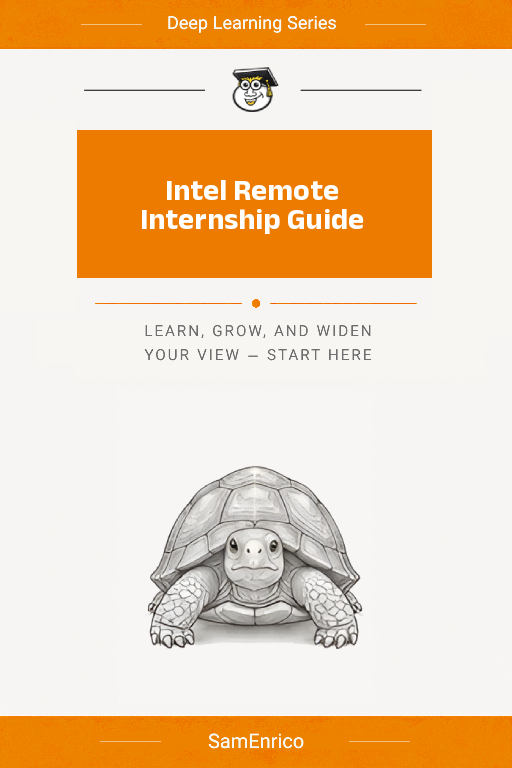
Intel Remote Internship Guide eBook
Land remote internships at Intel in hardware engin
Land remote internships at Intel in hardware engineering, software, or semiconductor manufacturing.
Formats
Free sample
Chapter 1: The Virtual Fab--For most engineering students, the dream of interning at Intel conjures a specific image: a cleanroom with yellow lighting, bunny suits, the hum of million-dollar lithography machines, and the satisfying click of a probe station making contact with a silicon wafer. That image is not wrong—for some roles. But for a growing and largely invisible segment of Intel’s workforce, the reality looks very different. It looks like a dual-monitor setup in a spare bedroom, a terminal window open to a remote server in Oregon or Israel, and a waveform viewer displaying the intricate dance of signals through a simulated processor. It looks like home.This chapter exists to correct a widespread and costly misconception: that hardware engineering, semiconductor manufacturing, and the inner workings of one of the world’s most complex chipmakers require physical presence.
They do not. Not entirely. Not anymore. The truth is that Intel—a company built on the physics of silicon, the chemistry of etching, and the precision of atomic-scale manufacturing—has quietly become a powerhouse of remote-capable work. And for the ambitious student who knows where to look and how to prepare, a remote internship at Intel is not a consolation prize.
It is a first-class ticket into the heart of the semiconductor industry.The concept we will build throughout this chapter—and the foundation for everything that follows in this book—is what I call the Virtual Fab. The Virtual Fab is not a product or a tool. It is a mindset and a map. It is the recognition that nearly every stage of semiconductor design, verification, and even manufacturing has a digital twin: a software-based equivalent that can be accessed, operated, and debugged from anywhere with a stable internet connection. When you understand the Virtual Fab, you stop asking “Can I do this job remotely?” and start asking “Which parts of this job have been virtualized, and how do I prove I can master them?”Let us begin with a story that illustrates the gap between perception and reality.The Intern Who Never Touched a Chip Two years ago, a computer engineering student named Maya applied for a hardware internship at Intel.
She had a strong GPA, several FPGA projects, and a summer of lab experience. She assumed that any hardware role would require her to relocate to Oregon or California. She almost did not apply to the position listed as “Pre-Silicon Validation Engineer – Remote” because she did not believe it could be real. How could you validate a chip that did not yet exist, from your apartment in Texas?She applied anyway. She got the interview.
And she spent twelve weeks running simulations on a server cluster in Hillsboro, Oregon, while sitting in her home office. She never touched a physical chip. She never entered a lab. She wrote System Verilog assertions, debugged RTL simulation logs, and presented her coverage reports over Zoom. At the end of the summer, she received a full-time offer.
Today, she works on the same team, still remotely, verifying the next generation of Intel processors.Maya’s story is not exceptional. It is increasingly normal. But it remains invisible to most students because the dominant narrative about hardware and semiconductor work is decades out of date. The Virtual Fab has arrived, but the career advice has not caught up.What the Virtual Fab Actually Means The term “fab” at Intel refers to a fabrication facility—the multibillion-dollar factories where silicon wafers are transformed into microprocessors through hundreds of precise steps. A Virtual Fab, then, is the software abstraction of that physical process.
It includes:Electronic Design Automation (EDA) tools that simulate the behavior of circuits before they are ever manufactured. These tools—Synopsys VCS, Cadence Xcelium, Siemens Questa—run on remote servers and produce simulation logs, waveforms, and coverage reports. They are the primary workspace for design and verification engineers.Emulation and simulation platforms like Intel’s own Simics or open-source QEMU, which run firmware, operating systems, and workloads on virtual representations of Intel hardware. These platforms allow developers to write and test low-level code without physical silicon.Manufacturing data systems that collect terabytes of sensor readings from every tool in every fab. Engineers access these data streams through secure dashboards to monitor process control, detect anomalies, and optimize yield—all without stepping foot in a cleanroom.Remote desktop and command-line access to the servers, workstations, and compute clusters where all of the above live.
The physical location of the engineer becomes irrelevant as long as the network connection is reliable.The Virtual Fab does not cover every role. Some work still requires physical presence: debugging a prototype with an oscilloscope, handling wafers in a cleanroom, performing maintenance on a lithography tool. But a remarkable amount of Intel’s core engineering work now happens in the Virtual Fab, and the company has invested heavily in making that work accessible remotely.The Three Tiers of Remote Viability To make the Virtual Fab actionable, we need a clear framework for evaluating whether a specific internship role is likely to be fully remote, hybrid, or on-site. Based on analysis of hundreds of Intel internship postings and conversations with current and former remote interns, I have developed a three-tier classification system.Tier 1: Fully Remote (100% Virtual Fab)These roles require no physical access to silicon, lab equipment, or cleanroom facilities. All work happens within the Virtual Fab.
Examples include:RTL Design: Writing Verilog or VHDL code for new IP blocks or processor features. Designers simulate their code, run linting and synthesis, and deliver RTL to the next stage of the flow—all remotely.Pre-Silicon Verification: The most remote-friendly hardware role. Verification engineers write testbenches, develop coverage models, simulate design behavior, and debug failures using waveform viewers. No chip exists yet, so there is nothing physical to touch.Firmware and Embedded Software: Developing BIOS, UEFI, microcode, or device drivers. Engineers run their code on emulators and simulators (QEMU, Simics) or on FPGA prototypes accessed remotely.
Physical hardware is only needed in the final validation stage, which is typically handled by a separate team.Process Automation and Equipment Data Analysis: Writing scripts to parse sensor data from fab equipment, developing dashboards for Statistical Process Control (SPC), or building models to predict yield excursions. These roles work entirely with data streams and databases.EDA Tool and Flow Development: Building and maintaining the software infrastructure that runs the Virtual Fab itself. These are software engineering roles within the hardware world.Tier 2: Hybrid (Occasional Lab or Fab Access)These roles are mostly remote but require infrequent physical presence—perhaps once a week or once a month. If you live near an Intel site, they are viable; if not, you may need to relocate or accept periodic travel. Examples include:Process Control Engineering: Monitoring fab equipment remotely, but occasionally needing to verify a sensor reading or reset a tool by hand.
Many process control engineers work remotely 90% of the time but keep a badge and a cleanroom suit for exceptions.Post-Silicon Validation: Testing chips after they return from manufacturing. Much of this work involves automated test equipment and can be done remotely, but some debug scenarios require probing physical pins or swapping components…
This is the end of the free sample. Get the eBook to keep going. Buy now
About this book
Details
- Author
- Comstock Rosia
- Publisher
- SamEnrico
- Language
- English
- Genre
- Non-Fiction, Student's Shortcut, Hardware
- Released
- 2026-06-01
- Pages (approx.)
- 135
- Available as
- eBook, Audiobook

Read better in the ZLOADR app
Your eBooks on your phone or tablet. Sign in with your SamEnrico account and start reading.
More by Comstock Rosia
 But You Are Free TechniqueComstock Rosia$11.99
 Industrial Manufacturing Transaction GuideComstock Rosia$11.99
 Ayurvedic Weight ManagementComstock Rosia$11.99
 The Gambling Relapse Autopsy GuideComstock Rosia$11.99
 The Friend Who Trafficked MeComstock Rosia$11.99
 Jungle Night NavigationComstock Rosia$11.99
 Gift Buying CompulsionComstock Rosia$11.99
 Circadian Rhythm GuideComstock Rosia$11.99
 The Colosseum of Dreams: Love and Labor in Renaissance FlorenceComstock Rosia$11.99
 Letters from the Hyrcanian Gates: Love and Conquest in PersiaComstock Rosia$11.99Letters from the Hyrcanian Gates: Love and Conquest in PersiaComstock Rosia$11.99
 A Collector's Handbook to the Ford Prefect E93aComstock Rosia$11.99