
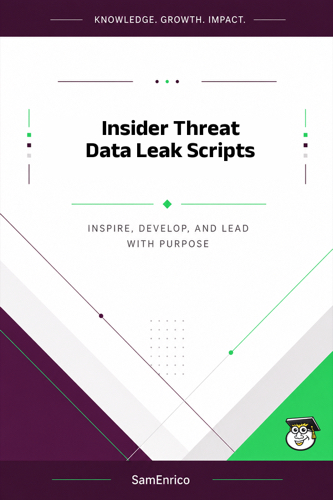
Non-FictionCrisis ManagementInsider Threat
Insider Threat Data Leak Scripts eBook
Notify customers after an employee causes a data b
by Cline Mozell
Notify customers after an employee causes a data breach using these internal incident notification templates.
Formats
Free sample
Chapter 1: The 2:14 AM Call...--–- The phone rings at 2:14 AM on a Tuesday. The caller ID shows the name of your head of security. In the fog of waking from a dead sleep, your first thought is a server failure. Your second thought is a ransomware attack. You answer, and the words you hear are not about firewalls, phishing emails, or external IP addresses.
They are about an employee. Someone you trusted. Someone who had a badge, a laptop, and legitimate, unquestioned access to your most sensitive customer data. That person, you are told, copied 47,000 customer records – including full names, social security numbers, dates of birth, and financial account details – to a personal USB drive three hours ago. The employee has not shown up for their shift.
Their desk is immaculate. Their laptop is missing. Their security badge was last used to exit the building at 11:47 PM. The head of security asks you a question that will define the next 72 hours of your life: "What do we tell the customers?"This is not a hypothetical scenario designed to sell books. This happens every single day in organizations of every size, across every industry.
The Verizon Data Breach Investigations Report consistently finds that insider threats account for approximately one-third of all data breaches. The Ponemon Institute’s annual Cost of Insider Threats study puts the average annual cost of insider incidents at over fifteen million dollars per organization. But here is what the statistics do not tell you, what the data sheets and compliance checklists and security vendor white papers will never capture: the ones caused by employees – not by hackers, not by nation-states, not by sophisticated external adversaries – are the ones that destroy customer trust faster, more completely, and more permanently than any other type of security incident.Why? Because customers understand hackers. They expect them.
They have internalized the idea that sophisticated criminals target companies constantly, and that even the best defenses can fail against a determined, well-resourced attacker. It is a story they have heard a hundred times. It is almost comforting in its predictability. But when the breach is caused by your own employee – someone you hired, someone you trained, someone you gave a key to the front door and the alarm code and the administrative password – the customer's reaction shifts from sympathy to fury, from understanding to violation, from "these things happen" to "how could you let this happen?" The narrative changes from "they were attacked" to "they failed us." This shift is not subtle. It is not marginal.
It is a chasm. Crossing it requires a completely different communication framework, a completely different set of scripts, and a completely different mindset. This is the Betrayal Factor. It is the single most important concept in this entire book, and if you remember nothing else from these pages, remember this: customers forgive hackers. They do not forgive the companies that employ the people who betray them.The Betrayal Factor is the psychological and reputational multiplier that applies exclusively – exclusively – to insider-caused breaches.
When a customer learns that their personal data was stolen by an external hacker, they experience fear. Fear is manageable. Fear is rational. Fear can be addressed with credit monitoring, fraud alerts, and technical explanations. But when a customer learns that their data was stolen by your employee, they experience fear, anger, and a profound sense of violation.
The trusted relationship has been broken not by an outsider, but by someone you vouched for. In the customer's mind, you did not just fail to protect their data. You failed to protect them from your own people. That is a different category of failure entirely. It is intimate.
It is personal. It is the difference between a stranger breaking your car window and your mechanic taking your car for a joyride. The damage to the relationship is orders of magnitude greater.This chapter dismantles the dangerous assumption that all breach notification templates are interchangeable. It explains why the scripts you use for external hacks will backfire catastrophically when the perpetrator is an employee. It draws on the most respected insider threat frameworks from best-selling authors and industry experts.
It walks through the reputational mechanics of the Betrayal Factor in detail. And it establishes the foundational narrative shift that every subsequent chapter in this book depends upon: you must stop communicating like a victim and start communicating like someone who failed to prevent a trusted person from abusing their access. That shift is uncomfortable. It requires admitting imperfection. It requires saying "we failed" instead of "we were attacked." But it is the only path to preserving customer trust, limiting legal liability, and keeping your job.
Let us begin.The Great Misconception: Why Most Breach Templates Assume a Hacker Open any standard breach notification template library. Go ahead. Search your company's incident response documentation. Look at the language your legal team has approved for breach communications. You will see phrases like "sophisticated cyber attack," "unauthorized third party gained access," "external threat actor exploited a vulnerability," and "we are working with law enforcement to identify the perpetrators." These are the vocabulary of victimhood.
They are designed to position the company as the target of an inevitable, high-skill criminal enterprise. They work reasonably well for external hacks because customers have been trained to expect them. The narrative is familiar. It has been tested in court. It triggers the right emotional responses – sympathy, concern, but not blame.Now imagine sending that same template after an employee caused the breach.
Read it out loud: "A sophisticated cyber attack" – no, it was a junior accountant with a USB drive and a grudge. "An unauthorized third party gained access" – no, it was a system administrator whose credentials you never revoked after they were promoted, a person who was authorized, who was trusted, who was yours. "We are working with law enforcement to identify the perpetrator" – you already know exactly who it is. You have their name, their photo, their home address, and their signed offer letter in your HR files. The moment that letter goes out, the customer reads it and thinks: "Why are they talking like this was a hack?
Why are they being evasive? What are they hiding?"The mismatch is obvious, yet organizations make this mistake constantly. I have seen it in Fortune 500 companies. I have seen it in small startups. I have seen it in healthcare, finance, retail, and technology.
They default to their existing breach response playbook, which was written for external attacks, and they apply it to insider incidents without modification. The result is a notification that feels dishonest, evasive, or incompetent – sometimes all three. Customers read between the lines. They are not stupid. They know that if you are using victim language for a problem you caused, you are hiding something.
And once they suspect you are hiding something, the trust is gone. Not diminished. Gone.Consider two real-world examples, both detailed further in Appendix F. In the Morgan Stanley insider breach, a financial advisor named Galen Marsh accessed and copied hundreds of thousands of client records over several years. He took screenshots of client account information, stored them on personal devices, and allegedly shared them with…
This is the end of the free sample. Get the eBook to keep going. Buy now
About this book
Details
- Author
- Cline Mozell
- Publisher
- SamEnrico
- Language
- English
- Genre
- Non-Fiction, Crisis Management, Insider Threat
- Released
- 2026-06-06
- Pages (approx.)
- 151
- Available as
- eBook, Audiobook

Read better in the ZLOADR app
Your eBooks on your phone or tablet. Sign in with your SamEnrico account and start reading.
More by Cline Mozell
 TM Stress Release ProcessCline Mozell$11.99
 The Governor's Pardon ListCline Mozell$11.99
 The Funnel for RetailersCline Mozell$11.99
 Billy Casper Putting Genius GuideCline Mozell$11.99
 The Great British Bank Job: The £250 Million Vanishing ActCline Mozell$11.99
 The Nile's Hidden Heart: Ancient Explorers and the Quest for the SourceCline Mozell$11.99
 A Beginners Guide to Artistic cycling (Volume 1)Cline Mozell$11.99
 Business Plan Cover Page DesignCline Mozell$12.99
 Kanban Scheduling System GuideCline Mozell$12.99Kanban Scheduling System GuideCline Mozell$12.99
 Radioacoustic Spectroscopy TechnicianCline Mozell$11.99
 Understanding Cleft Lip Palate Dysmorphism Kumar TypeCline Mozell$17.99
You may also like
 Hong Kong Handover 1997Dunn Johnnie$11.99
 Zumba For Postnatal Recovery CourseNeal Christian$11.99
 Zumba for BeginnersLadner Nikia$11.99
 YouTube Comment Mining GuideHumes Pandora$12.99
 Worry Box MeditationCarlin Rudy$11.99
 Workplace Stress MeditationNguyen Lynn$11.99
 Workplace Stress and Sleep RepairHawley Ivory$11.99
 Workplace Perfectionism CureDelaney Jeffry$11.99
 Workplace Injustice Anger GuideWallen Isabelle$11.99
 Work Addiction and Burnout LinkGreenwood Ester$11.99
 Women in Yoga and WellnessBeattie Galina$11.99
 Women in Stand Up ComedyChun Evangeline$11.99