
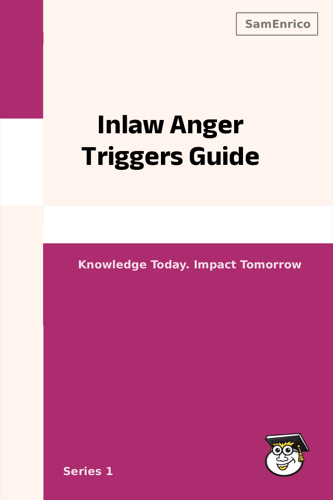
Inlaw Anger Triggers Guide eBook
Map specific behaviors from extended family that r
Map specific behaviors from extended family that reliably set you off.
Formats
Free sample
Chapter 1: The Buried Lie--–- The first time you felt that hot spike of rage at your mother-in-law’s dining table, you probably told yourself to calm down. You took a breath. You smiled. You rationalized: She doesn’t mean it. I’m being too sensitive.
This is just how families are. And then you spent the entire drive home silent, fuming, while your spouse asked, “What’s wrong?” and you said, “Nothing,” because you couldn’t find the words to explain why a single comment about your casserole had undone you.That was not a failure of your patience. That was a failure of the script you were handed.You have been taught a lie. It is a lie so pervasive, so embedded in wedding toasts and greeting cards and the well-meaning advice of your own parents, that you have probably never even questioned it. The lie sounds like this: When you marry someone, you marry their family.
This phrase is delivered as wisdom, as a warning, as an inevitability. It suggests that marriage is not a union between two people but a merger between two tribes — and that your job, as the newcomer, is to adapt, accommodate, and absorb whatever behaviors the existing tribe throws at you.The lie has a corollary, even more damaging: If you have problems with your in-laws, you are the problem. You are not trying hard enough. You are holding a grudge. You are keeping score.
You need to be the bigger person.This book exists because that lie has destroyed marriages, silenced millions of perfectly reasonable people, and left countless individuals wondering why they feel so angry all the time around people who claim to love them.Here is the truth that will set you free, and it must land with the force of a door slamming shut: You married one person. The rest are optional.The anger you feel is not a personality flaw. It is not a sign that you are “difficult” or “dramatic” or “unforgiving.” It is a signal — a loud, insistent, biologically wired signal — that a boundary has been crossed. Your nervous system is not broken. It is working exactly as designed.
The problem is that you have been trained to ignore it.This chapter will do three things. First, it will expose the cultural script that has gaslit you into doubting your own perceptions. Second, it will introduce the central framework of this entire book: the Expectation Gap, the hidden chasm between what you reasonably expect from adult family relationships and what your in-laws actually deliver. Third, it will give you your first tool — the Triggers Journal Protocol — which will transform your anger from a shameful secret into a usable map.By the time you finish this chapter, you will no longer ask “Why am I so angry?” You will ask “What boundary is being violated?” And that question changes everything.The Gaslighting of the New Family Member Let us name the dynamic explicitly, because naming is the first form of disempowerment.When you enter an existing family system through marriage, you become what family systems theorists call the identified patient — the person who is subtly (or not so subtly) blamed for any disruption in the family’s equilibrium. Before you arrived, the family had its own rhythms, its own unspoken rules, its own allocations of power and attention.
The mother-in-law knew her place. The father-in-law knew his grievances. The siblings knew their roles. Then you appeared, and suddenly your spouse started saying “we need to check our calendar” instead of “I’ll be there.” Suddenly holidays required negotiation. Suddenly the old ways were being questioned.To the existing family, you are not a welcome addition.
You are a disruption.And disruption, in any closed system, is experienced as threat. The family’s response is not usually conscious or malicious. They are not twirling mustaches in a dark corner. They are simply defending their homeostasis, the same way your body fights a virus. And the primary weapon in that defense is gaslighting — not the clinical term for psychosis, but the colloquial meaning: making you doubt the validity of your own perceptions.How do they do this?
Through a thousand small invalidations:“You’re too sensitive.”“That’s just how she is.”“You need to learn to let things go.”“Why do you always have to make everything a big deal?”“After everything we’ve done for you?”Each of these phrases has the same hidden message: Your feelings are not trustworthy. Your perception of events is distorted. The problem is not our behavior; the problem is your reaction to our behavior.This is the most insidious form of emotional abuse because it is delivered in the language of love and family unity. The person saying “you’re too sensitive” genuinely believes they are helping you. Your spouse, when they say “that’s just how she is,” believes they are being a peacemaker.
Your in-laws, when they exclude you from a family text chain, believe they are “sparing you the drama.”The result is that you end up feeling crazy. Not metaphorically crazy — genuinely uncertain of whether you have the right to be angry. You replay the conversation in your head. You ask your friends for their opinion. You read online forums.
You are searching for someone, anyone, to confirm that you are not imagining things.You are not imagining things.The anger you feel is the canary in the coal mine of your marriage. It is the earliest warning system that something in the family system is toxic to you. And the worst thing you can do is kill the canary.The Expectation Gap: Where Anger Lives Let us move from the emotional to the structural. Anger does not emerge from nowhere. It follows a predictable, almost mathematical formula:Anger = (Expectation − Reality) × Importance That is, your anger is the gap between what you expected to happen and what actually happened, multiplied by how much the situation matters to you.
Small gap, small anger. Large gap, large anger. No gap, no anger.This explains why the same behavior from an in-law can feel like a papercut one day and a stabbing the next. When you are well-rested and expecting nothing, a passive-aggressive comment rolls off your back. When you are exhausted and hoping for support, the same comment sends you into a spiral.The key insight — and this is the foundation of the entire book — is that most in-law anger is not caused by what they do.
It is caused by the gap between what they do and what you expected.And where do your expectations come from? They come from the lie.You expected that marriage would make you a full, equal member of a new family. You expected that your spouse would prioritize you. You expected that your in-laws would respect your autonomy, your parenting, your career, your home. You expected that family gatherings would be pleasant, or at least neutral.
You expected that if you were kind, they would be kind in return.These are not unreasonable expectations. They are the baseline assumptions of any healthy adult relationship.But your in-laws are operating from a completely different…
This is the end of the free sample. Get the eBook to keep going. Buy now
About this book
Details
- Author
- Broyles Cecila
- Publisher
- SamEnrico
- Language
- English
- Genre
- Non-Fiction, Self-Help, Inlaws
- Released
- 2026-06-06
- Pages (approx.)
- 146
- Available as
- eBook, Audiobook

Read better in the ZLOADR app
Your eBooks on your phone or tablet. Sign in with your SamEnrico account and start reading.
More by Broyles Cecila
 TikTok Content RemixingBroyles Cecila$11.99
 Nairobi Mobile Money IntegrationBroyles Cecila$11.99
 Nightmare Rescripting For Abandonment Dreams WorkbookBroyles Cecila$11.99
 The Calorie Deficit Weight Loss GuideBroyles Cecila$11.99
 The Ghost Admiral: Yamamoto's Gambit and the Doolittle RaidBroyles Cecila$11.99
 Understanding Prolymphocytic LeukemiaBroyles Cecila$17.99
 Data Governance ConsultantBroyles Cecila$11.99
 Data Labeling Best PracticesBroyles Cecila$12.99
 Atlassian GuideBroyles Cecila$12.99
 How to Become a Optometric AssistantBroyles Cecila$11.99
You may also like
 Hong Kong Handover 1997Dunn Johnnie$11.99
 Zumba For Postnatal Recovery CourseNeal Christian$11.99
 Zumba for BeginnersLadner Nikia$11.99
 YouTube Comment Mining GuideHumes Pandora$12.99
 Worry Box MeditationCarlin Rudy$11.99
 Workplace Stress MeditationNguyen Lynn$11.99
 Workplace Stress and Sleep RepairHawley Ivory$11.99
 Workplace Perfectionism CureDelaney Jeffry$11.99
 Workplace Injustice Anger GuideWallen Isabelle$11.99
 Work Addiction and Burnout LinkGreenwood Ester$11.99
 Women in Yoga and WellnessBeattie Galina$11.99
 Women in Stand Up ComedyChun Evangeline$11.99