
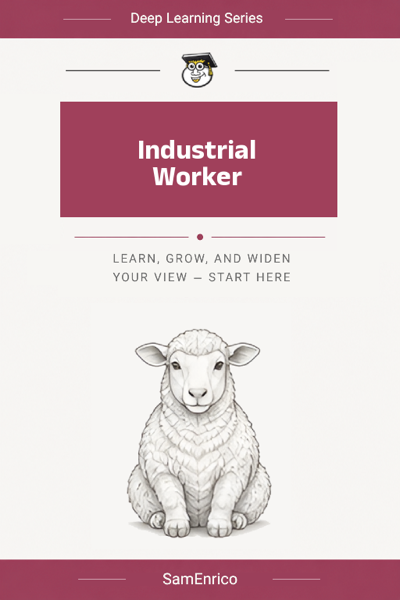
Non-FictionInformativeEducational
Industrial Worker eBook
A Coursebook on Industrial Worker
A Coursebook on Industrial Worker
Formats
Free sample
Chapter 1: The Invisible Infrastructure--There is a moment, about three weeks into your first industrial job, when you realize something that no one told you in training. You are standing in front of a machine that has stopped for no apparent reason. The screen says “Fault Code 417” or maybe just “System Fault” – something generic enough to be useless. Behind you, a production manager is breathing down your neck. Ahead of you, a shipping deadline is looming.
And you understand, in that moment, that the entire operation is waiting on you.No one told you that feeling. They taught you how to read a blueprint, how to lock out a machine, maybe even how to program a PLC. But no one told you that you would become the invisible infrastructure of modern civilization – the person who keeps things running so everyone else can pretend the machinery runs itself.This is the truth about industrial work in 2026: you are not a button pusher. You are not a cog in a machine. You are a diagnostician who reads machines, data, and people – in that order.
And the sooner you understand that, the sooner you stop feeling like an imposter and start feeling like what you actually are: the most valuable person on the factory floor.The Myth of the Unskilled Worker Let us start by killing a lie. You have heard it your whole life. Maybe your parents said it. Maybe a guidance counselor. Maybe just the quiet voice in your own head that says industrial work is what you do when you cannot do anything else.The lie is this: industrial workers are unskilled labor.Go ahead and search for that phrase online.
“Unskilled labor.” There are entire economics papers that use it. Politicians use it. The Bureau of Labor Statistics used to classify certain jobs that way. But here is what they mean when they say “unskilled”: they mean jobs that do not require a four-year college degree. That is it.
That is the whole definition.Here is what they do not mean: they do not mean easy. They do not mean simple. They do not mean that anyone off the street can walk in and do it.Take a moment to consider what an industrial worker in 2026 actually needs to know. You need to understand mechanical systems – bearings, gears, belts, chains, lubrication, alignment. You need to understand fluid power – hydraulics that can crush a steel beam, pneumatics that move faster than the eye can track.
You need to understand electricity – motors, relays, variable frequency drives, the difference between single phase and three phase, the reason you do not walk away from an open panel without checking for arc flash hazards first. You need to understand control systems – PLCs, ladder logic, HMIs, the scan cycle, the difference between a normally open contact and a normally closed one. You need to understand data – vibration analysis, thermal imaging, oil sampling, OEE, MTTR, control charts. You need to understand safety – not just where the hard hat goes but why LOTO exists, what the hierarchy of controls means, when you have the right to refuse a task and how to say no without getting fired. You need to understand communication – how to write a shift log that does not confuse the next guy, how to read a blueprint, how to explain a problem to an engineer who has never touched a wrench, how to explain the same problem to a manager who only cares about throughput.That is not unskilled.
That is a profession.And here is the part that will make you angry if you think about it too long: the people who call you unskilled could not do your job. They do not know which way to turn a wrench to loosen a bolt that has been rusted for ten years. They do not know how to listen to a bearing and tell the difference between a dry bearing and a failing one. They do not know how to trace a hydraulic line through a spaghetti mess of pipes and find the one valve someone forgot to open. They do not know how to look at a vibration spectrum and say “that bearing has two weeks left.”You know these things.
Or you are about to learn them.So let us retire the word “unskilled” right now. Put it in a box, lock the box, throw it in a river. You are not unskilled. You are specialized. You are needed.
You are the person who keeps the world moving while everyone else sleeps.The Three Things You Actually Do Now that we have cleared that up, let us talk about what you actually do all day. Not the job description. Not the list of tasks HR gave you on your first day. The real work.The real work of the industrial worker breaks down into three categories, and they are not what you think.First, you read machines. Every machine has a voice.
Not literally – most of them do not talk, thank God, because they would probably complain. But every machine has sounds, vibrations, temperatures, pressures, and rhythms that tell you how it is feeling. A motor that runs at 1,770 RPM sounds different from a motor that runs at 1,750. A pump that is cavitating sounds like it is full of gravel. A bearing that is about to fail has a pitch to it – a high-frequency whine that your ears can hear even if your brain does not know what it is yet.
Reading machines means listening to those voices and understanding what they are saying. It means looking at a thermal image and seeing the hot spot that everyone else missed. It means feeling a gearbox and knowing that 140 degrees is normal but 160 degrees is a problem.Second, you read data. This is the new part. Twenty years ago, you could get by with just your ears and your eyes.
Not anymore. Now every machine is covered in sensors. Every cycle is logged. Every fault is recorded. You have dashboards full of numbers that mean something – OEE, MTTR, vibration spectra, oil analysis reports, control charts.
Reading data means knowing which numbers matter and which are just noise. It means looking at a trend line and seeing that the vibration has been climbing for six weeks, even though no one else noticed. It means knowing that a change in oil viscosity of 10 percent is normal but 20 percent means trouble.Third, you read people. This is the one no one talks about. You work in a building full of people who have different priorities, different schedules, different levels of competence, and different moods.
There is the production manager who only cares about throughput and will push you to bypass safety procedures. There is the maintenance supervisor who has been doing this for thirty years and thinks every problem can be solved with a bigger hammer. There is the engineer who has never touched a wrench but has very strong opinions about how the wrench should be used. There is the new guy who is terrified to ask questions. There is the old timer who is counting the days until retirement and has stopped caring.
Reading people means knowing who to trust, who to ignore, who to teach, and who to learn from. It means…
This is the end of the free sample. Get the eBook to keep going. Buy now
About this book
Details
- Author
- Eaton Hilario
- Publisher
- SamEnrico
- Language
- English
- Genre
- Non-Fiction, Informative, Educational
- Released
- 2026-05-11
- Pages (approx.)
- 141
- Available as
- eBook, Audiobook

Read better in the ZLOADR app
Your eBooks on your phone or tablet. Sign in with your SamEnrico account and start reading.
More by Eaton Hilario
 Empathy For Grieving PeopleEaton Hilario$11.99
 The Serfdom and Villein GuideEaton Hilario$11.99
 Office HIIT Desk Break GuideEaton Hilario$11.99
 The Calm Parent GuideEaton Hilario$11.99
 Twelve Step Meditation CollectionEaton Hilario$11.99
 The Silent Tide of the East: Goryeo's Naval Defiance Against the Mongols (1231-1270)Eaton Hilario$11.99
 The Breeder's Guide to Kerry CattleEaton Hilario$11.99
 How to Start a Blood Transfusion Service Business (Beginners Guide)Eaton Hilario$11.99
 Enterprise Free to PaidEaton Hilario$12.99
 Annual Customer Review GuideEaton Hilario$12.99
You may also like
 Hong Kong Handover 1997Dunn Johnnie$11.99
 Zumba For Postnatal Recovery CourseNeal Christian$11.99
 Zumba for BeginnersLadner Nikia$11.99
 YouTube Comment Mining GuideHumes Pandora$12.99
 Worry Box MeditationCarlin Rudy$11.99
 Workplace Stress MeditationNguyen Lynn$11.99
 Workplace Stress and Sleep RepairHawley Ivory$11.99
 Workplace Perfectionism CureDelaney Jeffry$11.99
 Workplace Injustice Anger GuideWallen Isabelle$11.99
 Work Addiction and Burnout LinkGreenwood Ester$11.99
 Women in Yoga and WellnessBeattie Galina$11.99
 Women in Stand Up ComedyChun Evangeline$11.99