
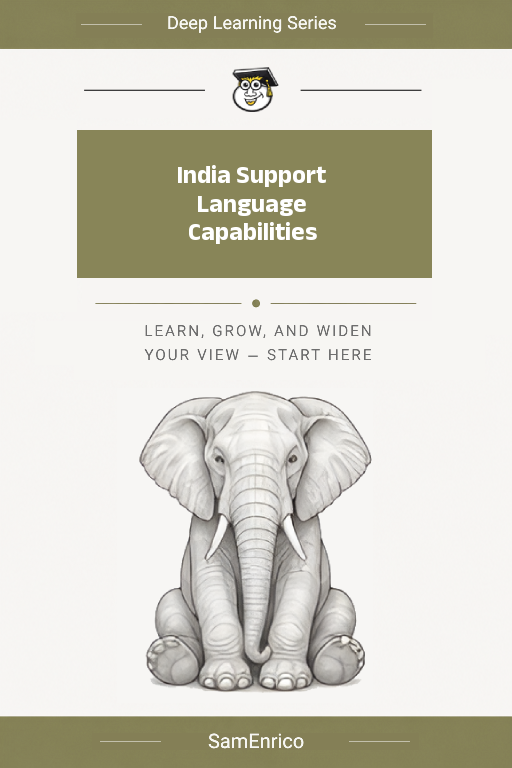
India Support Language Capabilities eBook
Access English Hindi and regional language support
by Beal Carmen
Access English Hindi and regional language support from Indian BPOs.
Formats
Free sample
Chapter 1: The Silence Below...--The first time I walked into a BPO in Noida, I expected chaos. What I found was a cathedral of efficiency. Five hundred young Indians sat in neat rows, headsets on, speaking English in carefully neutralized accents that could have come from Ohio or Manchester. On the wall, a banner read: "Accent is Everything." The quality coach I met—a sharp woman named Priya who had been there for eight years—told me something I could not forget. "We train agents to forget their mother tongue for eight hours a day," she said.
"If they slip into Hindi or Tamil on a call, they lose points. If they do it three times in a month, they lose their bonus."I asked her what percentage of customers those agents were serving in their mother tongue. She looked confused. "We serve in English," she said. "That is what the client pays for."That conversation happened in 2019.
At the time, I nodded politely. But the question haunted me: if India has 122 major languages and 536 million vernacular-first internet users—people who actively prefer their mother tongue over English for commerce, banking, and support—why was an entire industry pretending those people did not exist?The answer, I came to understand, is not simple. It is a story of colonial hangovers, cost arbitrage, and a thirty-year-old assumption that no one has bothered to question. That assumption is this: English is enough.This book is about why English is not enough. It is about the billion people who speak languages other than English—and often other than Hindi—and how global companies are losing them every single day.
But before we can build the solutions, we must understand the problem. And the problem begins with a single, devastating number.The 44 Percent Reality Let us start with a piece of mathematics that should terrify every CEO selling into India.According to the Internet and Mobile Association of India (IAMAI) and KANTAR, as of 2024, India had approximately 900 million active internet users. Of these, roughly 500 million—or 56 percent—consume digital content primarily in English. The remaining 400 million—44 percent—consume content primarily in Indian languages: Hindi, Tamil, Telugu, Bengali, Marathi, Kannada, Gujarati, Malayalam, Odia, Punjabi, and others.Those 400 million people are not a niche. They are larger than the population of the United States.
They are the fastest-growing segment of India's internet economy, adding roughly 30 million new users every year, the vast majority of whom come online through affordable smartphones and regional-language interfaces. And here is the part that keeps BPO executives awake at night: when those 400 million users encounter an English-only support interface, they do not complain. They do not ask for a supervisor. They simply leave.Data from a 2023 study by the language technology platform Bhashini found that customers who were served in their mother tongue were 3.2 times more likely to complete a transaction than those served only in English. A 2024 study by the market research firm You Gov, commissioned by the Indian e-commerce giant Flipkart, found that post-call satisfaction scores (CSAT) rose by 41 percentage points when agents used the customer's preferred language rather than English.
And a confidential internal study from a major global bank, shared with me on condition of anonymity, found that customers who received support in their mother tongue had a 28 percent lower churn rate and a 34 percent higher lifetime value.The conclusion is inescapable: every time your English-only BPO answers a call from a Tamil or Telugu or Punjabi speaker, you are not providing support. You are creating a negative brand experience that your competitors will happily exploit.The Myth of the English-Only BPOIf the data is so clear, why does the English-only model persist?To answer that, we need to go back to the early 1990s. That was when India's BPO industry was born. The catalyst was the Y2K crisis. Western companies needed massive amounts of software testing and call center support at a fraction of the cost of hiring locally.
India offered three things: a large pool of English-speaking graduates, a time zone advantage (the ability to provide 24/7 support by working the US night shift), and labor costs that were 80 to 90 percent lower than in the United States or United Kingdom.The value proposition was simple: cheap English. For a decade, that was enough. The first wave of BPOs—Wipro, Infosys BPO, Genpact, Convergys—built their business models entirely around serving US and UK customers. They hired agents based on their ability to sound "neutral"—which meant, in practice, erasing any trace of an Indian accent. They invested heavily in accent neutralization coaches who trained agents to pronounce "water" as "wadder" (American) or "woh-tuh" (British) instead of the natural Indian "vah-ter." They penalized agents for using Hindi or Tamil or Telugu even among themselves on the floor.
And they created a culture where the mother tongue was treated as a liability rather than an asset.For the US and UK markets, this made a certain kind of sense. The customers those BPOs were serving did not speak Hindi or Tamil. English was the only shared language. But something strange happened as the Indian domestic market began to grow. Starting around 2010, Indian companies—Flipkart, Amazon India, Paytm, Ola, Zomato, and later Jio and Airtel—began setting up their own customer support operations.
These companies were serving Indian customers. And yet, because the BPO industry had been built on an English-only template, and because the leadership of those BPOs had come from the export-oriented firms, they simply replicated the same model. English-only hiring. English-only training. English-only scripts.
The assumption was never questioned.The result is a staggering gap between what Indian customers want and what Indian BPOs provide. A 2022 survey by the customer experience platform Localeyes found that 76 percent of Indian consumers preferred to speak to customer support in their mother tongue. But when those consumers called support numbers for major brands, only 12 percent of calls were answered by agents who could speak the customer's preferred language. The other 88 percent of customers either hung up, struggled through in broken English, or demanded to be transferred—often multiple times—before giving up.That gap is not just a customer service problem. It is a multibillion-dollar revenue leak.The Bharat-India Divide To understand the scale of that leak, we need to understand one of the most important demographic shifts in modern India: the emergence of what marketers call "Bharat" versus "India.""India" refers to the urban, English-first, globally connected consumer.
These are the roughly 250 to 300 million Indians who live in major metropolitan areas—Mumbai, Delhi, Bangalore, Chennai, Hyderabad, Kolkata, Pune—and who are comfortable conducting their digital lives in English. They read English news, watch English-language content on Netflix and Prime, use English keyboards on their phones, and expect English customer support. For this segment, the English-only BPO works just fine."Bharat" refers to everything else. It is the small-town and rural consumer who came online for the first time between 2016 and 2024, driven by the collapse of data prices after Jio's entry into the telecom market. These 500 to 600 million users are not uncomfortable with English—many of them studied English in school—but they are not fluent.
They prefer to read news in Hindi or Tamil or Bengali. They watch You Tube videos in their mother tongue.…
This is the end of the free sample. Get the eBook to keep going. Buy now
About this book
Details
- Author
- Beal Carmen
- Publisher
- SamEnrico
- Language
- English
- Genre
- Non-Fiction, Business Brief
- Released
- 2026-05-30
- Pages (approx.)
- 146
- Available as
- eBook, Audiobook

Read better in the ZLOADR app
Your eBooks on your phone or tablet. Sign in with your SamEnrico account and start reading.
More by Beal Carmen
 FCPA Declination DecisionsBeal Carmen$11.99
 Tourist Driving Patience GuideBeal Carmen$11.99
 Stolen Diamond Smuggling NetworkBeal Carmen$11.99
 Opioid Recovery and LonelinessBeal Carmen$11.99
 Bipolar Crisis Response HandbookBeal Carmen$11.99
 Imposter Syndrome for ConsultantsBeal Carmen$11.99
 See Through Trust RulesBeal Carmen$11.99
 Walking Before Bed ProtocolBeal Carmen$11.99
 PMS Relief Nutrition GuideBeal Carmen$11.99
 Whispers in the Pines: The Vanishing of the Boy ScoutsBeal Carmen$11.99
 The Burning of Washington: America's Capital in FlamesBeal Carmen$11.99
 The Last Oracle of Delphi: When the Gods Stopped SpeakingBeal Carmen$11.99
You may also like
 Hong Kong Handover 1997Dunn Johnnie$11.99
 Zumba For Postnatal Recovery CourseNeal Christian$11.99
 Zumba for BeginnersLadner Nikia$11.99
 YouTube Comment Mining GuideHumes Pandora$12.99
 Worry Box MeditationCarlin Rudy$11.99
 Workplace Stress MeditationNguyen Lynn$11.99
 Workplace Stress and Sleep RepairHawley Ivory$11.99
 Workplace Perfectionism CureDelaney Jeffry$11.99
 Workplace Injustice Anger GuideWallen Isabelle$11.99
 Work Addiction and Burnout LinkGreenwood Ester$11.99
 Women in Yoga and WellnessBeattie Galina$11.99
 Women in Stand Up ComedyChun Evangeline$11.99