
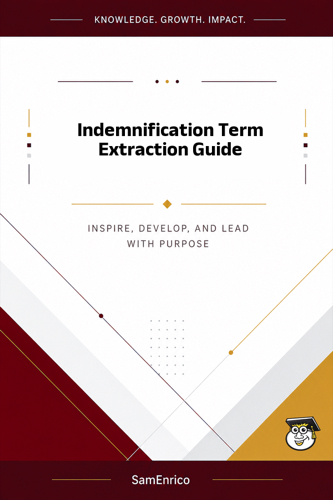
Indemnification Term Extraction Guide eBook
Use chain-of-thought prompting to parse cross-inde
by Enos Troy
Use chain-of-thought prompting to parse cross-indemnity, cap exceptions, and survival periods.
Formats
Free sample
Chapter 1: Five Hidden Bones--–- Every indemnity clause is a skeleton. Most contract readers see only a jumble of legal bones—a tibia here, a skull there—and mistake the pile for a living creature. But once you learn to name the bones and see how they connect, the skeleton becomes predictable, even beautiful. This chapter gives you the skeleton key.Let us start with a confession. Before I learned to extract indemnity terms systematically, I lost a negotiation badly.
Not because the other side was smarter, but because I misread a single clause. The trigger said “arising from,” but I thought it meant “directly caused by.” The cap was $500,000, but I missed an exception for IP infringement. The survival period was six months, but I assumed claims filed after that were still valid if the underlying event happened earlier. Every single error from the introduction—confusing cross-indemnity parties, misapplying cap exceptions, miscalculating survival—I committed in one afternoon. The company I represented paid $1.7 million that it should not have paid.
That was the day I stopped reading indemnity clauses and started extracting them.This chapter deconstructs the indemnity clause into its five core components. Think of these as the five bones of a skeleton: the skull (trigger), the spine (loss definition), the pelvis (indemnitor/indemnitee), the ribs (cap), and the clock (survival). Each bone has a specific shape and function. When you learn to palpate each one, you can diagnose a broken clause before it breaks you.The Skull: Trigger The trigger is the event that activates the entire indemnity obligation. Without a triggered event, the indemnity clause is a sleeping dog.
With a trigger, it wakes up and bites. The most common triggers are negligence, breach of contract, willful misconduct, or specified events such as intellectual property infringement. But the trigger is never just a noun; it always comes wrapped in language that defines causation.Let me give you an example. “Party A shall indemnify Party B for losses arising from Party A’s negligence.” The trigger is “negligence,” but the word “arising from” tells you how closely connected the loss must be to that negligence. Change the trigger to “directly caused by Party A’s negligence,” and the obligation narrows significantly.
Change it to “alleged negligence,” and the duty to defend attaches immediately upon accusation, even if the accusation is false.The trigger is the skull because it contains the brain of the clause—the decision-making logic that determines when the indemnity lives or dies. If you misread the trigger, you misread everything downstream. In Chapter 3, we will dissect trigger language in surgical detail, distinguishing broad causation (“arising from”) from narrow causation (“directly caused by”) and the deadly “alleged” trap. For now, your job is simple: find the trigger. Underline it.
Then ask three questions: (1) What event or conduct activates the duty? (2) What causation standard connects the event to the loss? (3) Does the word “alleged” appear anywhere near the trigger?The Spine: Loss Definition The loss definition specifies what the indemnitor must pay. This is the spine because it runs the length of the clause and gives it structure. A typical loss definition reads like this: “any and all claims, damages, losses, costs, expenses, and liabilities, including reasonable attorneys’ fees, expert witness fees, and court costs.” That looks comprehensive.
But watch what happens when you remove a single word.Compare two versions. Version A includes “reasonable attorneys’ fees.” Version B says “attorneys’ fees” without the modifier “reasonable.” Version B is a trap. If the clause does not say “reasonable,” a greedy indemnitee can submit inflated legal bills, and the indemnitor has no contractual basis to challenge them. Courts will sometimes imply a reasonableness standard, but they do not have to. I have seen a $200,000 indemnity claim turn into a $600,000 claim because the loss definition omitted the word “reasonable.”The loss definition also determines whether defense costs are covered separately from indemnity.
Some clauses cap indemnity at $1 million but then say “defense costs do not count against the cap.” Others say “defense costs are included within the cap.” The difference can be millions of dollars. A $1 million cap that includes defense costs may leave only $200,000 for actual damages after a prolonged litigation. A $1 million cap that excludes defense costs preserves the full $1 million for damages.Extract the loss definition by locating every noun that follows “any and all” or “all.” Then check for modifiers like “reasonable,” “direct,” “incidental,” “consequential,” “special,” or “punitive.” Each modifier shrinks or expands the spine. Also check for exclusions: “excluding lost profits” or “excluding consequential damages” are common carve-outs. If the loss definition excludes consequential damages, the indemnitee cannot recover lost business opportunities even if the trigger is clearly met.The Pelvis: Indemnitor and Indemnitee The indemnitor pays.
The indemnitee gets paid. That is the pelvis of the clause—the structure that connects the upper body (trigger and loss definition) to the lower body (cap and survival). You would think this is the easiest part to extract, but it is also the most frequently misread.The confusion arises from passive voice and nested clauses. Consider this real-world example: “Losses arising from the negligence of a party shall be indemnified.” Who indemnifies whom? The sentence does not say.
It could mean that the negligent party indemnifies the non-negligent party, or it could mean that a third party (like a parent company) indemnifies both. Passive voice buries the indemnitor. The rule is simple: never accept an indemnity clause written in passive voice. Demand active voice: “Party A indemnifies Party B.”Another common trap is misidentifying the indemnitee in multi-party contracts. A clause might say “Contractor indemnifies Owner for losses arising from Subcontractor’s work.” The indemnitee is Owner.
The indemnitor is Contractor. But Contractor will immediately seek indemnity from Subcontractor under a separate flow-down clause. If you only read the prime contract, you might think Contractor bears the ultimate risk. In fact, Contractor is an indemnitee vis-à-vis Subcontractor and an indemnitor vis-à-vis Owner. The pelvis is not a single bone; it is a joint connecting two directions.Extract the indemnitor and indemnitee by finding the verb “indemnify.” The subject of that verb is the indemnitor.
The object is the indemnitee. If the clause says “Party A shall indemnify Party B,” Party A pays, Party B gets paid. Write that down. Then check for mirror obligations. Does Party B also indemnify Party A?
If yes, you have mutual cross-indemnity (Chapter 2). If no, you have one-way indemnity, and you need to ask whether that asymmetry is justified.The Ribs: Cap The cap is the monetary ceiling on the indemnitor’s liability. It is the ribs because it protects the vital organs of the indemnitor’s balance sheet. Caps typically range from one times the contract value to $2 million, though some contracts have no cap (unlimited) and others have caps as low as $50,000 for low-risk services.But the cap is rarely just a number. The real complexity lies in its scope.
Does the cap apply to all indemnity claims, or only to certain types? Does it include defense costs, or are defense costs separate? Is the cap aggregate (across all claims) or per occurrence? These questions are…
This is the end of the free sample. Get the eBook to keep going. Buy now
About this book
Details
- Author
- Enos Troy
- Publisher
- SamEnrico
- Language
- English
- Genre
- Non-Fiction, AI Operator, Liability Analysis
- Released
- 2026-06-10
- Pages (approx.)
- 144
- Available as
- eBook, Audiobook

Read better in the ZLOADR app
Your eBooks on your phone or tablet. Sign in with your SamEnrico account and start reading.
More by Enos Troy
 The Breath Candle AnalogyEnos Troy$11.99
 Event Planner Crisis GuideEnos Troy$11.99
 Progressive Peace ScriptEnos Troy$11.99
 Diver's Bioluminescent ArtEnos Troy$11.99
 Emotion Regulation for HSPEnos Troy$11.99
 Campus Assault SurvivorEnos Troy$11.99
 Rewiring Retirement IdentityEnos Troy$11.99
 Egyptian Music GuideEnos Troy$11.99
 The Lion of the Punjab: Ranjit Singh's Rise to Power (1799-1839)Enos Troy$11.99
 The Last Ride of the Pony Express: A Gallop Through History’s Fastest MailEnos Troy$11.99
 Black Sunday: The Storm That Broke the PlainsEnos Troy$11.99
 Program Management FundamentalsEnos Troy$11.99