
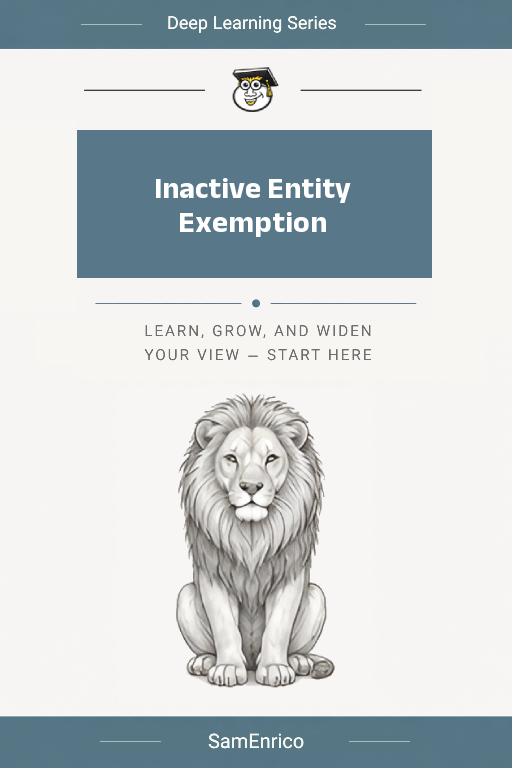
Inactive Entity Exemption Audiobook
Claim inactive entity exemption for companies not
Claim inactive entity exemption for companies not transacting business or holding assets.
Formats
Free sample
Chapter 1: The Before‑After Trap--–- It is a strange thing to own a company that does nothing. You do not wake up to inventory reports, you do not fire employees, you do not sign leases. Perhaps you formed the entity years ago for a real estate deal that never closed, or you kept a shelf corporation alive for a future venture that never arrived, or you simply forgot to dissolve an LLC after a partnership dissolved. The company sits in a drawer, digital or physical, accruing nothing but an annual registered agent fee and the occasional state filing notice. You think of it as dormant, asleep, harmless.
The federal government, under the Corporate Transparency Act, thinks of it as a ticking clock.The Corporate Transparency Act, enacted in 2021 and fully effective as of January 1, 2024, created a sweeping new reporting requirement for millions of small and medium‑sized business entities. Its stated purpose is noble enough: to combat money laundering, tax fraud, and the use of shell companies to hide illicit wealth. The mechanism is a Beneficial Ownership Information (BOI) report filed with the Financial Crimes Enforcement Network (Fin CEN), disclosing the names, addresses, identification numbers, and photographs of every individual who owns or controls the entity. Failure to file carries penalties of 500perday,upto500 per day, up to 500perday,upto10,000 in criminal fines, and potential imprisonment.But Congress, in a moment of legislative clarity, recognized that not all entities are created equal. Buried within the text of the CTA is an exemption for entities that are truly, permanently inactive.
Exemption #23, as it is known in Fin CEN’s regulations, was designed to carve out the ghosts of corporate America: entities that existed before January 1, 2020, never engaged in active business, hold no assets, move less than $1,000 per year, and are owned entirely by domestic persons. On paper, it sounds simple. In practice, it has become the most misunderstood, misapplied, and dangerous exemption in the entire CTA framework.The central problem is one of perception. Most business owners, attorneys, and even some accountants operate under a common‑sense definition of inactivity: if the company has no employees, no revenue, no office, and no active contracts, it must be inactive. That is not the legal definition.
Under the CTA and Fin CEN’s 2022 Final Rule, inactivity is not a spectrum or a feeling. It is a binary, cumulative, six‑prong test. Fail one…
This is the end of the free sample. Get the Audiobook to keep going. Buy now
About this book
Details
- Author
- Morrison Irma
- Publisher
- SamEnrico
- Language
- English
- Genre
- Non-Fiction, Annual Checkup, Inactive Rules
- Released
- 2026-05-30
- Pages (approx.)
- 158
- Available as
- eBook, Audiobook

Listen in the VoxFlicks app
Audiobooks and audio dramas wherever you go. Sign in with your SamEnrico account and press play.
More by Morrison Irma
 Spin Class Visualization Techniques CourseMorrison Irma$11.99
 Memory Care Housing BriefMorrison Irma$11.99
 Anger Trigger Identification GuideMorrison Irma$11.99
 Broker Dealer EnforcementMorrison Irma$11.99
 Peak Performance Self HypnosisMorrison Irma$11.99
 The Unstoppable Rise: How Nintendo Conquered the Gaming WorldMorrison Irma$11.99
 The Bloodhound and the Blitz: How a Dog Outsmarted WWII SpiesMorrison Irma$11.99
 How to Start a Hobby in Jigsaw PuzzlesMorrison Irma$11.99
 CTA Litigation UpdateMorrison Irma$12.99
 Understanding Diabetic AngiopathyMorrison Irma$17.99
 Advanced Cyber Threat DetectionMorrison Irma$11.99