
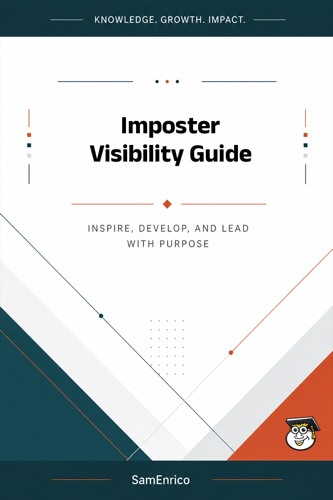
Non-FictionSelf-HelpVisibility
Imposter Visibility Guide eBook
Share your work without fear of negative judgment.
Share your work without fear of negative judgment.
Formats
Free sample
Chapter 1: The Visibility Gap--You are standing at the edge of a room. The door is open. Inside, there are people who need what you have—your idea, your solution, your story, your art, your voice. But you cannot make yourself step through the doorway. Your feet feel bolted to the floor.
Your heart is hammering. A voice inside your head is whispering, or perhaps shouting: Who do you think you are? What if they laugh? What if you're wrong? What if they see that you don't actually belong here?This is the Visibility Gap.
It is the painful distance between your desire to share your work and the paralyzing fear that stops you cold. It is not a small gap. For many people, it is a chasm so wide and so deep that they spend years—decades, entire careers—standing on the edge, never crossing. They write the book but never publish it. They have the idea but never pitch it.
They build the prototype but never launch it. They prepare the presentation but never raise their hand.And here is the cruelest part: the world never knows they were there. The gap is invisible from the other side. No one sees the person standing at the door, frozen. No one knows about the brilliant idea that died of suffocation inside a notebook.
No one mourns the art that was never shared, because how could they? They never knew it existed.This book is about closing that gap. Not eliminating the fear—that is almost certainly impossible, and perhaps not even desirable—but closing the distance between the fear and the action. Learning to step through the doorway while your heart is still hammering. Learning to share your work before you feel ready, because "ready" is a destination that does not exist.The Central Lie That Keeps You Stuck Before we can close the Visibility Gap, we have to name the lie that keeps it open.
The lie sounds reasonable. It sounds responsible, even wise. The lie is this:I will share my work when I feel ready. I will speak up when I feel confident. I will put myself out there when I have eliminated the possibility of failure or embarrassment or judgment.This is the single most seductive and destructive myth in the entire landscape of creative and professional work.
It is seductive because it feels like prudence. It feels like high standards. It feels like protecting yourself from unnecessary risk. But it is destructive because it sets up an impossible condition: you are waiting for a feeling that will never arrive before you take the action that might produce it.Confidence is not a prerequisite for action. Confidence is a result of action.
You do not feel confident and then share your work. You share your work—imperfectly, nervously, sweatily—and then, over time, as you accumulate evidence that you survived, you begin to feel something that resembles confidence. But the feeling comes after, not before.Think about every significant thing you have ever learned to do. Did you feel confident behind the wheel of a car before you ever drove one? Did you feel confident giving a presentation before you ever gave one?
Did you feel confident having a difficult conversation before you ever had one? Of course not. You did the thing badly, nervously, awkwardly. And then you did it again. And again.
And the confidence—or more accurately, the familiarity that looks like confidence—emerged from the repetition, not the other way around.Sharing your work is no different. But because the stakes feel higher—because the audience feels larger, because the judgment feels more personal, because the work feels like an extension of your very self—we convince ourselves that this domain is special. That we need to be ready in a way we didn't need to be ready for learning to drive or cook or parent or lead. This is the lie that keeps the Visibility Gap wide open.What This Book Is (And What It Is Not)Let me be clear about what you are holding. This is not a book that will teach you how to eliminate imposter syndrome.
That is not possible. Imposter syndrome is not a disease you cure; it is a response to certain conditions that you can learn to manage. The goal of this book is not to make you feel confident. The goal of this book is to make you willing to act even while the fear remains.This is also not a book about "faking it until you make it." That advice is not only unhelpful; it is actively counterproductive for people who struggle with imposter feelings. Telling someone who already feels like a fraud to "fake it" is like telling someone who is drowning to pretend they can swim.
It adds shame to fear. It reinforces the gap.What this book offers instead is a structured, actionable system for sharing your work in the presence of fear. The system is called RISE, and you will encounter it throughout these chapters. RISE stands for Reflect, Ideate, Select, Evaluate. It is a four-step cycle that turns visibility from a terrifying, high-stakes event into a manageable, repeatable practice.We will explore each step in depth across the coming chapters.
But for now, here is the simplest version:Reflect means honestly assessing where you are right now. What are you afraid of? What have you been avoiding? What patterns keep you stuck?Ideate means generating small, low-stakes ways to share your work. Not grand gestures.
Not viral-or-bust. Tiny, survivable acts of visibility.Select means choosing one action to take. Just one. Not a transformation. Not an overhaul.
One small, specific, time-bound act of sharing.Evaluate means reviewing what happened without shame or self-congratulation. What did you learn? What evidence did you collect? What will you do differently next time?Then you Reflect again. The cycle repeats.
This is not a linear path from fear to confidence. It is a spiral: you return to the same feelings again and again, but each time you are slightly further along, slightly more capable, slightly more willing to act.Why Visibility Feels So Dangerous To understand why the Visibility Gap is so difficult to close, we have to understand what is happening beneath the surface. The fear you feel when you contemplate sharing your work is not a sign of weakness or inadequacy. It is a sign that your brain is doing exactly what it evolved to do: protect you from social threat.For most of human history, social exclusion was not merely uncomfortable; it was lethal. Being expelled from the tribe meant exposure, starvation, death.
Your brain is wired to treat social judgment with the same urgency as a physical threat. When you imagine sharing your work and being criticized, laughed at, or ignored, your amygdala—the brain's alarm system—activates the same fight-or-flight response as if you were being chased by a predator.This is not a metaphor. The neurobiology is real. Your heart rate increases. Cortisol floods your system.
Your field of vision narrows. Your digestive system slows down. Your body is preparing for an attack. The attack is…
This is the end of the free sample. Get the eBook to keep going. Buy now
About this book
Details
- Author
- Pinckney Johna
- Publisher
- SamEnrico
- Language
- English
- Genre
- Non-Fiction, Self-Help, Visibility
- Released
- 2026-06-09
- Pages (approx.)
- 137
- Available as
- eBook, Audiobook

Read better in the ZLOADR app
Your eBooks on your phone or tablet. Sign in with your SamEnrico account and start reading.
More by Pinckney Johna
 Widow Social Isolation HelpPinckney Johna$11.99
 Reconstruction of Elder Abuse DeathsPinckney Johna$11.99
 Inaccessible Playground CrusaderPinckney Johna$11.99
 Memory Palace For Physics FormulasPinckney Johna$11.99
 Intention Setting Before ListeningPinckney Johna$11.99
 Pomodoro for LawyersPinckney Johna$11.99
 The Nightingale of Healing: Florence Nightingale's Medical RevolutionPinckney Johna$11.99
 Tangaroa's Wrath: The Birth of the First ReefPinckney Johna$11.99
 How to Produce Portable Water Filters and PurifiersPinckney Johna$11.99
 Mastering The Erector SpinaePinckney Johna$11.99
 How to Start a Comminution Plant for Effluent Treatment Business (Beginners Guide)Pinckney Johna$11.99
 How to Produce Dress ShoesPinckney Johna$11.99
You may also like
 Hong Kong Handover 1997Dunn Johnnie$11.99
 Zumba For Postnatal Recovery CourseNeal Christian$11.99
 Zumba for BeginnersLadner Nikia$11.99
 YouTube Comment Mining GuideHumes Pandora$12.99
 Worry Box MeditationCarlin Rudy$11.99
 Workplace Stress MeditationNguyen Lynn$11.99
 Workplace Stress and Sleep RepairHawley Ivory$11.99
 Workplace Perfectionism CureDelaney Jeffry$11.99
 Workplace Injustice Anger GuideWallen Isabelle$11.99
 Work Addiction and Burnout LinkGreenwood Ester$11.99
 Women in Yoga and WellnessBeattie Galina$11.99
 Women in Stand Up ComedyChun Evangeline$11.99