
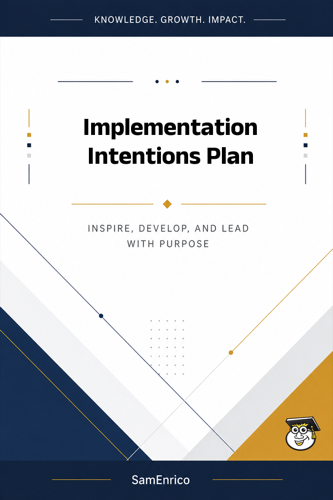
Implementation Intentions Plan eBook
Use when then statements to automate habit trigger
Use when then statements to automate habit triggers in specific situations.
Formats
Free sample
Chapter 1: The Resolution Graveyard--–- Every year, millions of people make the same mistake. They believe that wanting something badly enough is the same as doing it. They set goals with genuine enthusiasm, write them down with a sense of purpose, and promise themselves that this time will be different. And every year, by the second week of February, the vast majority of them have already failed. Not because they lacked desire.
Not because they lacked intelligence. Not even because they lacked discipline. They failed because they never told their brain one critical piece of information: when.The Most Depressing Statistic in Self-Improvement Let us begin with a number that should disturb you: 80 percent.That is the failure rate of New Year's resolutions by the second week of February. Not by December. Not by June.
By the second week of February. Within six weeks of making a solemn promise to themselves, four out of five people have already abandoned their goal.But here is what makes that statistic truly disturbing. The people who fail are not lazy. They are not stupid. They are not morally deficient.
In study after study, researchers have found that the people who break their resolutions are statistically identical to the people who keep them—at least on every measurable variable of motivation, intelligence, and self-control. The only difference is not in who they are but in how they planned.This chapter is about that difference. It is about the space between deciding to act and actually acting—a space that心理学家 call the intention-action gap. And by the time you finish reading these pages, you will understand why you have failed at habits in the past, why it was never your fault, and what single change will make failure virtually impossible going forward.The Day Sarah Decided to Change Consider Sarah. She is thirty-four years old, a marketing manager at a mid-sized firm, and she has three goals for the new year: exercise more, save money, and spend less time on her phone.
On January 1st, she writes these goals in a new notebook. She feels a surge of optimism. She buys running shoes, downloads a budgeting app, and sets a screen-time limit. She is ready.By January 15th, she has exercised four times. She has saved sixty dollars.
Her screen time is down twelve percent. She feels proud.By January 30th, she has exercised once in the last ten days. She has transferred no money to savings. Her screen time is back to December levels. She feels confused.By February 10th, she has abandoned all three goals.
She tells herself she lacks willpower. She tells herself she is not disciplined enough. She tells herself that some people are just built differently.She is wrong about all of it.Sarah did not fail because she lacked willpower. She failed because she never told her brain when to exercise, when to save money, and when to put down her phone. She had intentions—beautiful, noble, specific intentions.
She had the "what" perfectly clear in her mind. But she did not have the "when," the "where," or the "how." And without those three elements, her brain treated her resolutions as abstract wishes rather than executable commands.The Science of the Intention-Action Gap The intention-action gap is not a metaphor. It is a measurable neurological phenomenon. When you form a goal—"I want to exercise more"—your brain activates the prefrontal cortex, the region responsible for long-term planning and abstract reasoning. This is the part of your brain that can imagine a future version of yourself: fitter, wealthier, more focused.
It is a remarkable ability. No other animal can mentally time-travel to a better version of itself.But here is the problem. The prefrontal cortex is slow. It is energy-intensive. And most critically, it is not connected directly to motor output.
You cannot think your way into action. The prefrontal cortex can want things all day long, but it cannot actually do things. Doing requires the activation of different neural circuits—circuits that respond not to abstract desires but to concrete triggers.Think of it this way. Your brain has two operating systems. System One is fast, automatic, and energy-efficient.
It runs habits, routines, and reflexive responses. When you drive home from work and suddenly realize you cannot remember the last ten minutes of the journey, that is System One. It handled the driving while your conscious mind wandered elsewhere. System Two is slow, deliberate, and energy-hungry. It handles novel problems, complex calculations, and willpower.
When you are learning to drive a manual transmission for the first time, that is System Two. Every shift requires conscious attention.The problem with goals is that they live in System Two. You have to consciously remember them, consciously choose them, and consciously override whatever impulse is currently pulling you in a different direction. That is exhausting. And because it is exhausting, you can only do it for so long before your brain defaults back to System One—which, remember, has no memory of your goals whatsoever.This is why Sarah failed.
Her goal to exercise lived in System Two. Every day, she had to consciously decide to exercise. And every day, that decision competed with a hundred other decisions: whether to hit snooze, whether to check email, whether to make coffee first, whether to sit down "just for a minute." Each decision drained a little more of her finite willpower. By the time she actually needed to decide whether to put on her running shoes, she had nothing left.Why Willpower Is Not the Answer There is a persistent myth in self-help culture that success is primarily a matter of willpower. If you just try harder, if you just want it badly enough, if you just develop more discipline, you will succeed.
This myth is comforting because it suggests that failure is always within your control. But it is also wrong, and worse than wrong—it is actively harmful.The research on willpower is clear. Willpower is a finite resource that depletes with use. In the famous radish experiment, psychologists Baumeister and colleagues asked one group of participants to resist eating freshly baked chocolate chip cookies while eating radishes instead. Another group was allowed to eat the cookies.
Both groups were then given a difficult puzzle to solve. The radish-eaters gave up on the puzzle in half the time of the cookie-eaters. Why? Because they had already exhausted their willpower resisting the cookies. They had nothing left for the puzzle.This depletion effect has been replicated dozens of times.
Every decision you make, every impulse you resist, every goal you hold in mind draws from the same limited pool of self-control. And here is the kicker: the pool is smaller than you think.In one study, researchers found that judges hearing parole cases were far more likely to grant parole in the morning than in the afternoon. As the morning wore on, the approval rate dropped steadily. Then, after the judges took a lunch break, the approval rate jumped back up. The judges were not consciously biased.
They were simply exhausted. After making hundreds of small decisions, they had no willpower left to carefully consider a prisoner's…
This is the end of the free sample. Get the eBook to keep going. Buy now
About this book
Details
- Author
- Trimble Virgilio
- Publisher
- SamEnrico
- Language
- English
- Genre
- Non-Fiction, Self-Help, Planning
- Released
- 2026-06-11
- Pages (approx.)
- 137
- Available as
- eBook, Audiobook

Read better in the ZLOADR app
Your eBooks on your phone or tablet. Sign in with your SamEnrico account and start reading.
More by Trimble Virgilio
 Meditation For Busy People ManualTrimble Virgilio$11.99
 Hospital Visitor Conversation GuideTrimble Virgilio$11.99
 Habit Rehearsal VisualizationTrimble Virgilio$11.99
 Walking Meditation for SeniorsTrimble Virgilio$11.99
 The Last Oath of Sir Balin: The Knight Who Cursed CamelotTrimble Virgilio$11.99
 The Alchemist's Fire: Heron of Alexandria and the Birth of AutomationTrimble Virgilio$11.99
 How to Become a Cleaner-touch-up WorkerTrimble Virgilio$11.99
 Freemium Retention GuideTrimble Virgilio$12.99
 One Page Amazon Seller ManualTrimble Virgilio$12.99
 Understanding Gonadal Dysgenesis MixedTrimble Virgilio$17.99
 PotterTrimble Virgilio$11.99
You may also like
 Pomodoro For OutliningNeville Adrianne$11.99
 Prospective Memory and SleepToler Elenora$11.99
 Study Schedule BlueprintQuinones Katharyn$11.99
 The Remote Weekly Review GuideEsparza Taren$11.99
 Daily Scheduling Master PlanHaag Melvin$11.99
 Atomic Habits For PlanningErinn Palma$11.99
 Weekly Review Habit GuideNeville Dallas$11.99
 The SMART Goals WorkbookBurgos Verda$11.99
 Morning Planning SessionFlorence Windy$11.99
 Week Planning Scheduling SystemKerns Madelene$11.99
 Study Schedule Planning GuideThornhill Soon$11.99
 Trigger Anticipation PlanningWesley Sean$11.99