
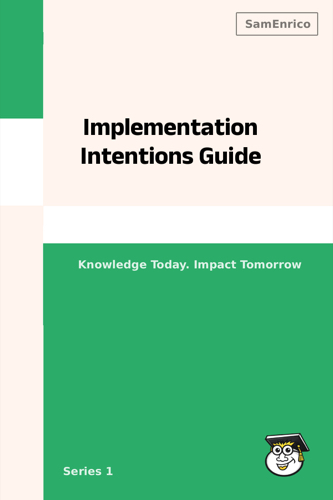
Implementation Intentions Guide eBook
Use 'if then' planning to automate starting trigge
Use 'if then' planning to automate starting triggers.
Formats
Free sample
Chapter 1: The Willpower Trap--Most people who set out to change their lives fail not because they lack ambition, not because they lack desire, and certainly not because they lack the intelligence to know what to do. They fail because they have been sold a dangerous lie disguised as inspiration. The lie whispers that success belongs to those who want it badly enough, that failure is simply a lack of grit, and that if you just tried harder—really tried, this time—everything would finally fall into place.This lie is the foundation of a $10 billion self-help industry that profits from your repeated failure. Every January, millions of people resolve to lose weight, exercise more, save money, or finally finish that project. They feel fired up, committed, and absolutely certain that this year will be different.
By February, most have quietly abandoned their goals. By March, many feel a familiar shame creeping in: What is wrong with me? Why can’t I just do what I said I would do?The answer, as you will discover in this chapter, is nothing. Nothing is wrong with you. The problem is not a defect in your character.
The problem is a flaw in the strategy that virtually everyone uses to pursue their goals. You have been trying to win a game using the wrong set of rules, and no amount of effort can fix a broken design.The Most Expensive Word in Self-Help There is one word that appears in almost every goal statement, and that word is the most expensive word in self-help because it has cost readers of this genre billions of dollars in wasted books, courses, and coaching programs. That word is want.I want to lose weight. I want to be more productive. I want to stop procrastinating.
I want to be a better partner. I want to save money.These are called goal intentions. They are statements that specify a desired end state. And they are almost completely useless for producing actual behavior change. This is not an opinion.
It is a conclusion drawn from decades of psychological research, most notably the work of psychologist Peter Gollwitzer and his colleagues at New York University and the University of Konstanz.Gollwitzer spent years studying why people fail to act on their intentions. He found that the relationship between wanting and doing is shockingly weak. In one classic study, Gollwitzer and Brandstätter (1997) asked university students about their intentions to complete a critical report over winter break. Nearly all of them—upwards of 80 percent—reported a strong intention to complete the work. They wanted to do it.
They knew it was important. They had every reason to follow through.When the researchers followed up after the break, fewer than 20 percent had actually completed the report. Eighty percent of people with strong, genuine, heartfelt intentions had failed to translate those intentions into action.This gap between what we intend to do and what we actually do has a formal name in the psychological literature: the intention-behavior gap. It is one of the most reliable and robust findings in the study of human action. Knowing what you want does not predict doing it.
Wanting more does not close the gap. Trying harder does not close the gap. The gap persists because it is not a motivational problem. It is an architectural problem.Why Your Brain Sabotages Your Best Intentions To understand why goal intentions fail, you need to understand something about how your brain is wired. The human brain did not evolve to help you achieve long-term goals in a modern environment filled with distractions, processed foods, and infinite scrolling.
It evolved to keep you alive on the savanna, where the most important skill was responding to immediate threats and opportunities.The part of your brain responsible for conscious planning and self-control is the prefrontal cortex. This is the seat of your willpower, your ability to deliberate, and your capacity to override impulses. It is also small, slow, and metabolically expensive. Every time you use your prefrontal cortex to resist a cookie, force yourself to open a textbook, or bite back an angry comment, you burn through a finite resource that psychologists call ego depletion.The rest of your brain—particularly a set of structures called the basal ganglia—operates on an entirely different principle. The basal ganglia run on autopilot.
They handle habits, routines, and automatic responses without any conscious effort. When you brush your teeth, drive a familiar route, or reach for your phone without thinking, you are running on basal ganglia processing. This system is fast, energy-efficient, and nearly impossible to fatigue.Here is the problem that no amount of willpower can solve: goal intentions live in the prefrontal cortex. They require conscious effort to maintain. You have to remember your goal, remind yourself why it matters, and deliberately choose to act.
Every step of that process drains your limited cognitive resources. And because the basal ganglia are constantly running competing automatic programs—reaching for the phone, opening the fridge, clicking on a notification—you are fighting an uphill battle against your own neural architecture.This is why sheer determination almost always fails in the long run. You are asking the smallest, most fatigable part of your brain to override the largest, most efficient part of your brain, repeatedly, every single day, forever. That is not a battle you can win. It is a battle you were never meant to fight.The Moment Everything Changes But there is a way out.
There is a strategy that does not require you to overpower your basal ganglia with your prefrontal cortex. Instead, it invites you to use your prefrontal cortex for exactly one moment of deliberate planning, after which you delegate the behavior to your basal ganglia, where it runs automatically.That strategy is the implementation intention. An implementation intention takes the following specific form:If [situation X occurs], then I will perform [behavior Y].That is it. A single "If-Then" statement that specifies exactly when and where you will act. Not "I want to exercise more," but "If it is 7:00 AM on a weekday, then I will put on my running shoes and step outside my front door." Not "I want to eat healthier," but "If I open the refrigerator, then I will take out a container of cut vegetables before I look at anything else." Not "I want to be less distracted at work," but "If I sit down at my desk, then I will turn my phone face down and close all browser tabs except the one I need."The difference between a goal intention and an implementation intention is not a matter of degree.
It is a difference in kind. A goal intention leaves the moment of action unspecified, which means you must consciously decide to act every single time. An implementation intention attaches a specific action to a specific trigger, which means the action begins to run automatically as soon as the trigger appears.Gollwitzer and his colleagues have tested this difference across hundreds of studies, involving thousands of participants, in domains ranging from health behavior to academic performance to emotional regulation. The results are stunningly consistent.…
This is the end of the free sample. Get the eBook to keep going. Buy now
About this book
Details
- Author
- Connell Collette
- Publisher
- SamEnrico
- Language
- English
- Genre
- Non-Fiction, Self-Help, Behavioral Planning
- Released
- 2026-06-08
- Pages (approx.)
- 150
- Available as
- eBook, Audiobook

Read better in the ZLOADR app
Your eBooks on your phone or tablet. Sign in with your SamEnrico account and start reading.
More by Connell Collette
 The Sharice Davids StoryConnell Collette$11.99
 Morning Email Batching GuideConnell Collette$11.99
 Alcoholism and Grief DrinkingConnell Collette$11.99
 Enteric Nervous SystemConnell Collette$11.99
 Senses Master GuideConnell Collette$11.99
 Self Talk For Difficult PeopleConnell Collette$11.99
 Adult Day Care GuideConnell Collette$11.99
 The Last Stand of the Pirate QueenConnell Collette$11.99
 The Amber Road: Dutch Merchants and the Birth of Global TradeConnell Collette$11.99
 The Essential Guide to PsychedelicConnell Collette$11.99
 How to Produce RefrigeratorsConnell Collette$11.99
 How to Produce Alkyd Primer Exterior PaintConnell Collette$11.99