
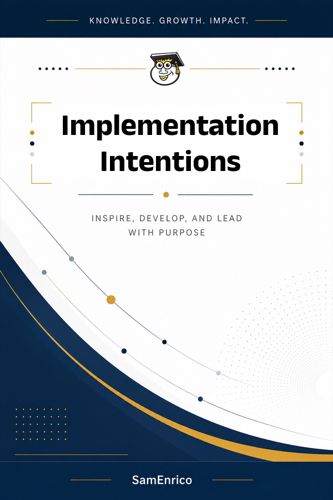
Implementation Intentions Audiobook
undefined
by Hartley Dean
undefined
Formats
Free sample
Chapter 1: The Billion-Dollar Mistake--Every January 1st, approximately 40% of Americans make a New Year's resolution. By January 8th, one quarter of them have already broken it. By February 1st, 80% have failed. By December, only 8% will report any lasting success.Here is what makes this statistic genuinely disturbing: those 40% of people who made resolutions were not the unmotivated ones. They were the motivated ones.
They cared enough to make a public promise to themselves. They wanted to exercise more, save money, eat better, or spend more time with family. They had what psychologists call a goal intention—a clear desire to achieve a specific outcome.And they failed anyway.Not because they lacked motivation. Not because they were lazy or undisciplined or morally weak. They failed because motivation, by itself, is almost completely useless when it comes to translating a want into a do.
They failed because they made the billion-dollar mistake: they confused wanting with planning.This is the Good Intention Paradox, and it is one of the most replicable findings in the science of human behavior: People who strongly want to change their behavior fail at roughly the same rate as people who barely want to change at all.The self-help industry generates over one billion dollars annually selling motivation, inspiration, and goal-setting advice. And yet, across every domain—health, finance, productivity, relationships—the failure rate for personal change remains stubbornly high. We are spending a billion dollars a year on the wrong solution to the right problem.Consider the research. In a meta-analysis of more than ninety studies, psychologists Peter Gollwitzer and Paschal Sheeran found that the correlation between goal intention strength and actual behavior change is, at best, modest. Among people with "low" intention to exercise, only about 20% actually exercise regularly.
Among people with "high" intention—the ones who say "I really, really want to do this"—only about 35% succeed. A fifteen-point difference, yes. But that means 65% of highly motivated people still fail.Sixty-five percent.If motivation were the answer, that number would be reversed. If wanting it badly enough were the solution, the highly motivated group would succeed at 80% or 90%. Instead, the vast majority of people who desperately want to change—who can feel the urgency, who have written down their goals, who have told their friends, who have bought the expensive planner and the motivational calendar—still end up on the couch, wondering what is wrong with them.Nothing…
This is the end of the free sample. Get the Audiobook to keep going. Buy now
About this book
Details
- Author
- Hartley Dean
- Publisher
- SamEnrico
- Language
- English
- Genre
- Non-Fiction, Self-Help / Implementation
- Released
- 2026-06-07
- Pages (approx.)
- 145
- Available as
- eBook, Audiobook

Listen in the VoxFlicks app
Audiobooks and audio dramas wherever you go. Sign in with your SamEnrico account and press play.
More by Hartley Dean
 Personal OKR GuideHartley Dean$12.99
 International Trade Pandemic GuideHartley Dean$11.99
 The Foster Care Quiet ChildHartley Dean$11.99
 HGH Decline Natural PreventionHartley Dean$11.99
 Networking Weekly ReviewHartley Dean$11.99
 Loving Kindness for OptometristsHartley Dean$11.99
 Church Building Memory PalaceHartley Dean$11.99
 Couch To 5K PlanHartley Dean$11.99
 The Alchemists of Ale: Renaissance Brewers and the Birth of Modern BeerHartley Dean$11.99
 How to Produce Masonry MaterialsHartley Dean$11.99
 A Collector's Handbook to the Morris Six MSHartley Dean$11.99
 Agent Background Checks IndiaHartley Dean$12.99