
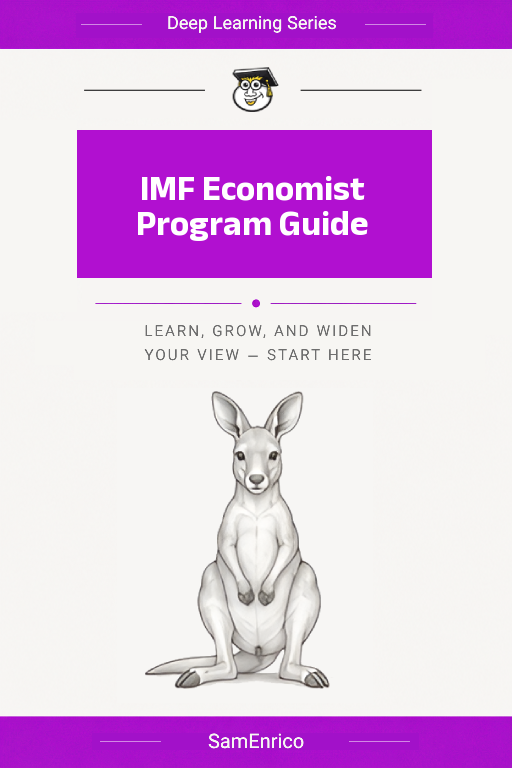
IMF Economist Program Guide eBook
Apply for three year program at International Mone
by Best Dorian
Apply for three year program at International Monetary Fund requiring PhD in economics for macro focused roles.
Formats
Free sample
Chapter 1: The Firefighter’s Dilemma--–- You have spent five years learning to build economic models that no one outside your dissertation committee will ever read. You can solve a DSGE system in your sleep. Your regression tables are works of art. But when a country’s currency collapses overnight and the finance minister is screaming for answers, none of that matters if you cannot write a policy memo that arrives before the bond markets open.This is the firefighter’s dilemma. The International Monetary Fund does not hire economists to publish papers.
It hires them to extinguish economic fires. And the Economist Program—the Fund’s three-year rotational fellowship for newly minted Ph Ds—is the most selective, most intense, and most career-accelerating training ground for macroeconomic firefighters in the world.If you are reading this book, you already know the basic facts. You have a Ph D in economics, or you are about to get one. You are under thirty-four years old—or very close to it. You have spent years mastering general equilibrium theory, panel econometrics, and perhaps a programming language or two.
You have seen the IMF Economist Program listed on job boards, heard rumors of the six-figure starting salary, and noticed that your classmates who made it through now work in Washington D.C., traveling the world and advising finance ministers. You want that life. You deserve that life. But you have no idea how to actually get it.That is not your fault. The IMF’s recruitment process is deliberately opaque.
The eligibility rules are strict but inconsistently communicated. The interview process involves written tests, panel grilling, and a simulated “mission” exercise that mimics a real country crisis—none of which are taught in any Ph D program. And the candidates who succeed are not necessarily the best economists. They are the ones who understand something that the rest of the world misses: the Fund does not want brilliant academics. It wants brilliant operators who happen to have Ph Ds.This chapter will rewire how you think about the IMF, the Economist Program, and your own candidacy.
You will learn why the Fund’s operational culture rewards speed over precision, judgment over complexity, and policy relevance over academic elegance. You will understand the difference between being a researcher and being a mission economist—and why the latter is far harder to learn on the job. And you will confront a choice that every EP applicant must make: are you willing to trade the freedom of academic inquiry for the adrenaline of real-time crisis management?By the end of this chapter, you will know whether the EP is truly for you. And if it is, you will have the foundation for everything that follows in this book—from mastering the Financial Programming framework in Chapter 5 to surviving the simulated mission in Chapter 11.The Three Words That Explain Everything The IMF’s internal culture can be distilled into three words: mission-ready immediacy.Everything the Fund does—every meeting, every memo, every phone call with a finance ministry—is organized around the next mission. An IMF “mission” is a two- to three-week visit to a member country, during which a team of economists meets with government officials, central bankers, and private sector representatives to assess economic conditions and negotiate policy adjustments.
If a country has an active IMF lending program, the mission is when program targets are reviewed and new conditions are set. If the country is under surveillance (Article IV consultation), the mission is when the team gathers data for the annual health check.Here is what most Ph D economists do not understand: a mission is not a research trip. You do not fly to Nairobi or Jakarta to test a hypothesis or collect panel data. You fly there to produce actionable recommendations within a fixed timeframe, often under severe time pressure, with incomplete information, while managing political tension between the government and the Fund.This is the firefighter’s dilemma in practice. When a building is burning, you do not stop to build a perfect model of flame propagation.
You grab a hose, make a judgment call, and move. The IMF operates the same way. A mission economist might have forty-eight hours to analyze a country’s fiscal accounts, identify a looming financing gap, and propose adjustment measures—all while the mission chief is demanding answers and the finance minister is pushing back.The candidates who thrive in the EP are not the ones who can derive the most elegant theoretical result. They are the ones who can look at a spreadsheet of messy, inconsistent data, spot the inconsistency, correct it with a reasonable assumption, and produce a memo that a policymaker can understand before lunch.This is the central theme of this entire book. Every subsequent chapter—from technical skills to interview tactics to mission survival—builds on the premise that the EP is looking for a specific type of economist: technically deep, operationally fast, and politically aware.
If you cannot accept that trade-off, you should stop reading now. If you can, then let us go deeper.What the Economist Program Actually Is (And Is Not)Before we dissect the application process, you need a clear, honest definition of the EP. Based on official IMF documentation, insider accounts, and analysis of past cohorts, here is the definitive description.The Economist Program is a three-year rotational fellowship for Ph D economists, consisting of two eighteen-month assignments—typically one in an area department (geographic focus) and one in a functional department (thematic focus). EPs start at the A12 grade level, receive intensive mentorship, participate in mission travel from the first year, and have a conversion rate of approximately ninety-five percent to regular staff positions at the end of the three years (provided they receive satisfactory performance ratings).That is the official version. Here is the unofficial version that the IMF will never tell you.The EP is a three-year auditions process for a career that most economists will never access.
The ninety-five percent conversion rate sounds high, and it is—but it conceals the fact that the EP selection process is so brutal that only the top few percent of applicants ever get to take the audition. The Fund invests enormous resources in each EP (salary, training, mentorship, mission travel), so it has a strong incentive to convert almost everyone who makes it through the door. But getting through the door is the real challenge.Moreover, the EP is not a training program in the traditional sense. You will not spend months in classrooms. You will learn by doing—usually by being thrown into a mission with minimal preparation, given a specific task (e.g., “analyze the fiscal outlook for the next three years”), and expected to produce work that meets the standards of senior economists who have been doing this for decades.
The learning curve is vertical. The first six months are often described by EP alumni as “drinking from a fire hose while running a marathon.”Finally, the EP is not a path to academic stardom. Yes, IMF economists publish research. The Fund’s Working Paper series is well-regarded, and some EPs go on to…
This is the end of the free sample. Get the eBook to keep going. Buy now
About this book
Details
- Author
- Best Dorian
- Publisher
- SamEnrico
- Language
- English
- Genre
- Non-Fiction, Non-Obvious Career
- Released
- 2026-05-29
- Pages (approx.)
- 153
- Available as
- eBook, Audiobook

Read better in the ZLOADR app
Your eBooks on your phone or tablet. Sign in with your SamEnrico account and start reading.
More by Best Dorian
 Carnegie Libraries LegacyBest Dorian$11.99
 Twitch Streamer Viewer EnvyBest Dorian$11.99
 Social Media and Eating DisordersBest Dorian$11.99
 Long Breath AwarenessBest Dorian$11.99
 The Vaccine Communication ScriptBest Dorian$11.99
 The Orphanage Childhood GuideBest Dorian$11.99
 First Responder Trauma DreamsBest Dorian$11.99
 Imposter Syndrome For Single ParentsBest Dorian$11.99
 Ballet Dancer Pressure GuideBest Dorian$11.99
 The Silent Codebreakers: How a Whistleblower Exposed the NSA’s Darkest SecretBest Dorian$11.99
 The Boxers' Last Stand: How a Secret Society Defied the WorldBest Dorian$11.99
 The Iron Spine of Europe: The Men Who Built the ContinentBest Dorian$11.99
You may also like
 Hong Kong Handover 1997Dunn Johnnie$11.99
 Zumba For Postnatal Recovery CourseNeal Christian$11.99
 Zumba for BeginnersLadner Nikia$11.99
 YouTube Comment Mining GuideHumes Pandora$12.99
 Worry Box MeditationCarlin Rudy$11.99
 Workplace Stress MeditationNguyen Lynn$11.99
 Workplace Stress and Sleep RepairHawley Ivory$11.99
 Workplace Perfectionism CureDelaney Jeffry$11.99
 Workplace Injustice Anger GuideWallen Isabelle$11.99
 Work Addiction and Burnout LinkGreenwood Ester$11.99
 Women in Yoga and WellnessBeattie Galina$11.99
 Women in Stand Up ComedyChun Evangeline$11.99