
Non-FictionSelf-HelpFast Presentations
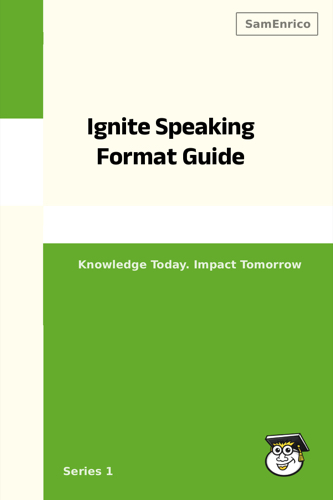
Ignite Speaking Format Guide eBook
Master the 20 slides, 15 seconds each fast paced f
by Moll Merissa
Master the 20 slides, 15 seconds each fast paced format.
Formats
Free sample
Chapter 1: The 300-Second Ceiling--–- On a Tuesday evening in March 2006, a room full of designers in Seattle watched a speaker click through forty-seven slides in sixty minutes. Forty-seven. By slide twelve, people were checking their phones. By slide twenty, someone in the back row was openly napping. By slide forty, the speaker had lost the room so completely that when he finally said "thank you," the applause was not relief for him—it was relief for themselves.
That night, over cheap beer and the specific exhaustion of having sat through yet another terrible presentation, a small group of designers asked a question that would eventually spread to conferences, boardrooms, and stages around the world: what is the shortest amount of time it takes to say something worth hearing?The answer they landed on was five minutes.Not because five minutes is arbitrary, but because five minutes is the outer limit of what a human being can hold in working memory without the structure of a story. Five minutes is the length of a song that makes you cry. Five minutes is how long it takes to run one mile if you are in decent shape. Five minutes is the difference between a pitch that gets a "tell me more" and a pitch that gets a "send me the deck." And when you pair five minutes with exactly twenty slides, each advancing automatically after fifteen seconds, you create something that did not exist before: a container so tight that it forces every single word to earn its place.This book is about that container. It is about the Ignite format—twenty slides, fifteen seconds each, no going back—and it is about why learning to speak inside these constraints will make you a better speaker in every other context.
But before we get to the how, we need to talk about the why. Because if you do not understand why five minutes is the new twenty, you will treat this format as a gimmick rather than the discipline it is. And that would be a mistake.The Problem with Endless Time We have been trained to believe that more time equals more value. A sixty-minute keynote is more impressive than a thirty-minute talk. A ninety-minute workshop is more substantial than a forty-five-minute one.
A three-day offsite must be better than a one-day offsite because look at all those hours on the schedule. This is a lie. It is one of the most persistent and damaging lies in professional communication.Here is what actually happens when you give a speaker sixty minutes. The first five minutes are spent clearing their throat—thanking the organizer, acknowledging the previous speaker, telling a story about the weather or the flight in or how happy they are to be here. The next ten minutes are spent establishing credibility, which is a polite way of saying listing credentials that the audience will forget by the time they reach the parking lot.
The middle twenty minutes contain perhaps ten minutes of actual insight buried inside digressions, repeated points, and the speaker trying to remember what comes next. The final ten minutes are spent summarizing what they already said, asking if there are any questions, and then answering two questions while promising to "follow up offline" on the other seven. Then they say thank you, and the audience stands up having retained maybe three things, none of which will change their behavior.This is not a failure of individual speakers. This is a failure of the format. When you give someone unlimited time, they will use it.
Not because they are lazy or incompetent, but because the human brain does not naturally compress. We expand to fill available space. That is why a one-hour meeting never takes thirty minutes. That is why a two-page email never takes one page. That is why the presentation you said would be "just a quick ten minutes" somehow became forty-five.
Time is not a constraint; it is a permission slip to be less disciplined.The Ignite format removes that permission slip.The Fifteen-Second Contract Let us be precise about what the format actually requires. You will create exactly twenty slides. Each slide will advance automatically after fifteen seconds. You cannot click to linger on a slide. You cannot click to go back to a previous slide.
You cannot pause. You cannot restart. When the fifteen seconds are up, the slide changes whether you are ready or not. This is not a technical limitation; it is a psychological contract between you and the audience. The contract says: I will not waste your time.
I will not drone. I will not clear my throat. I will give you one idea, one image, and fifteen seconds, and then I will move on.Fifteen seconds is not a long time. It is roughly the length of two deep breaths. It is the time it takes to tie a shoe or send a short text message or wait for an elevator door to close.
But fifteen seconds is also the approximate outer limit of focused attention before the brain begins to wander. Cognitive psychologists have known this for decades: the human mind does not sustain passive attention indefinitely. It operates in bursts. Those bursts last between ten and twenty seconds before the brain checks out, re-evaluates, and either re-engages or drifts. By forcing a slide change every fifteen seconds, the Ignite format rides this natural rhythm.
Just as the audience is about to look away, the screen changes. Just as their attention begins to fade, a new image appears. Just as they think they know where you are going, you are somewhere else.This is not manipulation. This is respect. You are acknowledging that your audience has limits, and you are designing your talk to work within those limits rather than fighting against them.The Cognitive Science of Speed You do not need a Ph D in psychology to use this format effectively, but understanding a few basic principles will help you see why the rules exist and why breaking them—even a little—comes at a cost.The first principle is cognitive load theory.
Every human being has a limited amount of working memory. That working memory can hold approximately four to seven discrete pieces of information at once. When you give a presentation, every element competes for that limited space: your words, your slides, your body language, the room temperature, the notification buzzing in someone's pocket. If you exceed the audience's cognitive load, they stop processing. They do not choose to stop.
Their brain simply runs out of room and begins discarding information. The first thing discarded is usually the least important thing—which, in most presentations, is the nuance, the evidence, and the call to action. The audience remembers your opening joke and your closing slide and almost nothing in between.The Ignite format reduces cognitive load by limiting what can appear on any single slide. No bullet points. No paragraphs.
No complex diagrams. At most, one image and three words. That is it. When the audience looks at your slide, they are not reading. They are not decoding.
They are not trying to figure out the relationship between six bullet points and what you just said. They are…
This is the end of the free sample. Get the eBook to keep going. Buy now
About this book
Details
- Author
- Moll Merissa
- Publisher
- SamEnrico
- Language
- English
- Genre
- Non-Fiction, Self-Help, Fast Presentations
- Released
- 2026-06-10
- Pages (approx.)
- 137
- Available as
- eBook, Audiobook

Read better in the ZLOADR app
Your eBooks on your phone or tablet. Sign in with your SamEnrico account and start reading.
More by Moll Merissa
 Bob's Burgers Voice StoriesMoll Merissa$11.99
 Gen Z Experience TravelMoll Merissa$11.99
 Multiple Sclerosis ED GuideMoll Merissa$11.99
 Calcium Without Dairy CourseMoll Merissa$11.99
 Leverage Ratio Step DownsMoll Merissa$11.99
 Goodwill Impairment TestMoll Merissa$12.99
 Perimenopause Pelvic FixMoll Merissa$11.99
 Creative Habits for AccountantsMoll Merissa$11.99
 The Vanishing Witness: A Global Hunt for JusticeMoll Merissa$11.99
 How to Become a Parts RemoverMoll Merissa$11.99
 Frost and Flame: The Hidden Love of the Troll King and the Fire ElfMoll Merissa$11.99
 How to Produce CountersMoll Merissa$11.99
You may also like
 Hong Kong Handover 1997Dunn Johnnie$11.99
 Zumba For Postnatal Recovery CourseNeal Christian$11.99
 Zumba for BeginnersLadner Nikia$11.99
 YouTube Comment Mining GuideHumes Pandora$12.99
 Worry Box MeditationCarlin Rudy$11.99
 Workplace Stress MeditationNguyen Lynn$11.99
 Workplace Stress and Sleep RepairHawley Ivory$11.99
 Workplace Perfectionism CureDelaney Jeffry$11.99
 Workplace Injustice Anger GuideWallen Isabelle$11.99
 Work Addiction and Burnout LinkGreenwood Ester$11.99
 Women in Yoga and WellnessBeattie Galina$11.99
 Women in Stand Up ComedyChun Evangeline$11.99