
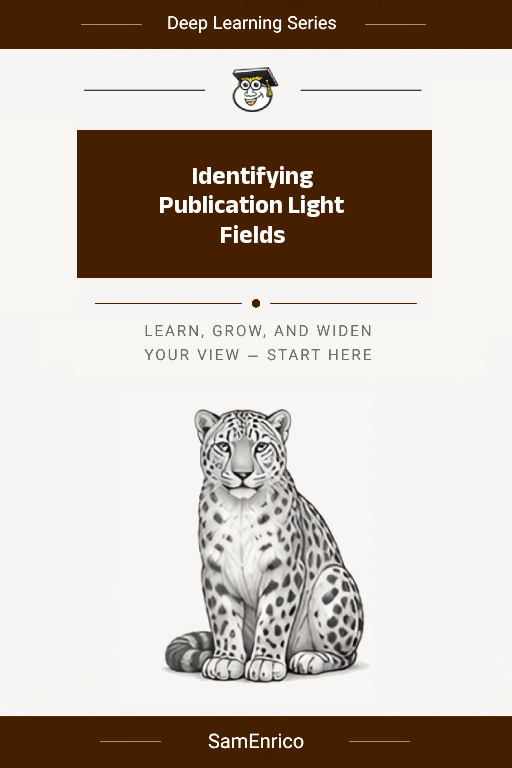
Non-FictionStudent's ShortcutFields
Identifying Publication Light Fields eBook
Target PhD programs in fields where pre-doctoral p
Target PhD programs in fields where pre-doctoral publications are rare, like humanities or engineering.
Formats
Free sample
Chapter 1: The CV Lie...--Every year, fifty thousand ambitious students sit down to write their Ph D applications. They have high GPAs. They have glowing recommendation letters. They have research experience. And nearly forty thousand of them will be rejected.The rejection letter rarely tells the truth.
It says things like "the applicant pool was exceptionally competitive" or "we had limited openings in your area of interest." But the real reason, the one that admissions committees whisper about in closed-door meetings but rarely write down, is simpler and more brutal: You did not look like someone who could finish a doctorate.And what makes a candidate look finishable? Publications.Not necessarily good publications. Not even great publications. Just evidence that you have taken a project from question to conclusion and submitted it to the judgment of strangers. A conference proceeding.
A data note. A book review. A preprint with a submission receipt attached. Anything that moves your work out of the privacy of your laptop and into the public, critical, indifferent world.This is the paradox that crushes more Ph D dreams than bad grades ever will: you are expected to have published before you start a program that is supposed to teach you how to publish. No one tells you this explicitly.
No graduate school website says "publications required." But the comparison between admitted students and rejected students tells an unmistakable story. The ones who get in have something on their CV under "Publications" or "Selected Presentations." The ones who don't, don't.This book is for the second group.It is for the history major who wrote a brilliant seminar paper on eighteenth-century trade routes and has no idea how to turn it into something a journal would accept. It is for the electrical engineering student who helped design a sensor array for a lab project but was listed fourth on the author list and worries that doesn't count. It is for the career changer who has research ideas but no academic home, no advisor, no institutional affiliation to lend credibility.It is for anyone who has been told, directly or indirectly, that they need to publish before applying to a Ph D—but has never been told how.The answer is not what you think. You do not need to write a masterpiece.
You do not need to land a spot in Nature or American Historical Review. You do not need an advisor holding your hand through peer review. What you need is something this book calls a Publication Light Field.The Definition That Will Save Your Career A Publication Light Field is a category of publication venue that shares three specific characteristics, each of which has been engineered to be accessible to pre-doctoral applicants.First, low barriers to entry. The venue accepts submissions from scholars without institutional affiliations. This means you do not need a university email address.
You do not need a Ph D in progress. You do not need a letter from your advisor vouching for you. Undergraduate journals, certain open-access platforms, workshop proceedings, and some conference poster tracks operate on this principle. They evaluate work on its merits, not on the credentials of the person who submitted it.Second, reasonable time to decision. The venue returns a first decision within eight weeks.
This is not fast by commercial standards—your Amazon package arrives in two days—but it is blindingly fast by academic standards. Traditional humanities journals can take eighteen months to return a first review. Elite STEM journals can take six months. A Publication Light Field venue respects the reality that you are applying to Ph D programs on a fixed calendar, usually in December or January, and cannot wait a year to find out whether your submission was accepted.Third, genuine peer review, not a scam. The venue has a real editorial board, a documented peer review process, and a verifiable publication record.
This is the hardest characteristic to verify because the predatory publishing industry has grown explosively over the past decade, specifically targeting desperate pre-doctoral applicants. These predators promise fast acceptance for a fee. They send flattering emails to your inbox. They put your name on a PDF that no serious scholar will ever read or cite. A Publication Light Field venue is the opposite of this.
It is low-barrier but legitimate. It has a reputation you can check, a DOI you can trust, and a presence in standard indexes like the Directory of Open Access Journals or conference proceedings that appear in IEEE Xplore.These three characteristics—low barriers, reasonable speed, genuine quality—define the Light Field. And here is the counterintuitive truth that most applicants never discover: admissions committees do not care whether you published in a top-tier venue or a Light Field venue. They care whether you published at all.The reason is simple. Ph D programs are not buying your publication record.
They are buying evidence that you can complete a research project. A Light Field publication provides that evidence. A half-finished manuscript that you polished for two years provides nothing but anxiety and lost time.The Two Disciplines, Two Different Panics Before we go any further, we need to acknowledge that "publication" means different things in different parts of the academy. A single book that claims to serve both humanities students and engineering students must reckon with this difference honestly, or it will help no one.Let us start with engineering and its close cousins in the physical sciences, computer science, and applied mathematics.In engineering, the currency of academic legitimacy is the conference proceeding. Major conferences like the IEEE International Conference on Robotics and Automation (ICRA) or the ASME International Mechanical Engineering Congress (IMECE) publish peer-reviewed papers that appear on your CV as citable publications.
The timeline is compressed: you submit in the fall, receive reviews in the winter, present in the spring or summer. From submission to publication, the process often takes less than six months.Engineering also normalizes co-authorship. A typical paper has four to six authors. The first author is usually the student who did most of the work. The last author is usually the principal investigator who secured funding and supervised the project.
The middle authors contributed data, analysis, or writing. In this system, being third author on a lab paper is not a mark of shame. It is evidence that you can work collaboratively, which is a skill engineering Ph D programs actively want.The engineering applicant's panic, therefore, is not about whether they can publish alone. It is about speed and visibility. They worry: My lab moves slowly.
My advisor is too busy to review my draft. The conference deadline just passed. What if I have nothing to show by December?Now consider humanities : history, philosophy, literary studies, classics, art history, and their interpretive cousins.In the humanities, the gold standard is the single-author journal article or the scholarly monograph. The timeline is glacial. You submit an article to a journal.
The editor sends it to two or three peer reviewers. Those reviewers take six months to read it. They recommend revisions. You revise for three months. The editor sends it back to the reviewers for another three months.
Eighteen months after submission, you receive a final decision. If the journal is prestigious, the acceptance rate is under ten…
This is the end of the free sample. Get the eBook to keep going. Buy now
About this book
Details
- Author
- Levesque Arnulfo
- Publisher
- SamEnrico
- Language
- English
- Genre
- Non-Fiction, Student's Shortcut, Fields
- Released
- 2026-05-29
- Pages (approx.)
- 146
- Available as
- eBook, Audiobook

Read better in the ZLOADR app
Your eBooks on your phone or tablet. Sign in with your SamEnrico account and start reading.
More by Levesque Arnulfo
 Rejection Sensitivity Love GuideLevesque Arnulfo$11.99
 Being Late TriggersLevesque Arnulfo$11.99
 The Everyday ImposterLevesque Arnulfo$11.99
 Child Nightmare GuideLevesque Arnulfo$11.99
 Teen Adoption Identity GuideLevesque Arnulfo$11.99
 Sabbatical Programs ImpactLevesque Arnulfo$11.99
 Pet Loss Poetry AnthologyLevesque Arnulfo$11.99
 Fibromyalgia and CostochondritisLevesque Arnulfo$11.99
 Condoleezza Rice PianoLevesque Arnulfo$11.99
 The Celestial Cartographers: How 15th-Century Southeast Asians Charted the MoonLevesque Arnulfo$11.99
 The Bone-Eater of the Andes: The Curse of the YacumamaLevesque Arnulfo$11.99
 Silent Saboteurs: The Betrayal of the Tuskegee AirmenLevesque Arnulfo$11.99
You may also like
 Hong Kong Handover 1997Dunn Johnnie$11.99
 Zumba For Postnatal Recovery CourseNeal Christian$11.99
 Zumba for BeginnersLadner Nikia$11.99
 YouTube Comment Mining GuideHumes Pandora$12.99
 Worry Box MeditationCarlin Rudy$11.99
 Workplace Stress MeditationNguyen Lynn$11.99
 Workplace Stress and Sleep RepairHawley Ivory$11.99
 Workplace Perfectionism CureDelaney Jeffry$11.99
 Workplace Injustice Anger GuideWallen Isabelle$11.99
 Work Addiction and Burnout LinkGreenwood Ester$11.99
 Women in Yoga and WellnessBeattie Galina$11.99
 Women in Stand Up ComedyChun Evangeline$11.99