
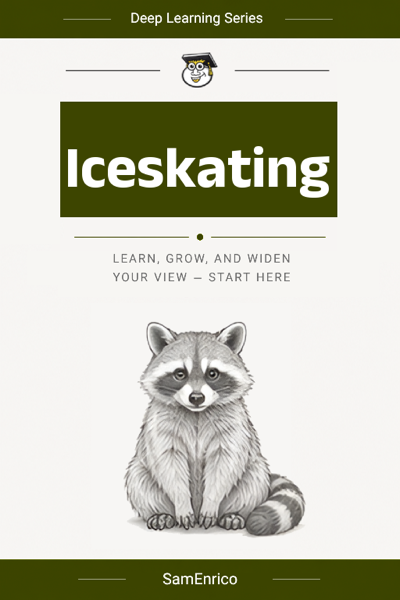
Non-FictionInformativeEducational
Iceskating
A Coursebook on Iceskating
A Coursebook on Iceskating
Formats
About this book
Free sample
Chapter 1: The Frozen Mirror...-- Before the first blade touched ice, humans crossed frozen lakes on animal bones tied with leather—and fell. A lot. This chapter is not about those falls. It is about why, after ten thousand years of slipping, we decided to turn ice into art, sport, and obsession. You are about to learn a physical skill, but first you must understand what you are joining: a story of survival, showmanship, tragedy, and reinvention.
The modern skater who steps onto a rink without knowing this history is like a pianist who has never heard of Beethoven—technically capable, but culturally hollow. So let us begin not with your first stride, but with the first stride anyone ever took on ice.1.1 The Bone Skate Era: When Falling Was Not Optional Long before indoor rinks or figure eights, ice skating was a matter of getting to the other side of a frozen river before the ice cracked. Archaeologists have recovered bone skates dating to approximately 3000 BCE in Scandinavia, made from horse or cattle metatarsals (the long bones of the lower leg). These were not blades in any modern sense: they were flat, slightly polished bone surfaces, strapped to leather boots with no edge to speak of. The skater pushed with a pole—like a modern punter on a Venetian gondola—and slid forward in a straight line.
Turns were nearly impossible. Stops were accomplished by dragging the pole or simply falling.Why did this method persist for thousands of years? Because it worked. The Netherlands, with its extensive network of frozen canals, became the epicenter of bone-skate transport by the 13th century. Farmers skated to market.
Mail carriers delivered letters on ice. Children skated to school. In fact, the Dutch word for skate, schaats, derives from an Old Frankish word meaning "to stride" or "to move on foot." There was no artistry, no competition, no judging. There was only utility.But utility breeds technique. By the 14th century, Dutch skaters had discovered that angling the flat bone slightly created a primitive edge—not sharp enough to carve, but sufficient to change…
This is the end of the free sample. Get the eBook to keep going. Buy now
Contents
- Chapter 1
- Chapter 2
- Chapter 3
- Chapter 4
- Chapter 5
- Chapter 6
- Chapter 7
- Chapter 8
- Chapter 9
- Chapter 10
- Chapter 11
- Chapter 12
Details
- Author
- Cisneros Cassy
- Publisher
- SamEnrico
- Language
- English
- Genre
- Non-Fiction, Informative, Educational
- Released
- 2026-05-09
- Pages (approx.)
- 135
- Available as
- eBook, Audiobook

Read better in the ZLOADR app
Your eBooks on your phone or tablet. Sign in with your SamEnrico account and start reading.
More by Cisneros Cassy
 Pinterest Wedding Comparison GuideCisneros Cassy$11.99
 Chinese NEV Subsidy EvolutionCisneros Cassy$11.99
 Narcissistic Partner Recovery GuideCisneros Cassy$11.99
 CASL Email Compliance GuideCisneros Cassy$11.99
 The Serpent’s Gambit: How a Forgotten Pharaoh Outwitted the GodsCisneros Cassy$11.99
 The Billion-Dollar Bet That Broke a Nation: The Icelandic Financial CollapseCisneros Cassy$11.99
 EU Green Subsidy HandbookCisneros Cassy$12.99
 Automated Concept Mapping GuideCisneros Cassy$12.99
 Understanding I Cell DiseaseCisneros Cassy$17.99
 How to Start a Hobby in Motorcycle StuntsCisneros Cassy$11.99
You may also like
 Hong Kong Handover 1997Dunn Johnnie$11.99
 Zumba For Postnatal Recovery CourseNeal Christian$11.99
 Zumba for BeginnersLadner Nikia$11.99
 YouTube Comment Mining GuideHumes Pandora$12.99
 Worry Box MeditationCarlin Rudy$11.99
 Workplace Stress MeditationNguyen Lynn$11.99
 Workplace Stress and Sleep RepairHawley Ivory$11.99
 Workplace Perfectionism CureDelaney Jeffry$11.99
 Workplace Injustice Anger GuideWallen Isabelle$11.99
 Work Addiction and Burnout LinkGreenwood Ester$11.99
 Women in Yoga and WellnessBeattie Galina$11.99
 Women in Stand Up ComedyChun Evangeline$11.99