
Non-FictionHealth & WellnessDiagnostic
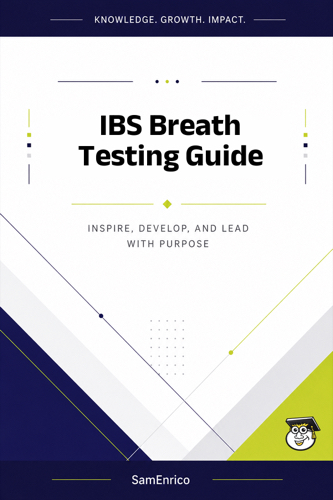
IBS Breath Testing Guide Audiobook
Understand hydrogen and methane breath tests for S
Understand hydrogen and methane breath tests for SIBO and carbohydrate malabsorption.
Formats
Free sample
Chapter 1: The Fermentation Equation--Most people believe their digestive problems begin with food. They blame the pizza, the broccoli, the gluten-free bread that still caused bloating. They spend years eliminating one food after another, shrinking their diets until they are eating nothing but rice and chicken, yet somehow the bloating remains. This is because they are looking at the wrong variable. The problem is not what you are eating.
The problem is what is eating your food before you can.Inside your small intestine, trillions of microscopic organisms are having a feast every time you swallow. They ferment carbohydrates into gases that your body never intended to produce in significant quantities. These gases—hydrogen, methane, and hydrogen sulfide—are not merely byproducts. They are the actual drivers of your symptoms. Bloating, diarrhea, constipation, brain fog, fatigue, and even skin conditions like rosacea can all be traced back to which gases are being produced, where, and in what quantity.This chapter will teach you the foundational science of breath testing.
You will learn why human cells do not produce hydrogen or methane, which bacteria create which gases, and how a simple breath sample can reveal the hidden war happening inside your gut. By the end of this chapter, you will understand why a breath test is not just another lab order—it is the only non-invasive window into functional gut health.The Fundamental Truth: You Are Not the One Making Gas Let us start with a fact that changes everything. Human cells do not produce hydrogen gas. They do not produce methane gas. They do not produce hydrogen sulfide.
If these gases appear in your breath, they were manufactured by microorganisms living inside your digestive tract.This is not a flaw in your design. It is a feature of the symbiotic relationship between humans and our gut microbiome. Under normal circumstances, the vast majority of carbohydrate fermentation occurs in the large intestine, or colon, where billions of bacteria safely break down fibers and resistant starches into short-chain fatty acids that actually nourish your colon cells. The gases produced in the colon are largely absorbed or expelled without causing significant symptoms because the colon is designed for this purpose—it has a massive surface area, a robust blood supply to carry away absorbed gases, and a lower density of nerve endings compared to the small intestine.The small intestine is a different story entirely. This 20-foot-long…
This is the end of the free sample. Get the Audiobook to keep going. Buy now
About this book
Details
- Author
- Newell Kaitlyn
- Publisher
- SamEnrico
- Language
- English
- Genre
- Non-Fiction, Health & Wellness, Diagnostic
- Released
- 2026-06-09
- Pages (approx.)
- 146
- Available as
- eBook, Audiobook

Listen in the VoxFlicks app
Audiobooks and audio dramas wherever you go. Sign in with your SamEnrico account and press play.
More by Newell Kaitlyn
 Fogging Technique for CriticismNewell Kaitlyn$11.99
 Benzo Recovery Emotional Numbing GuideNewell Kaitlyn$11.99
 Postpartum Depression Group Therapy GuideNewell Kaitlyn$11.99
 Geo Arbitrage for AccountantsNewell Kaitlyn$11.99
 Blocked Intersection CalmNewell Kaitlyn$11.99
 The Difficult Investor TalkNewell Kaitlyn$11.99
 Induction Script WritingNewell Kaitlyn$11.99
 Chronic Pain Exercise Prescription HandbookNewell Kaitlyn$11.99
 The Rosetta Stone Heist: A Theft That Rewrote HistoryNewell Kaitlyn$11.99
 The Odds of a Lifetime: How a Maori Mathematician Revolutionized Probability in the OutbackNewell Kaitlyn$11.99
 The Frozen Odyssey: The 1933 Arctic Expedition That Defied DeathNewell Kaitlyn$11.99
 How to Become a AnnealerNewell Kaitlyn$11.99
You may also like
 Hong Kong Handover 1997Dunn Johnnie$11.99
 Zumba For Postnatal Recovery CourseNeal Christian$11.99
 Zumba for BeginnersLadner Nikia$11.99
 YouTube Comment Mining GuideHumes Pandora$12.99
 Worry Box MeditationCarlin Rudy$11.99
 Workplace Stress MeditationNguyen Lynn$11.99
 Workplace Stress and Sleep RepairHawley Ivory$11.99
 Workplace Perfectionism CureDelaney Jeffry$11.99
 Workplace Injustice Anger GuideWallen Isabelle$11.99
 Work Addiction and Burnout LinkGreenwood Ester$11.99
 Women in Yoga and WellnessBeattie Galina$11.99
 Women in Stand Up ComedyChun Evangeline$11.99