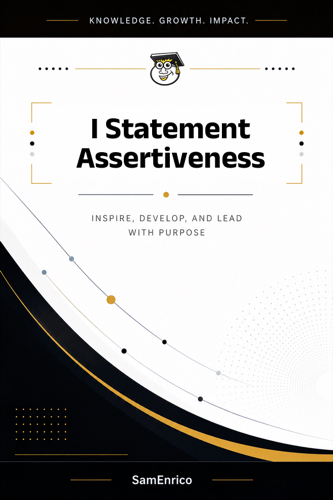
I Statement Assertiveness eBook
Express feelings without blame using I feel statem
by Tang Roy
Express feelings without blame using I feel statements in boundary setting.
Formats
Free sample
Chapter 1: The Blame Trap--–- The word lands like a stone dropped into still water. “You.” Not even a full sentence yet, just a pronoun, and already the other person’s shoulders have tightened. Their jaw has shifted. Their breathing has changed. You haven’t even finished your complaint—“You always do this,” “You never listen,” “You’re so selfish”—and the conversation is already over.
What comes next is not dialogue. It is damage control.This is the Blame Trap. And every single person reading this book has fallen into it, often within the last twenty-four hours. The trap is so common, so culturally normalized, that most people don’t even recognize it as a problem. They think arguments are supposed to feel this way.
They think relationships naturally involve defensiveness, withdrawal, and resentment. They think the solution is to find better words to express their blame—to say “You hurt me” more loudly, more clearly, more often.But the research from the top ten bestselling assertiveness books over the past fifty years points to a different conclusion. The problem is not that you are blaming incorrectly. The problem is that you are blaming at all. And until you understand why the word “you” triggers a neurological shutdown in the person you are trying to reach, you will continue to have the same fights, feel the same frustration, and wake up in the same emotional distance tomorrow that you feel today.This chapter is not about fixing your communication.
It is about demolishing the fundamental misunderstanding that keeps you stuck. By the time you finish these pages, you will understand why your best attempts at “being honest” have backfired, why the people you love most become the most defensive with you, and what actually happens inside the human brain when blame enters the room. More importantly, you will take the first step out of the Blame Trap and into a way of speaking that creates safety instead of destroying it.The Neuroscience of a Single Word Let us begin with a simple experiment. Read the following sentence and notice what happens in your body: “You are so careless.”Do not analyze it. Do not argue with it.
Just feel.Most people report a sensation somewhere between a stomach tighten and a chest flush. Some feel heat in the face. Others feel a sudden urge to cross their arms or look away. A few experience a flash of anger so quick they almost miss it. These are not psychological reactions in the abstract sense.
They are physiological events, measurable and repeatable, rooted in the oldest structures of the human brain.The amygdala, a small almond-shaped cluster of nuclei located deep within the temporal lobe, serves as the brain’s threat detection system. It evolved to do one thing: distinguish between safety and danger faster than conscious thought can process. When the amygdala detects a threat, it initiates a cascade of hormonal releases—adrenaline, cortisol, norepinephrine—that prepare the body for fight, flight, or freeze. Blood moves away from the prefrontal cortex (responsible for rational thought, empathy, and impulse control) and toward the large muscle groups. The digestive system slows.
The pupils dilate. Hearing becomes more acute.All of this happens in approximately 150 to 300 milliseconds. That is faster than the blink of an eye. And here is the critical insight that changes everything: the human brain processes the word “you” in accusation as a threat signal.Not the content of the accusation. Not whether the accusation is fair.
The word itself. The brain has learned through a lifetime of social experience that when someone says “You” in a certain tone, followed by a negative evaluation, danger is imminent. The specific configuration of phonemes—the /ju/ sound, the shape of the mouth, the accompanying facial expression—has become conditioned to predict attack.This is not speculation. Neuroscientific research using functional magnetic resonance imaging (f MRI) has shown that the same brain regions activated by physical pain are activated by social rejection and verbal blame. The anterior cingulate cortex, which processes the distressing aspect of pain, lights up when a person hears “You always…” or “You never…” statements.
The insula, which monitors internal body states, registers visceral disgust. The amygdala, as described, initiates survival mode.The result is a cruel irony. When you use a “you” statement because you want to be heard, you are literally disabling the other person’s ability to hear you. Their prefrontal cortex is going offline. Their capacity for empathy is diminishing.
Their working memory—the cognitive space where they could hold your perspective alongside their own—is being flooded with threat-related information. They are not being stubborn or difficult. They are being biological.Why “You” Statements Feel So Satisfying (And Why That Feeling Is a Lie)There is a reason we reach for “you” statements even when we know they cause problems. They feel good in the moment. Not good in a lasting way, but good in the way a sugar rush feels good—immediate, intense, and followed by a crash.The satisfaction comes from two sources.
First, “you” statements create a momentary sense of moral superiority. When you say “You are so inconsiderate,” you are not just describing a behavior. You are assigning a stable, negative trait to the other person. In that sentence, you become the judge and they become the defendant. The asymmetry is delicious.
For a few seconds, you are not the one who feels hurt, lonely, or ignored. You are the one who is right.Second, “you” statements discharge emotional pressure. Blame is a form of emotional vomit—it gets the poison out of your system and onto someone else’s shoes. The physical relief of saying “You never help me” is real. Your shoulders drop.
Your jaw unclenches. Your breathing slows. You have done something. You have expressed yourself. You have been honest.But here is the lie: that relief is not connection.
It is catharsis without repair. It is the feeling of dropping a heavy weight on someone else’s foot and calling it communication.The research across the top ten assertiveness books reveals a consistent pattern: “you” statements provide short-term emotional release at the cost of long-term relational damage. The person who receives the blame may comply in the moment—they may apologize, change their behavior, or try harder—but they will do so from a place of shame or fear, not from understanding or care. And shame-based compliance never lasts. Within days or weeks, the old pattern returns, often worse than before, because now there is resentment layered on top of the original issue.The Shame Cycle: A Four-Stage Relational Death Spiral The most important framework in this chapter—one that will appear throughout the rest of this book—is the Shame Cycle.
Every failed conversation, every recurring argument, every relationship that slowly suffocates under the weight of unexpressed needs follows this exact pattern. Learn to see it, and you learn to escape it.Stage One: Trigger Someone feels hurt, frustrated, lonely, disrespected, or afraid. The trigger could be a specific event (your partner arriving forty minutes late without calling) or a pattern that has accumulated over time (the…
This is the end of the free sample. Get the eBook to keep going. Buy now
About this book
Details
- Author
- Tang Roy
- Publisher
- SamEnrico
- Language
- English
- Genre
- Non-Fiction, Self-Help, I Statements
- Released
- 2026-06-07
- Pages (approx.)
- 142
- Available as
- eBook, Audiobook

Read better in the ZLOADR app
Your eBooks on your phone or tablet. Sign in with your SamEnrico account and start reading.
More by Tang Roy
 The Money Argument Deescalation GuideTang Roy$11.99
 Pinterest Save ComparisonTang Roy$11.99
 Thyroid AffirmationsTang Roy$11.99
 Parenting Child With Addiction GuideTang Roy$11.99
 Governor's Minimum Security VisitTang Roy$11.99
 Output Based PerformanceTang Roy$11.99
 Public Health Crisis LeadershipTang Roy$11.99
 Hypnagogic State LearningTang Roy$11.99
 The Blind Samurai: Blindfolded to Glory in 19th-Century JapanTang Roy$11.99
 The Rape of Nanking: A City in FlamesTang Roy$11.99
 The Last Empress: How a Teen Queen Changed a DynastyTang Roy$11.99
 Scaling Consulting into FirmsTang Roy$11.99