
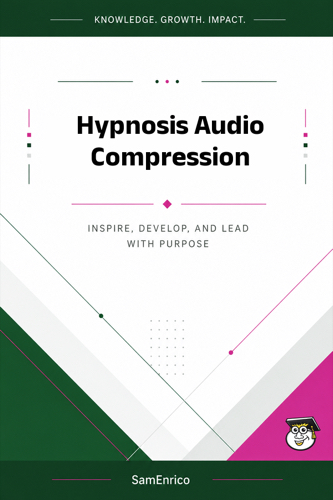
Non-FictionSelf-HelpAudio Compression
Hypnosis Audio Compression eBook
Uses dynamic range compression for consistent list
Uses dynamic range compression for consistent listening levels across devices.
Formats
Free sample
Chapter 1: The Invisible Saboteur...–- Every hypnosis audio creator has experienced it. You spend hours crafting the perfect script, recording with pristine microphone technique, and layering in just the right amount of theta-frequency background texture. You test the final track on your studio headphones, and it sounds like pure magic—the voice is warm and authoritative, the whispers are intimate, the awakening suggestions land with perfect emphasis. You export the file, upload it to your client portal, and wait for the testimonials to roll in.Then the emails arrive."I tried listening in my car on the way to work, but I couldn't hear half of what you said during the relaxation induction.""The part where you say 'sleep now' scared me awake because it was so much louder than everything else.""I put this on my phone while falling asleep, and the quiet parts disappeared completely. I kept straining to hear, which is the opposite of relaxing.""I listened on my Air Pods while cooking dinner, and the background music kept drowning out your voice."None of these listeners are wrong.
None of them have defective equipment. And none of them are complaining about your script, your delivery, or your therapeutic technique. They are all experiencing the same underlying problem—a problem that has nothing to do with hypnosis itself and everything to do with how sound behaves in the real world.This problem has a name, though you have likely never heard it spoken in hypnotherapy training. It is called dynamic range inconsistency, and it is the invisible saboteur of more hypnosis recordings than any other single factor. Worse, most practitioners do not even know it exists.
They blame themselves—"I must not have spoken clearly enough"—or they blame their listeners—"They must not have been in the right headspace"—when the real culprit is a purely technical phenomenon that can be measured, understood, and completely eliminated.Before we can fix this problem, we must understand it from the ground up. And to understand it, we must first acknowledge a difficult truth: the listening experience you create in your studio is almost never the listening experience your audience receives.The Great Disconnect: Why Your Studio Lies to You Let us begin with an experiment you can perform yourself within the next hour. Record yourself reading a simple hypnosis script—something with natural variation in volume. Start softly: "Take a deep breath and allow your eyes to close." Build to a medium volume: "Feel the relaxation spreading through your body." Then deliver a firm, clear suggestion: "And now, you will sleep." Export this recording as an uncompressed WAV file. Listen to it on your studio headphones or nearfield monitors in a quiet room.
It will sound exactly as you intended.Now play that same file through your smartphone speaker while standing in your kitchen with the exhaust fan running. Play it through your car stereo while driving at 65 miles per hour. Play it through a Bluetooth speaker in your living room while a partner watches television in the next room. Play it through a pair of cheap earbuds while walking down a city street.What you will discover is that your perfectly crafted audio file sounds radically different on each of these playback systems. The soft induction that seemed so intimate on headphones becomes nearly inaudible on a smartphone speaker.
The firm suggestion that landed with such authority in the studio becomes jarring and startling on car speakers. The background music that added depth and warmth in your treated room becomes a muddy, voice-masking mess on consumer earbuds.This is not a flaw in your recording. It is a fundamental property of how sound interacts with hardware, environments, and human perception. And until you understand these interactions, you will continue to produce hypnosis tracks that work beautifully for some listeners and fail completely for others.The Four Listening Environments That Define Your Audience To understand why dynamic range inconsistency matters so much for hypnosis, we must first understand where your listeners are actually listening. Market research across meditation apps, self-hypnosis platforms, and clinical hypnosis practices reveals that the vast majority of hypnosis audio is consumed in four distinct environments.
Each environment presents unique acoustic challenges.Environment One: Headphones in Quiet Spaces This is the environment most creators imagine when they produce their tracks. The listener is sitting or lying down in a reasonably quiet room, wearing over-ear headphones or high-quality earbuds. The background noise floor is low—perhaps 30 to 40 decibels, equivalent to a quiet library. The headphones provide excellent isolation, allowing even very soft sounds to be perceived clearly. In this environment, a well-recorded hypnosis track with wide dynamic range (soft whispers at -30d B, firm suggestions at -10d B) works perfectly.
The listener hears every nuance.However, this environment accounts for only about 25 to 30 percent of all hypnosis listening sessions, according to data from major meditation apps. The majority of listening happens elsewhere.Environment Two: Headphones in Noisy Environments This is the commuter, the gym-goer, the person doing household chores. The listener is wearing headphones or earbuds, but the ambient noise level is substantial—perhaps 60 to 70 decibels, equivalent to a busy coffee shop, a subway car, or a running vacuum cleaner. Headphones provide some isolation, but low-frequency noise (engine rumble, HVAC systems, traffic) still penetrates. In this environment, soft passages become inaudible unless the listener cranks the volume to unsafe levels.
The listener does not want to do this, so they instead strain to hear, which activates the sympathetic nervous system and works directly against trance induction.Environment Three: Car Speakers The car is a uniquely challenging listening environment. The background noise floor at highway speeds is 70 to 85 decibels—loud enough to require raised voices for conversation. Car speakers are typically positioned poorly for critical listening (low in the doors, firing at your legs). Road noise has a frequency distribution heavy in low and mid-low frequencies, which masks the lower range of the human voice. Additionally, most car audio systems apply aggressive equalization and dynamic processing of their own, further distorting your carefully crafted track.
In this environment, only the loudest 20 to 30 percent of your audio will be clearly audible unless you have specifically engineered for car playback.Environment Four: Smartphone and Smart Speakers This environment includes listeners who simply press play on their phone speaker while getting ready for bed, or who ask their smart speaker to play a hypnosis track while they lie on the couch. Phone speakers have no low-frequency response to speak of (they roll off sharply below 300 Hz), meaning any bass content in your music or binaural beats will simply disappear. They also have poor transient response, meaning sharp consonants (like "t," "k," and "p") can become harsh and piercing. Smart speakers add the complication of room acoustics—a voice that sounds clear in the center of the room may become muddy and diffuse when the listener is lying off-axis on a sofa.Each of these environments demands a different dynamic range profile. Yet your hypnosis track cannot magically adapt to each listener's environment.
It must be engineered to work reasonably well in all of them. This is the central challenge of hypnosis audio…
This is the end of the free sample. Get the eBook to keep going. Buy now
About this book
Details
- Author
- Proffitt Gerri
- Publisher
- SamEnrico
- Language
- English
- Genre
- Non-Fiction, Self-Help, Audio Compression
- Released
- 2026-06-10
- Pages (approx.)
- 152
- Available as
- eBook, Audiobook

Read better in the ZLOADR app
Your eBooks on your phone or tablet. Sign in with your SamEnrico account and start reading.
More by Proffitt Gerri
 Suicide Loss Support Groups OnlineProffitt Gerri$11.99
 Stress Fertility Problems GuideProffitt Gerri$11.99
 Step Four Sex Conduct Inventory HandbookProffitt Gerri$11.99
 Goal Setting for MillennialsProffitt Gerri$11.99
 Battle Pass Grind AddictionProffitt Gerri$11.99
 Reporting Structure NegotiationProffitt Gerri$11.99
 Location Memory StrategiesProffitt Gerri$11.99
 The Curse of the Forgotten Pharaoh's ScrollProffitt Gerri$11.99
 The Silk Road Hack: How a 21st-Century Cyber Heist Exposed a Billion-Dollar Dark Web EmpireProffitt Gerri$11.99
 Growing AnisacanthusProffitt Gerri$11.99
 How to Produce Yogurt Maker AccessoriesProffitt Gerri$11.99
 Mailchimp Custom Audience TagsProffitt Gerri$12.99
You may also like
 Hong Kong Handover 1997Dunn Johnnie$11.99
 Zumba For Postnatal Recovery CourseNeal Christian$11.99
 Zumba for BeginnersLadner Nikia$11.99
 YouTube Comment Mining GuideHumes Pandora$12.99
 Worry Box MeditationCarlin Rudy$11.99
 Workplace Stress MeditationNguyen Lynn$11.99
 Workplace Stress and Sleep RepairHawley Ivory$11.99
 Workplace Perfectionism CureDelaney Jeffry$11.99
 Workplace Injustice Anger GuideWallen Isabelle$11.99
 Work Addiction and Burnout LinkGreenwood Ester$11.99
 Women in Yoga and WellnessBeattie Galina$11.99
 Women in Stand Up ComedyChun Evangeline$11.99