
Hydration Brain Function Guide eBook
Maintain water intake to prevent fatigue and cogni
by Doan Kathlyn
Maintain water intake to prevent fatigue and cognitive decline while studying.
Formats
Free sample
Chapter 1: The Two Percent Heist--The first lie you were ever told about thirst happened before you could walk. When you cried as an infant, someone offered a bottle. When you came inside from playing, someone said, “Drink something, you look thirsty.” When you sat down to study for the first big exam of your life, no one said a word about water. And that silence has cost you more cognitive hours than all the all-nighters you will ever pull combined.Let me introduce you to a student named Maya. She is nineteen years old, a sophomore pre-med student at a large public university, and she nearly failed organic chemistry.
Not because she did not study. She studied more than anyone in her dorm. She attended every office hour. She made flashcards, joined a study group, and hired a tutor for the last three weeks before finals. Her practice exam scores were solid B-pluses.
Her actual final grade was a D.Maya did not know she was dehydrated. She drank when she felt thirsty. She carried a water bottle to class but often forgot to refill it. She drank coffee in the morning, sometimes two cups, and soda with lunch. She never felt “thirsty” in the way she imagined severe dehydration would feel—no cracked lips, no dizziness, no headache.
She felt fine. And that was the problem.“Feeling fine” is not the same as being optimally hydrated. In fact, feeling fine while studying is often a sign that you have already lost more cognitive function than you realize. The research is startlingly clear: by the time your brain registers the sensation of thirst, you have already lost between one and two percent of your body weight in water. That number—two percent—is the tipping point.
Beyond it, your working memory, your alertness, your ability to plan, to inhibit distractions, and to mentally flex between concepts all begin to decline measurably. And Maya, like approximately sixty percent of students, was living her entire academic life below that line.This chapter is about that tipping point. It is about the heist that happens inside your head every day without your permission. It is about why “drink when you’re thirsty” is possibly the worst hydration advice you have ever received. And it is about the first and most important step you will take toward reclaiming the cognitive horsepower that dehydration has been stealing from you since your first early morning class.The Sixty Percent Problem Let us start with a number that should shock you: sixty percent.
That is the proportion of individuals who, according to multiple large-scale hydration studies, fail to meet even the most basic daily fluid intake recommendations. But the real number is worse, because those recommendations themselves are minimums for survival, not for cognitive optimization. If we use the stricter standard of euhydration—the state in which your body’s fluid levels are perfectly balanced for peak mental performance—the failure rate climbs into the eighties for certain populations, including college students.Maya was not unusual. She was typical. And that is the tragedy of voluntary dehydration.
The term “voluntary” sounds like a choice, as if students are actively deciding to be dehydrated. But voluntary dehydration is not a decision. It is a failure mode of the human body’s signaling systems. Your thirst mechanism evolved in an environment where water was scarce and danger was abundant. It was designed to be conservative—to only trigger a strong thirst signal when dehydration had already progressed to a point that threatened survival.
In the modern world, where water is everywhere and cognitive performance matters more than running from predators, that ancient thirst mechanism is a liability.Consider what happens in a typical student day. Maya wakes up after eight hours of sleep. During those eight hours, she lost water through respiration—every breath out carried water vapor. She lost water through insensible perspiration, the constant low-level sweating that happens even in a cool room. She lost water simply by being alive.
She wakes up already in a state of mild dehydration, but she does not feel thirsty. She drinks coffee, which for a non-habitual user acts as a mild diuretic, increasing urine output beyond the volume of the coffee itself. She attends a ninety-minute lecture in a dry, air-conditioned classroom, losing additional water through respiration without ever feeling hot. By the time she sits down to study at two in the afternoon, she has lost approximately 1.5 percent of her body weight in water. She does not feel thirsty.
She feels “a little tired.” She blames the lunch she ate. She pushes through.That “pushing through” is the sound of cognitive decline being rationalized as normal. It is not normal. It is preventable. And it happens to sixty percent of students every single day.Defining the Tipping Point The one to two percent body weight loss threshold is not arbitrary.
It comes from decades of military, athletic, and occupational research. The United States Army funded much of the early work because soldiers in the field were making tactical errors not from lack of training but from lack of water. The Navy studied pilots whose reaction times slowed after long flights in dry cockpits. The research consistently found the same thing: once fluid loss exceeds one percent of body weight, cognitive function begins to degrade. At two percent, the degradation is clinically significant and measurable across multiple domains.What does one percent of body weight look like in real terms?
For a 70 kilogram student—about 154 pounds—one percent is 700 milliliters of water loss. That is less than three standard cups of water. You can lose that much fluid in a ninety-minute lecture in a dry, air-conditioned room without ever feeling thirsty. You can lose that much overnight during sleep. You can lose that much by having two cups of coffee in the morning if you are not a habitual drinker and then not replenishing.Two percent is 1.4 liters.
That is a large water bottle’s worth of fluid. You can lose that much in a single afternoon of studying in a warm library, or by sleeping eight hours, skipping morning water, drinking coffee, and then sitting through a three-hour exam without drinking. And here is the cruelest part: you will not feel the decline as it happens. Your brain does not have a dashboard warning light for hydration status. What you will feel is a vague sense of increased effort.
Problems that should take thirty seconds take forty-five. Reading a paragraph once is not enough; you have to read it twice. You check your phone more often. You re-read the same sentence three times. You blame the material.
You blame the professor. You blame your own intelligence. But the culprit is water, and it has been robbing you in plain sight.The Domains of Cognitive Decline When researchers measure the impact of dehydration on cognitive function, they do not just ask people “how do you feel?” They run standardized tests that isolate specific cognitive domains. The results are devastatingly specific.Working memory is the first to go. Working memory is your brain’s scratchpad—the temporary storage system that holds information while you manipulate…
This is the end of the free sample. Get the eBook to keep going. Buy now
About this book
Details
- Author
- Doan Kathlyn
- Publisher
- SamEnrico
- Language
- English
- Genre
- Non-Fiction, Self-Help, Health
- Released
- 2026-06-09
- Pages (approx.)
- 126
- Available as
- eBook, Audiobook

Read better in the ZLOADR app
Your eBooks on your phone or tablet. Sign in with your SamEnrico account and start reading.
More by Doan Kathlyn
 The Group Project AnxietyDoan Kathlyn$11.99
 Medical Relapse Prevention After OverdoseDoan Kathlyn$11.99
 Ranked Ladder Gaming AddictionDoan Kathlyn$11.99
 Circadian Rhythm And Bipolar DisorderDoan Kathlyn$11.99
 Caregiver Sleep Recovery GuideDoan Kathlyn$11.99
 Chaotic Home Survival SkillsDoan Kathlyn$11.99
 Resentment After ScamDoan Kathlyn$11.99
 Japanese Type 10 and Type 97 TanksDoan Kathlyn$11.99
 The Serpent’s Crown: How a Forgotten Queen Outwitted an EmpireDoan Kathlyn$11.99
 The Frozen Cartographer: Ibn Majid and the Uncharted Southern SeasDoan Kathlyn$11.99
 Silicon Throne: The Untold Rise and Fall of a Tech DynastyDoan Kathlyn$11.99
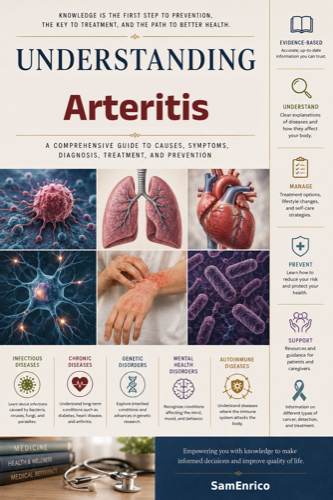 Understanding ArteritisDoan Kathlyn$17.99
You may also like
 Hydration Habit BuilderDelacruz Johnna$11.99
 The Hydration and Focus GuideMathias Mel$11.99
 Conversation Starters for PharmaciesLinares Jazmine$11.99
 The Remote Work Rest ProtocolMaloney Christia$11.99
 Hydration First Morning RuleDover Delmar$11.99
 The SMART for Health GoalsLeighton Lonny$11.99
 The Remote Work Break ScheduleNobles Wilhemina$11.99
 Medical Appointment ReviewWeldon Jeni$11.99
 Hydration First Morning PlanHauser Jenice$11.99
 Health Procrastination SolutionsWallace Antoinette$11.99
 Dream Health Indicator LogMathias Mel$11.99
 Work Addiction And Sick DaysAhrens Anneliese$11.99