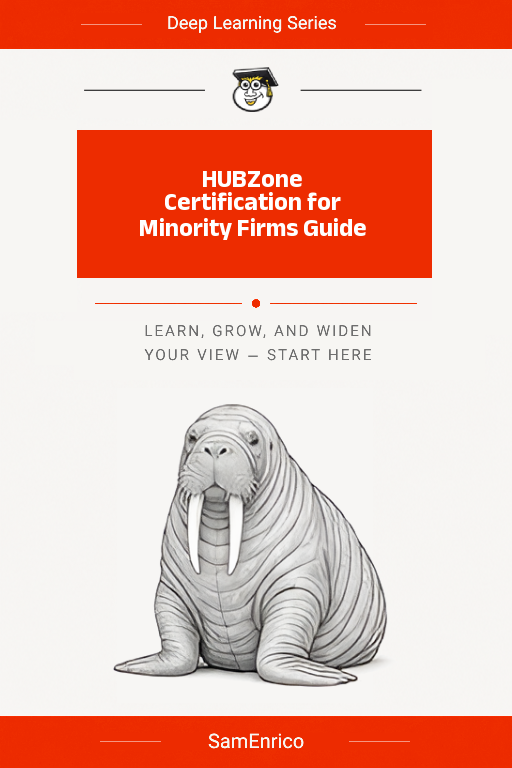
HUBZone Certification Guide eBook
Qualify for HUBZone certification as minority owne
Qualify for HUBZone certification as minority owned firm in historically underutilized area. Receive 10 percent price preference in competitive federal contracting.
Formats
Free sample
Chapter 1: The $93,000 Miracle...--The first time Maria Sanchez lost a federal contract she never actually bid on, she didn't even know it happened.She was sitting in her kitchen in Commerce City, Colorado—a small, hardscrabble community just northeast of Denver that most people drive through without noticing. Her construction company, Sanchez Site Prep, had been in business for six years. She had seven employees, a decent reputation, and a persistent, exhausting problem: every time she found a federal contract she could perform, she lost to someone bigger, cheaper, or more connected.On this particular Tuesday, her bid for a 340,000soilstabilizationprojectatthe Rocky Mountain Arsenal National Wildlife Refugehadjustbeenrejected.Shedidn′tlosebymuch—340,000 soil stabilization project at the Rocky Mountain Arsenal National Wildlife Refuge had just been rejected. She didn't lose by much—340,000soilstabilizationprojectatthe Rocky Mountain Arsenal National Wildlife Refugehadjustbeenrejected.Shedidn′tlosebymuch—12,000. The winning bidder, a non-local firm from Phoenix, had simply undercut her by a margin she couldn't match.
Maria had done the math seven times. Her bid was already at absolute rock bottom. Any lower and she'd be paying her crew out of her own savings.Her business development consultant, a retired procurement officer named Delroy, called her that afternoon. "Maria, I need to ask you something strange," he said."Ask away. I'm drinking coffee and questioning my life choices.""Where's your office?""My office?
It's in my house. You know that. The spare bedroom.""Where's that house?""Commerce City. You've been here. Why?""Does any of your crew live in Commerce City?""Three of them.
The other four live in Aurora and Thornton."Delroy paused. "Maria, do you know what a HUBZone is?"She didn't.That conversation launched her on a journey that would, within fourteen months, transform her small construction company into a preferred contractor for the U.S. Army Corps of Engineers. And the engine of that transformation wasn't better equipment, cheaper labor, or political connections. It was a 10% number on a piece of paper that the government itself gave her—a number that turned her kitchen-table business into a billion-dollar program's hidden weapon.This book is about how you can do the same thing.But first, you need to understand what Maria learned: that the HUBZone program is not charity.
It is not welfare. It is not a diversity checkbox. It is, instead, one of the most brutally effective competitive advantages available to any small business in America—and it is sitting unused in thousands of communities just like yours, waiting for someone to claim it.The $16.6 Billion Blind Spot Let's start with a number that should make you angry: $16.6 billion.That is how much the federal government spent on contracts awarded to HUBZone-certified firms in Fiscal Year 2023. It is the largest single-year total in the program's twenty-five-year history. It represents contracts for everything from janitorial services at the Department of Veterans Affairs to cybersecurity work at the Department of Homeland Security to heavy construction at Army installations across the country.And yet, according to the SBA's own data, the federal government failed to meet its statutory 3% HUBZone contracting goal for the seventh time in ten years.Think about that.
The government wants to give contracts to HUBZone firms. It is legally required to try. And still, there are not enough certified firms to meet the demand.Maria Sanchez didn't know any of this when she first spoke to Delroy. She thought federal contracting was a closed club, a network of good-old-boy relationships she couldn't crack. What she didn't realize was that the federal government is, in many ways, desperate for firms exactly like hers: small, capable, minority-owned, and located in a community that most people have forgotten.The HUBZone program was created by Congress in 1997 as part of the Small Business Reauthorization Act.
The idea was simple: steer federal procurement dollars toward historically underutilized business zones—areas with high poverty, low employment, or rural isolation—to encourage private investment and job creation in places that had been left behind. Every federal agency with contracting authority (and there are more than sixty of them) is required to make a "good faith effort" to award 3% of its prime contracting dollars to HUBZone-certified firms.Three percent sounds small. But three percent of the federal procurement budget—which hovers around 600billionannually—isenormous.Inpracticalterms,thegovernmentistryingtogiveawayroughly600 billion annually—is enormous. In practical terms, the government is trying to give away roughly 600billionannually—isenormous.Inpracticalterms,thegovernmentistryingtogiveawayroughly18 billion every year to businesses that qualify for this program.And most of that money goes unclaimed.Not because the government isn't trying. Agency contracting officers have HUBZone goals built into their performance reviews.
Large prime contractors need HUBZone subcontractors to meet their own utilization targets. There are entire offices at the SBA dedicated to helping firms get certified. The demand side of the equation is strong, growing, and largely unsatisfied.The supply side—firms like yours—is the bottleneck.The "Double-Dip" Advantage No One Is Talking About Here is where the opportunity becomes specifically relevant to you as a minority-owned firm.Most small business owners think of federal socioeconomic certifications as a menu: you pick one. You can be a Woman-Owned Small Business (WOSB). Or you can be a Service-Disabled Veteran-Owned Small Business (SDVOSB).
Or you can be a HUBZone firm. Or you can be an 8(a) participant.This is wrong.The federal government's contracting rules explicitly allow—and in some cases encourage—stacking multiple certifications. A firm can be a minority-owned, HUBZone-certified, 8(a) participant simultaneously. Each certification opens different doors. Each gives you a different tool for different procurement situations.Maria Sanchez discovered this when she applied for her HUBZone certification and realized she also qualified for the 8(a) program through her status as a Latina-owned business.
Within six months, she had both certifications. Within a year, she had stopped bidding on open contracts altogether—because agencies started calling her directly with sole source opportunities.The "Double-Dip" advantage works like this:HUBZone gives you the 10% price preference when you compete against non-HUBZone firms in full and open competition. Your bid can be up to 10% higher than a large business's bid, and you will still win on price evaluation.8(a) gives you access to sole source contracts up to 4.5millionforservicesand4.5 million for services and 4.5millionforservicesand7 million for manufacturing, with no competition required, as long as you are determined to be a responsible contractor.Minority-owned status (MBE) gives you preference in state and local contracting and makes you more attractive to large primes who have their own diversity spending goals.When you combine these, you are not just a small business. You are a procurement officer's dream: a certified, ready-to-go contractor who helps them check three boxes at once.The chapter you are reading now is the first step in learning how to build that stack. But before we get into the mechanics of certification, you need to understand the single most powerful weapon in the HUBZone arsenal: the 10% price evaluation preference.The 10% Rule: How to Bid Higher and Win Let me tell you about the $93,000 miracle.A large business—let's call them Acme Construction—bids 93,000onafederalcontractforofficerenovation.AHUBZone−certifiedfirm—let′scallthem Maria′s Site Prep—bids93,000 on a federal contract for office renovation.
A HUBZone-certified firm—let's call them Maria's Site Prep—bids 93,000onafederalcontractforofficerenovation.AHUBZone−certifiedfirm—let′scallthem Maria′s Site Prep—bids98,000.Who wins?If you said Acme because their bid is…
This is the end of the free sample. Get the eBook to keep going. Buy now
About this book
Details
- Author
- Betancourt Felica
- Publisher
- SamEnrico
- Language
- English
- Genre
- Non-Fiction, Business Brief, HUBZone
- Released
- 2026-06-01
- Pages (approx.)
- 147
- Available as
- eBook, Audiobook

Read better in the ZLOADR app
Your eBooks on your phone or tablet. Sign in with your SamEnrico account and start reading.
More by Betancourt Felica
 South Africa Cost ArbitrageBetancourt Felica$11.99
 Anger Communication ScriptsBetancourt Felica$11.99
 The Mother Wound CourseBetancourt Felica$11.99
 Pelvic Floor JournalBetancourt Felica$11.99
 Invasion Of Russia CampaignBetancourt Felica$11.99
 The Interruption Free Hour ProtocolBetancourt Felica$11.99
 CRE Earnest Money ProtectionBetancourt Felica$11.99
 Chunking for AP ExamsBetancourt Felica$11.99
 Body Image After AmputationBetancourt Felica$11.99
 The Phantom of the Paris Catacombs: A Forgotten Underground RevolutionBetancourt Felica$11.99
 The Last Broadcast: How a Radio Station Outlasted the Berlin WallBetancourt Felica$11.99
 Understanding AmenorrheaBetancourt Felica$17.99