
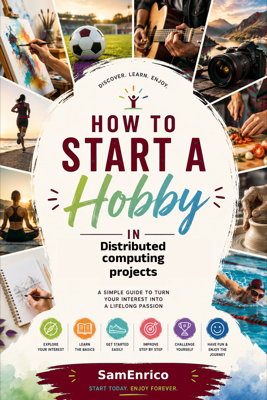
Non-FictionInformativeEducational
How to Start a Hobby in Distributed computing projects eBook
How to Start a Hobby in Distributed computing proj
How to Start a Hobby in Distributed computing projects
Formats
Free sample
Chapter 1: The Sleeping Supercomputer--–- Your computer has a secret life. While you scroll through social media, check email, or walk away to make coffee, ninety-five percent of its processing power sits idle—a vast, silent ocean of unused potential. The machine on your desk, the laptop in your bag, even the old desktop gathering dust in your garage contains more computational muscle than the entire world had available just thirty years ago. And right now, almost all of that power is doing nothing. This book exists to change that.You’re about to discover one of the most quietly revolutionary acts an ordinary person can perform in the digital age: turning your everyday computer into a volunteer supercomputer that helps cure diseases, discover planets, decode ancient texts, and solve problems that no single machine could tackle alone.
No Ph D required. No programming experience needed. No expensive hardware to buy. Just curiosity and a willingness to let your machine do something remarkable while you sleep.Welcome to the world of distributed computing—a world where millions of ordinary people have already contributed more than two million years of computing time to scientific research, often without realizing they were part of something historic. A fourteen-year-old in Ohio helped discover a new pulsar while doing homework.
A grandmother in Tokyo contributed to a breakthrough in Alzheimer’s research between knitting projects. A retired plumber in Manchester found a prime number so large that it now bears his name. None of them set out to become scientists. They just installed some free software and let their computers do the rest.This chapter is your invitation to join them. By the time you finish reading, you’ll understand exactly what distributed computing is, why it matters, and how you can take your first step toward becoming part of the largest collaboration in human history—all without leaving your chair.The Relatable Scenario: You, Right Now Let’s be honest about where you’re sitting.
Maybe you’re at a desk in a cubicle, waiting for a slow report to generate. Maybe you’re on a couch, half-watching television while your laptop idles on the coffee table. Maybe you’re in a coffee shop, your machine running on battery power while you sip something lukewarm. Wherever you are, your computer is almost certainly doing very little of consequence at this exact moment.That’s not a criticism. It’s just the nature of modern computing.
Your machine has been engineered to handle bursts of intense activity—opening applications, rendering web pages, playing videos—followed by long stretches of near-silence. Even during those bursts, most of your computer’s capabilities remain untapped. A typical word processor uses less than one percent of your processor’s potential. A web browser might spike to five or ten percent when loading a complex page. The rest is overhead, waiting for you to do something demanding.Distributed computing asks a simple question: what if those idle cycles could be harnessed?
What if, instead of letting ninety-five percent of your computer’s power evaporate as heat and wasted electricity, you could redirect it toward something meaningful? What if the time between your keystrokes became research time, and the hours you spend asleep became discovery hours?That’s the core insight driving this entire book. You don’t need to buy a supercomputer. You don’t need to learn complicated programming languages. You don’t need to sacrifice performance or convenience.
You just need to give permission—and then let thousands of researchers around the world borrow your spare capacity to solve problems that would otherwise take centuries.Take a moment to let that sink in. The machine you already own, the one sitting silently in front of you, contains the potential to contribute to genuine scientific breakthroughs. Not metaphorically. Literally. Your computer, right now, could be helping to map protein folds for cancer research, searching gravitational wave data for signs of colliding black holes, or testing climate models that predict the next decade of global weather patterns.
The only missing ingredient is your consent.That consent is what this book will help you give. By the end of Chapter 4, you’ll have installed your first distributed computing project and completed your first work unit. By the end of Chapter 6, you’ll have found a community of like-minded volunteers. And by the end of this chapter, you’ll understand why this seemingly small act matters more than you might think.What Is Distributed Computing, Really?Distributed computing sounds technical, but the underlying principle is almost embarrassingly simple. It’s the digital equivalent of asking a thousand people to each carry one bucket of water instead of asking one person to carry a thousand buckets.
The work gets done faster, no individual is overburdened, and the collective result is something no single person could have achieved alone.Here’s how it works in practice. A research team has a problem that requires enormous amounts of computation—searching for patterns in radio telescope data, simulating molecular interactions, testing cryptographic algorithms. The problem is too big for any single computer to handle in a reasonable timeframe, and the team doesn’t have access to a supercomputer. So they break the problem into millions of tiny pieces, each small enough that an ordinary computer can process it in a few hours or days. Then they distribute those pieces to volunteers around the world.
Each volunteer’s computer works on one piece, sends the result back, and receives a new piece. When all the pieces are completed, the research team reassembles them into a complete answer.That’s distributed computing in a nutshell. Your computer becomes one worker in a global assembly line, handling a small but essential task while researchers coordinate the overall effort. You never see the full picture—just your small piece. But without you and thousands of others like you, the full picture would never come into focus.The platforms that make this possible have names you’ll become familiar with throughout this book.
The Berkeley Open Infrastructure for Network Computing—BOINC, for short—hosts more than fifty active projects across astronomy, biology, mathematics, and climate science. Folding@home focuses exclusively on protein folding and has become one of the largest distributed computing projects in history, particularly during the COVID-19 pandemic when it helped researchers understand the virus’s structure. Distributed.net has been solving cryptographic challenges since 1997, making it the oldest continuously running volunteer computing project in existence.Each platform works slightly differently, but they all share the same fundamental architecture. A central server coordinates the work, handing out tasks and collecting results. Volunteers install client software that communicates with the server, downloads tasks, runs them using spare processing power, and uploads the results.
The client software is designed to be unobtrusive—it runs at low priority, yields immediately when you need your computer for other tasks, and can be configured to operate only when the computer would otherwise be idle.The technical term for this is “volunteer computing,” and it has a surprisingly long history. The first major volunteer computing project was the Great Internet Mersenne Prime Search, launched in 1996 and…
This is the end of the free sample. Get the eBook to keep going. Buy now
About this book
Details
- Author
- Grant Cassandra
- Publisher
- SamEnrico
- Language
- English
- ISBN
- 9781506114699
- Genre
- Non-Fiction, Informative, Educational
- Released
- 2026-05-02
- Pages (approx.)
- 156
- Available as
- eBook, Paperback, Audiobook

Read better in the ZLOADR app
Your eBooks on your phone or tablet. Sign in with your SamEnrico account and start reading.
More by Grant Cassandra
 The Second CircumnavigationGrant Cassandra$11.99
 Migraine and Weather ChangesGrant Cassandra$11.99
 Conflict To Creativity Team GuideGrant Cassandra$11.99
 The Prayer Group CultGrant Cassandra$11.99
 Blue Zone Fish IntakeGrant Cassandra$11.99
 Discord Paid CommunityGrant Cassandra$11.99
 NVC in RelationshipsGrant Cassandra$11.99
 Stress and High Blood PressureGrant Cassandra$11.99
 Rosie O'Donnell CircleGrant Cassandra$11.99
 The Silk Road's Shadow: The Untold Story of the 'Queen of Cocaine'Grant Cassandra$11.99
 The Fur Trade Frontier: Canada's Path to NationhoodGrant Cassandra$11.99
 The Deepwater Pioneers: Unlocking the Secrets of the Caspian SeaGrant Cassandra$11.99
You may also like
 Hong Kong Handover 1997Dunn Johnnie$11.99
 Zumba For Postnatal Recovery CourseNeal Christian$11.99
 Zumba for BeginnersLadner Nikia$11.99
 YouTube Comment Mining GuideHumes Pandora$12.99
 Worry Box MeditationCarlin Rudy$11.99
 Workplace Stress MeditationNguyen Lynn$11.99
 Workplace Stress and Sleep RepairHawley Ivory$11.99
 Workplace Perfectionism CureDelaney Jeffry$11.99
 Workplace Injustice Anger GuideWallen Isabelle$11.99
 Work Addiction and Burnout LinkGreenwood Ester$11.99
 Women in Yoga and WellnessBeattie Galina$11.99
 Women in Stand Up ComedyChun Evangeline$11.99