
Non-FictionInformativeEducational
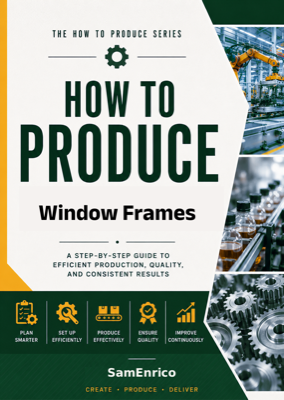
How to Produce Window Frames eBook
This publication, published by SamEnrico, covers H
This publication, published by SamEnrico, covers How to Produce Window Frames
Formats
Free sample
Chapter 1: Beyond Wood Versus Plastic--–- The window frame is one of the most misunderstood, underestimated, and poorly manufactured components in modern construction. Walk through any housing development, any commercial district, any city street, and within minutes you will find a failed window frame—paint peeling from rotted timber, chalky white oxidation on u PVC, or corroded aluminum bleeding rust streaks down a facade. These failures are not accidents of weather or bad luck. They are the predictable outcomes of producers who never learned to think systematically about what a window frame actually is and what it must do.This book exists because the gap between master craftsmanship and modern manufacturing has never been wider, yet the opportunity to bridge that gap has never been more profitable. On one side of the industry, traditional joiners produce beautiful, bespoke timber frames using techniques refined over centuries—but they struggle with consistency, scalability, and thermal performance.
On the other side, high-volume automated factories churn out thousands of identical u PVC or aluminum frames with precise dimensional accuracy—but they sacrifice aesthetic soul, repairability, and often longevity. The producer who succeeds in the coming decade will be the one who masters both worlds: the material wisdom of the artisan and the process discipline of the factory.This first chapter establishes the foundation upon which every subsequent chapter is built. Before we cut a single piece of timber, extrude a single meter of u PVC, or weld a single steel corner, we must understand the ecosystem in which window frames exist. We must move beyond the childish "wood versus u PVC versus aluminum" debate and instead ask the only question that matters: What does this specific window need to do, in this specific building, in this specific climate, for this specific client? The answer to that question determines everything else—material selection, joint design, thermal break strategy, finishing schedule, and even how the frame is packaged and shipped.The Three Non-Negotiable Functions of Any Frame Every window frame, regardless of material or price point, must perform three fundamental functions simultaneously.
Fail at any one of these, and the window is not merely suboptimal—it is a functional failure that will leak, sag, rot, or conduct heat until it is replaced at great expense.Function One: Structural Support The frame must carry loads. This sounds obvious, yet it is astonishing how many window frames are designed with only a vague nod to structural reality. A typical double-glazed insulated glass unit (IGU) for a 1200mm by 1500mm casement window weighs approximately 45 to 60 kilograms—roughly the weight of a small adult human. That weight is not distributed evenly across the frame. It concentrates at the bottom rail, transfers to the side jambs, and ultimately bears on the sill and the building structure below.
The frame must also resist wind loads, which in coastal or high-rise applications can exceed 2.5 kilopascals (approximately 52 kilograms per square meter of force). In hurricane-prone regions, design pressures can reach 4 kilopascals or more.Structural failure in window frames rarely means catastrophic collapse. More often, it means sagging. The bottom rail bows downward over time, the sash no longer seals against the frame, air leaks appear, and water finds its way inside. The producer who ignores structural calculations is building failure into every frame from day one.
Chapter 3 will provide the exact calculation methods for determining required frame thickness based on glass weight, span width, and local wind load requirements. For now, understand this: a window frame is a structural component, not a decorative trim piece.Function Two: Thermal Break The frame must manage heat flow. In heating-dominated climates, the window frame is one of the weakest links in the building envelope. A poorly performing frame can have a U-value (a measure of heat transfer) three to five times worse than a well-insulated wall. That means heat pouring out of the building in winter and pouring in during summer, directly impacting energy bills, occupant comfort, and carbon emissions.Different materials conduct heat at wildly different rates.
Aluminum, for example, is an excellent conductor—excellent for a heat sink, terrible for a window frame. A standard aluminum frame without thermal break has a U-value around 5.5 to 6.0 W/m²K, meaning it loses heat five times faster than a Passivhaus-certified frame (which must achieve below 0.80 W/m²K). Timber performs much better natively, with a U-value around 1.8 to 2.2 W/m²K depending on thickness and species. u PVC with multi-chambered profiles and steel reinforcement sits in the middle, typically 1.4 to 1.8 W/m²K for standard configurations.The solution for aluminum—and increasingly for steel and even some timber systems—is the thermal break: a layer of low-conductivity material inserted between the interior and exterior portions of the frame. Polyamide (glass-reinforced nylon 6.6) is the industry standard, with thermal conductivity approximately 1,000 times lower than aluminum.
Chapter 2 will dive deep into the science of thermal break materials and their proper installation. For now, recognize that thermal management is not an add-on or an upgrade. It is a fundamental function of any frame intended for habitable buildings.Function Three: Aesthetic Interface The frame must look right. This is not vanity; it is architecture. Windows are among the most visible elements of any building facade.
They establish rhythm, scale, and proportion. A frame that is structurally sound and thermally efficient but aesthetically wrong—too thick, too thin, wrong profile, wrong color—diminishes the entire building. Conversely, a beautifully proportioned frame enhances the architecture even when viewed from across a street.Aesthetic considerations also affect manufacturing. Deep sightlines (the visible width of the frame and sash when viewed from inside or outside) require more material and different joining strategies. Narrow sightlines demand higher-strength materials or internal reinforcement to maintain structural integrity with less visible bulk.
The tilt-and-turn window, popular throughout continental Europe, requires a different hardware layout and profile geometry than a traditional casement, affecting everything from machining operations to weatherseal design. Chapter 3 will show how to translate aesthetic requirements into workshop geometry, ensuring that what looks good on paper can actually be produced.Moving Beyond the Material Wars Spend any time in the window industry, and you will hear passionate advocates for each material family. Timber people will tell you that wood is beautiful, renewable, and naturally insulating. u PVC people will tell you that plastic is cheap, durable, and maintenance-free. Aluminum people will tell you that metal is strong, slender, and endlessly recyclable.
Steel people will tell you that nothing else can match the slender sightlines and industrial aesthetic of a true steel window.They are all right. And they are all wrong.The right material for a window frame depends entirely on the application. Consider three scenarios:Scenario A: A historic row house in Boston, built in 1890, with original wood windows that have rotted beyond repair. The neighborhood has a historic preservation overlay that requires exact replication of the original profiles, sightlines, and detailing. The client wants the house to retain its character while improving energy performance.Here, timber is almost certainly the correct choice—specifically, a laminated timber blank that resists cupping while allowing custom profiling to match the historic patterns.
u PVC would look wrong. Aluminum or steel would be historically inappropriate. The material decision flows from the context.Scenario B…
This is the end of the free sample. Get the eBook to keep going. Buy now
About this book
Details
- Author
- Oldham Breanne
- Publisher
- SamEnrico
- Language
- English
- Genre
- Non-Fiction, Informative, Educational
- Released
- 2026-06-02
- Pages (approx.)
- 138
- Available as
- eBook, Audiobook

Read better in the ZLOADR app
Your eBooks on your phone or tablet. Sign in with your SamEnrico account and start reading.
More by Oldham Breanne
 HGH and Bone Density ConnectionOldham Breanne$11.99
 Pandemic Ethics Decision GuideOldham Breanne$11.99
 Airport Terminal Memory PathOldham Breanne$11.99
 Goal Adjustment GuideOldham Breanne$11.99
 Foster Care Locked KitchenOldham Breanne$11.99
 Chemical BurnOldham Breanne$11.99
 Opioid Hyperalgesia GuideOldham Breanne$11.99
 HIIT Master GuideOldham Breanne$11.99
 The Druid's Gambit: A Cloak-and-Dagger Spell in the Tuatha Dé DanannOldham Breanne$11.99
 The Corsairs of the Stage: Black Ballet’s Golden AgeOldham Breanne$11.99
 How to Produce Material Handling ToolsOldham Breanne$11.99
 A Collector's Handbook to the Morris Twenty-fiveOldham Breanne$11.99
You may also like
 Hong Kong Handover 1997Dunn Johnnie$11.99
 Zumba For Postnatal Recovery CourseNeal Christian$11.99
 Zumba for BeginnersLadner Nikia$11.99
 YouTube Comment Mining GuideHumes Pandora$12.99
 Worry Box MeditationCarlin Rudy$11.99
 Workplace Stress MeditationNguyen Lynn$11.99
 Workplace Stress and Sleep RepairHawley Ivory$11.99
 Workplace Perfectionism CureDelaney Jeffry$11.99
 Workplace Injustice Anger GuideWallen Isabelle$11.99
 Work Addiction and Burnout LinkGreenwood Ester$11.99
 Women in Yoga and WellnessBeattie Galina$11.99
 Women in Stand Up ComedyChun Evangeline$11.99