
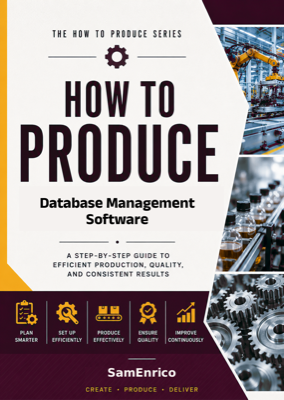
Non-FictionInformativeEducational
How to Produce Database Management Software eBook
This publication, published by SamEnrico, covers H
by Trice Jolie
This publication, published by SamEnrico, covers How to Produce Database Management Software
Formats
Free sample
Chapter 1: The Hidden Engine...–- Every second of every day, billions of transactions race through databases you have never seen, powering systems you take for granted. When you tap your phone to pay for coffee, when you scroll through a social media feed, when a hospital retrieves your medical records in an emergency, you are touching the work of a database management system. Yet almost no one—not even most software engineers—can explain what actually happens between the moment a query arrives and the moment the result appears on screen. This book exists to change that. You will not learn how to use a database; you will learn how to build one from the ground up.The Invisible Giant Consider for a moment what happens when a bank customer checks their balance online.
A SQL query lands at the database. The database must verify that the customer has permission to see the account. It must retrieve the correct version of the balance—not a stale copy, not a transaction that has not yet committed. It must acquire the right locks to ensure that no other transaction simultaneously performs an overdraft withdrawal. It must log every action so that if the power fails one millisecond later, the bank loses zero dollars.
And it must do all of this in less than fifty milliseconds, across millions of customers, thirty thousand queries per second, every single day of the year.That is the hidden engine. And you are going to build it.Most programmers spend their entire careers standing on the shoulders of database systems without ever looking down. They write SELECT * FROM users WHERE id = 5 and trust that something smart happens. They add an index when queries get slow. They set max_connections to a higher number when the application crashes.
But when the database corrupts a page, or two transactions deadlock in a way the application never handles, or the replica falls behind by six hours, the average engineer has no mental model for what went wrong. That is a career-limiting gap.This book closes that gap by teaching you to construct a working database management system from scratch. You will write actual code: a parser, an optimizer, a storage engine with B-Trees and LSM Trees, a transaction manager with MVCC and ARIES recovery, a distributed sharding layer, and a comprehensive testing harness. By the time you finish, you will understand not only how Postgre SQL, My SQL, Mongo DB, and Cassandra work under the hood, but also why they make the design trade-offs they do.What This Chapter Will Build Before we write a single line of code, we need a roadmap. This chapter establishes the architectural foundation upon which everything else rests.
You will learn:The five major components of every database management system and how they communicate The critical distinction between OLTP (online transaction processing) and OLAP (online analytical processing) engines—and why they are diverging How data flows from a SQL string to a result set through parser, rewriter, optimizer, executor, and storage layers The trade-offs that define system archetypes: row-oriented, columnar, and document store engines A concrete mental model for where each subsequent chapter fits in the overall architecture By the end of this chapter, you will see databases not as monolithic black boxes but as elegant pipelines of composable components that you could implement yourself. Let us begin.The Five Pillars of Every Database Every production database management system, regardless of its specialization, consists of the same five logical components arranged in a pipeline. Understanding this pipeline is the single most important insight in the entire book.Component One: The Parser The parser receives a raw SQL string and transforms it into a structured representation called an Abstract Syntax Tree (AST). This is the only component that cares about the textual form of the query. The parser validates syntax—mismatched parentheses, misspelled keywords, missing table names—and rejects invalid queries with an error message.
If the query is valid, the AST captures the query's structure: which tables appear in the FROM clause, which columns in the SELECT list, which predicates in the WHERE clause, and so on.Critically, the parser does not yet know whether the tables or columns actually exist. That responsibility belongs to the next component. The parser is purely syntactic. The output of the parser is a tree structure that still contains table and column names as strings, not as internal identifiers. Binding those names to actual database objects happens after parsing, during semantic analysis.Component Two: The Rewriter The rewriter takes the AST and applies logical transformations that do not depend on data statistics.
These transformations are always correct regardless of how many rows are in the tables. For example, the rewriter eliminates redundant joins where a table appears twice with the same predicates. It pushes predicates down into subqueries to filter early. It flattens nested subqueries when possible. It also injects security policies—row-level security predicates that restrict which rows a user can see—transparently before the optimizer ever sees the query.The rewriter is the unsung hero of database performance.
Many slow queries become fast simply because the rewriter transformed them into equivalent but more efficient forms. A classic example is converting SELECT * FROM orders WHERE EXISTS (SELECT 1 FROM customers WHERE customers.id = orders.customer_id) into an inner join. Both queries return the same results, but the join allows better join ordering and index utilization.This chapter is the only place in the book where we discuss the rewriter at a high level. Chapter 2 implements it fully, including the security predicate injection that makes multitenant databases safe.Component Three: The Optimizer The optimizer receives the rewritten AST and must answer the hardest question in database engineering: given dozens or hundreds of possible execution strategies, which one will run the fastest? This problem is NP-hard in the general case, yet practical optimizers solve it in milliseconds using clever heuristics and dynamic programming.The optimizer maintains statistics about each table: total row count, number of distinct values per column, histograms of value distributions.
Using these statistics, it estimates the cost of every candidate plan—the number of disk reads, CPU cycles, and network transfers. It then selects the plan with the lowest estimated cost.How does the optimizer explore the space of possible plans? For a join of ten tables, there are approximately 10! (three million) possible join orders. The optimizer cannot evaluate all of them, so it uses dynamic programming to prune the search space, keeping only the cheapest way to join each subset of tables.
This is called the Selinger algorithm, named after Patricia Selinger who published the technique in 1979 while working at IBM. Her algorithm remains the foundation of almost every commercial optimizer today.Chapter 3 dives deep into cost-based optimization, including join ordering, index selection, and the Selinger dynamic programming algorithm that changed the industry.Component Four: The Executor The executor takes the optimized plan and runs it. The plan consists of physical operators: table scans, index scans, filters, projections, joins, aggregations, and sorts. The executor calls each operator, retrieves rows, passes them through the pipeline, and assembles the final result set.The executor implements what is known…
This is the end of the free sample. Get the eBook to keep going. Buy now
About this book
Details
- Author
- Trice Jolie
- Publisher
- SamEnrico
- Language
- English
- Genre
- Non-Fiction, Informative, Educational
- Released
- 2026-05-11
- Pages (approx.)
- 159
- Available as
- eBook, Audiobook

Read better in the ZLOADR app
Your eBooks on your phone or tablet. Sign in with your SamEnrico account and start reading.
More by Trice Jolie
 Emotional Memory RewriteTrice Jolie$11.99
 LBO Term Sheet Negotiation GuideTrice Jolie$11.99
 Moving to Senior LivingTrice Jolie$11.99
 OKR For Weight LossTrice Jolie$11.99
 Reconstruction of Exhumation CasesTrice Jolie$11.99
 Dubai Universities RankingTrice Jolie$11.99
 Deep Tissue Release GuideTrice Jolie$11.99
 Self Hypnosis for Pregnancy SleepTrice Jolie$11.99
 The Ghost in the Machine: How a 1960s Robot Outsmarted Its CreatorTrice Jolie$11.99
 The Siege of Vienna: The Last Ottoman Onslaught (1683)Trice Jolie$11.99
 How to Start a Maintenance of Mausoleums Business (Beginners Guide)Trice Jolie$11.99
 One Page Marketing Experiments GuideTrice Jolie$12.99
You may also like
 Hong Kong Handover 1997Dunn Johnnie$11.99
 Zumba For Postnatal Recovery CourseNeal Christian$11.99
 Zumba for BeginnersLadner Nikia$11.99
 YouTube Comment Mining GuideHumes Pandora$12.99
 Worry Box MeditationCarlin Rudy$11.99
 Workplace Stress MeditationNguyen Lynn$11.99
 Workplace Stress and Sleep RepairHawley Ivory$11.99
 Workplace Perfectionism CureDelaney Jeffry$11.99
 Workplace Injustice Anger GuideWallen Isabelle$11.99
 Work Addiction and Burnout LinkGreenwood Ester$11.99
 Women in Yoga and WellnessBeattie Galina$11.99
 Women in Stand Up ComedyChun Evangeline$11.99