
Non-FictionInformativeEducational
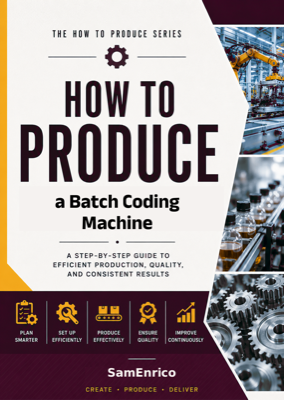
How to Produce a Batch Coding Machine eBook
This publication, published by SamEnrico, covers H
This publication, published by SamEnrico, covers How to Produce a Batch Coding Machine
Formats
Free sample
Chapter 1: Beyond the Ink...--–- The first thing you must understand about batch coding is that it has nothing to do with ink. Or lasers. Or labels. Those are merely the instruments. Batch coding, at its core, is about trust—trust between a manufacturer and a regulator, between a brand and a consumer, and between a product and its documented history.
When you set out to produce a batch coding machine, you are not building a printer. You are building a silent witness that follows every package, every bottle, every medical device from the moment it receives its identity until the moment it is opened, consumed, or implanted.This distinction is not philosophical. It is practical, legal, and financial. A batch coding machine that fails—that prints a smeared expiration date, that skips a serial number, that applies a lot code to the wrong product—does not simply inconvenience the production line. It creates a liability that can travel across continents, survive for years, and surface during a regulatory audit or a product recall.
I have seen a single missing digit on a pharmaceutical batch code trigger a $470 million recall. I have watched a food manufacturer’s brand value drop by 30 percent because a batch code on contaminated lettuce was illegible, making traceability impossible. I have consulted for automotive suppliers who faced class-action lawsuits because counterfeit brake pads, indistinguishable from genuine ones, lacked the proper batch markings that would have revealed their origin.This chapter establishes the foundational why before we ever touch the how. Before you select a print engine, before you design a conveyor, before you write a single line of PLC code, you must understand what you are truly producing: a machine that secures the chain of custody for every item it touches.The Cost of Invisible Failure Batch coding errors occupy a strange place in manufacturing economics. They are simultaneously low-frequency and high-impact.
Most lines run for weeks without a coding issue. Operators become complacent. Managers assume that if the machine is running, it is coding correctly. Then, without warning, a sensor drifts, an ink nozzle partially clogs, a laser mirror loses calibration, and two hours of production—twelve thousand units—roll off the line with codes that are unreadable, incorrect, or completely missing.The tragedy is that the machine itself rarely detects these failures. A batch coding machine has no inherent knowledge of whether the mark it just made is legible, accurate, or even present.
It only knows that it fired. This is why, in the chapters ahead, we will spend considerable time on verification systems—cameras, sensors, and rejectors that close the feedback loop. But for now, understand this: the machine you produce will be blind to its own mistakes unless you design eyes for it.The cost structure of coding failures falls into four overlapping categories, each of which should be quantified before you finalize any design specification.Direct recall costs are the most visible. When a product cannot be traced because its batch code is missing or illegible, regulators require a recall of all potentially affected units, often spanning multiple production runs. For a medium-sized food manufacturer, a single recall can cost 10millionto10 million to 10millionto30 million in logistics, disposal, and replacement production.
For pharmaceutical companies, the numbers are higher. A recall triggered by a coding error—such as applying an expiration date that is too early or too late—can exceed $100 million when you factor in regulatory fines and mandatory plant shutdowns for investigation.Liability and litigation costs often exceed recall expenses. If a consumer is harmed because a missing batch code prevented a contaminated product from being identified and removed from the market, the resulting lawsuits can bankrupt a company. I am aware of a case where a baby formula manufacturer settled for 65millionafterincorrectlycodedlotnumberspreventedthecompanyfromisolatingacontaminatedbatch,leadingtodozensofinfantillnesses.Thecodingmachineitselfcostlessthan65 million after incorrectly coded lot numbers prevented the company from isolating a contaminated batch, leading to dozens of infant illnesses. The coding machine itself cost less than 65millionafterincorrectlycodedlotnumberspreventedthecompanyfromisolatingacontaminatedbatch,leadingtodozensofinfantillnesses.Thecodingmachineitselfcostlessthan15,000.Brand damage is harder to quantify but often more devastating.
Consumers do not distinguish between a coding error and a quality control failure. If they see a smeared, unreadable date code on a package, they assume the entire product is cheap or unsafe. Repeat purchases drop. Premium pricing erodes. One major beverage company found that a six-month period of inconsistent date code printing—caused by an aging CIJ machine that management refused to replace—reduced brand trust scores by 18 percent, a deficit that took three years and $40 million in marketing to recover.Operational chaos is the hidden cost.
When coding errors are detected at the end of a production line—by a quality control inspector or, ideally, by an automated verification system—the line must stop. Thousands of units must be re-inspected manually or, in worst cases, destroyed. Production schedules collapse. Downstream processes run out of inventory. Warehouse workers spend hours searching for mis-coded pallets.
I have measured these disruptions and found that a single uncorrected coding error that escapes to the customer costs, on average, 40 hours of labor across quality, logistics, and management teams.The machine you produce must be judged not by its printing speed or its consumables cost but by its ability to prevent these failures. Every design decision—from sensor selection to HMI layout to rejection mechanism design—should be evaluated against the question: "Does this reduce the probability of an undetected coding error?"Regulatory Landscapes: The Rules That Cannot Be Broken Batch coding exists at the intersection of commercial practice and legal requirement. In many industries, coding is not optional. The specific requirements vary by jurisdiction and product category, but the underlying principle is universal: manufactured goods must carry a unique identifier that links them to their production records, and that identifier must remain legible throughout the product's intended shelf life.In the United States, the Food and Drug Administration (FDA) enforces coding requirements under 21 CFR Part 11, which governs electronic records and electronic signatures. For pharmaceutical products, the Drug Supply Chain Security Act (DSCSA) requires serialization at the package level—each individual saleable unit must have a unique serial number embedded in a 2D data matrix barcode.
The batch coding machine you produce for pharma applications must therefore be capable of generating, storing, and printing thousands of unique serial numbers without repetition or error. This is not a trivial requirement. It demands robust random number generation, secure memory for serial number pools, and error-handling routines that prevent the same serial number from ever being printed twice.For medical devices, the Unique Device Identification (UDI) system requires similar serialization, with the additional requirement that the code must be readable after sterilization, implantation, or years of storage. This drives technology selection toward laser marking (which creates permanent surface changes) rather than ink-based printing (which can degrade or wipe off).The European Union operates under EU Annex 11 for computerized systems and, for pharmaceuticals, the Falsified Medicines Directive (2011/62/EU). These regulations require not only serialization but also aggregation—the ability to link individual package codes to the case, pallet, and shipment that contain them.
Your batch coding machine must therefore communicate upward to warehouse management systems (WMS) and enterprise resource planning (ERP) systems, which…
This is the end of the free sample. Get the eBook to keep going. Buy now
About this book
Details
- Author
- Avalos Krysten
- Publisher
- SamEnrico
- Language
- English
- Genre
- Non-Fiction, Informative, Educational
- Released
- 2026-05-08
- Pages (approx.)
- 154
- Available as
- eBook, Audiobook

Read better in the ZLOADR app
Your eBooks on your phone or tablet. Sign in with your SamEnrico account and start reading.
More by Avalos Krysten
 Networking for the Data ScientistAvalos Krysten$11.99
 Gut Brain Axis and ArthritisAvalos Krysten$11.99
 Letting Go of Career IdentityAvalos Krysten$11.99
 Mindful Parenting MBSR GuideAvalos Krysten$11.99
 The Lion’s Den: The British Spy Who Infiltrated the Zulu KingdomAvalos Krysten$11.99
 Ferro-anthophyllite MiningAvalos Krysten$11.99
 Chinese Student Conversation CirclesAvalos Krysten$12.99
 How to Start a Bone Degreasing By Knackers Business (Beginners Guide)Avalos Krysten$11.99
You may also like
 Hong Kong Handover 1997Dunn Johnnie$11.99
 Zumba For Postnatal Recovery CourseNeal Christian$11.99
 Zumba for BeginnersLadner Nikia$11.99
 YouTube Comment Mining GuideHumes Pandora$12.99
 Worry Box MeditationCarlin Rudy$11.99
 Workplace Stress MeditationNguyen Lynn$11.99
 Workplace Stress and Sleep RepairHawley Ivory$11.99
 Workplace Perfectionism CureDelaney Jeffry$11.99
 Workplace Injustice Anger GuideWallen Isabelle$11.99
 Work Addiction and Burnout LinkGreenwood Ester$11.99
 Women in Yoga and WellnessBeattie Galina$11.99
 Women in Stand Up ComedyChun Evangeline$11.99