
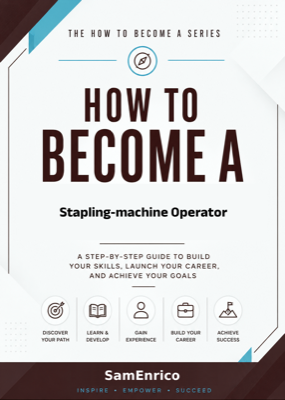
Non-FictionInformativeEducational
How to Become a Stapling-machine Operator eBook
How to Become a Stapling-machine Operator
How to Become a Stapling-machine Operator
Formats
Free sample
Chapter 1: The Million-Dollar Jam--Every factory floor has a sound. Not the obvious noise of motors and conveyors, but a deeper rhythm—a heartbeat made of metal striking metal, wire feeding through guides, and finished products sliding into stacking trays. When that rhythm is steady, the world keeps turning. Booklets get mailed. Jeans get shipped.
Boxes arrive on doorsteps. When that rhythm stops, the world notices in ways most people never trace back to the source.The source is often a single staple.Not a desk stapler—the kind you refill once a year and forget exists. An industrial staple. Half an inch of flattened steel wire traveling at thirty feet per second through a stitching head that has slammed down five million times before breakfast. When that staple jams—when it folds back on itself instead of penetrating, when the wire kinks in the feed channel, when the clincher fails to close the legs—a machine that cost $200,000 stops.
A production line that promised 10,000 units per hour becomes a silent monument to a one-cent piece of wire.The operator who clears that jam in ninety seconds is worth more to the company than the engineer who designed the machine.This chapter is about why that statement is true. It is about the economics of the invisible, the career security of the hands-on trade, and the million-dollar jam that launched more careers than any college degree ever will. By the end of this chapter, you will see stapling-machine operation not as a niche skill for a dying industry, but as a blueprint for job security in an automated world.The Economics of the Stitch Let us begin with a number: $1,200 per minute.That is the approximate cost of downtime on a high-speed saddlestitcher running at 12,000 booklets per hour. When the machine stops, the company loses not only the product that would have been made in that minute, but also the labor of the operators standing idle, the amortized cost of the machine not producing, and the ripple effect on downstream processes—packaging, palletizing, shipping, invoicing.A ten-minute jam costs 12,000.Aone−hourbreakdowncosts12,000. A one-hour breakdown costs 12,000.Aone−hourbreakdowncosts72,000.
A catastrophic failure requiring a service technician from three states away can exceed $500,000 before anyone has replaced a single part.Now consider the scale of the industry that depends on stapling. Every magazine on every newsstand in America is bound with wire stitches. Every corrugated box that carries goods from warehouse to doorstep is assembled with staples or stitched seams. Every pair of jeans, every work shirt, every uniform—assembled by industrial sewing machines that are, in every functional sense, stapling machines using thread instead of wire. The global industrial fastening market exceeds four billion dollars annually.
Behind that number are tens of thousands of operators, feeders, and technicians who keep the machines running.The median age of these workers is fifty-two years old. One in three is eligible for retirement within the next decade. The number of young workers entering the trade has fallen by forty percent since 2000, driven by two decades of "college for everyone" messaging that emptied vocational programs and filled universities with students who would have been happier and wealthier in the trades.This gap between retiring experts and incoming novices is the single greatest career opportunity in modern manufacturing. Companies are desperate for operators who understand their machines. They will train, they will pay overtime, they will fast-track promotions, and they will look past missing credentials if you can demonstrate one thing: the ability to keep the line moving.Three Industries, One Skill Set The term "stapling-machine operator" is a lie.
Not a malicious one, but a bureaucratic one—the kind of lie that appears on government job classification forms and HR intake sheets. In reality, there are three distinct industries that use stapling technology, and each requires a slightly different dialect of the same core language.First, the bookbinding operator works with wire stitchers on paper products. Signatures—the folded sheets that become pages—are gathered, collated, and fed into a saddlestitcher that drives staples through the spine. The operator monitors paper alignment, staple depth, and clinch tightness. A loose staple means pages fall out.
A tight staple means the booklet won't lie flat. The operator lives in the narrow space between too much and not enough.Second, the garment operator works with industrial sewing machines. The technology is different—thread instead of wire, needles instead of drivers—but the underlying skills are identical: feeding material at consistent speed, maintaining tension, clearing jams, and producing uniform fastening. The garment operator who cannot diagnose a tension problem will never produce a straight seam. The one who can will run circles around coworkers who only know how to press the pedal.Third, the packaging operator works with box stayers and corner staplers.
Corrugated cardboard is less forgiving than paper or fabric. A staple that penetrates too deeply crushes the flute structure and weakens the box. A staple that sits too high snags on conveyors and causes pileups. The packaging operator learns to read the material by sound and feel—the crunch of correct penetration, the resistance pattern of a clean clinch.These three paths diverge in equipment and converge in mindset. Every successful operator, regardless of industry, develops mechanical empathy—the ability to sense what a machine is doing without seeing it directly, to hear the change in pitch that precedes a jam, to feel the difference between a clean feed and a misfeed through the vibration in the floor.The Three Rungs of the Ladder Not every person who works near a stapling machine is an operator.
Understanding the three career levels is essential for planning your advancement and knowing which skills to develop first.Rung One: The Feeder The feeder is entry-level. You load materials—paper signatures, fabric rolls, cardboard blanks—into the machine's infeed system. You do not make adjustments. You do not clear jams. You do not perform maintenance.
Your job is to keep the machine fed and to call an operator when something goes wrong.The salary range for feeders is 28,000to28,000 to 28,000to35,000 per year, depending on region and industry. The work is physical. You will stand for eight to twelve hours. You will lift fifty-pound bundles. You will learn the rhythms of the machine without being responsible for them.The feeder position is valuable for two reasons.
First, it pays a living wage while you learn. Second, and more important, it immerses you in the production environment. You hear the machine's healthy sounds every day. You see what good feeding looks like. You build the sensory memory that will later let you diagnose problems from across the room.Most feeders become operators within six to eighteen months.
The ones who stall at this level are those who never ask questions, never watch the operator clear a jam, never study the machine when it is stopped for maintenance. The ones who advance are the ones who treat every shift as a paid apprenticeship.Rung Two: The Operator The operator runs the machine. You perform routine setup: adjusting back gauges and side guides, setting clinch allowance, loading new wire spools or thread cones. You monitor production…
This is the end of the free sample. Get the eBook to keep going. Buy now
About this book
Details
- Author
- Willoughby Cortney
- Publisher
- SamEnrico
- Language
- English
- ISBN
- 9781506065472
- Genre
- Non-Fiction, Informative, Educational
- Released
- 2026-06-02
- Pages (approx.)
- 133
- Available as
- eBook, Paperback, Audiobook

Read better in the ZLOADR app
Your eBooks on your phone or tablet. Sign in with your SamEnrico account and start reading.
More by Willoughby Cortney
 International Franchise Succession PlanningWilloughby Cortney$11.99
 Endometriosis and HysterectomyWilloughby Cortney$11.99
 SnoreLab App GuideWilloughby Cortney$11.99
 The Italian Tuition Calculator GuideWilloughby Cortney$11.99
 Austrian Green Tax CreditsWilloughby Cortney$11.99
 The Lioness of the Horn: The Military Genius of GuditWilloughby Cortney$11.99
 Understanding Retinohepatoendocrinologic SyndromeWilloughby Cortney$17.99
 Kenya Remote Hiring PlatformsWilloughby Cortney$12.99
 Ankara Student City GuideWilloughby Cortney$12.99
 Lead TeacherWilloughby Cortney$11.99
You may also like
 Hong Kong Handover 1997Dunn Johnnie$11.99
 Zumba For Postnatal Recovery CourseNeal Christian$11.99
 Zumba for BeginnersLadner Nikia$11.99
 YouTube Comment Mining GuideHumes Pandora$12.99
 Worry Box MeditationCarlin Rudy$11.99
 Workplace Stress MeditationNguyen Lynn$11.99
 Workplace Stress and Sleep RepairHawley Ivory$11.99
 Workplace Perfectionism CureDelaney Jeffry$11.99
 Workplace Injustice Anger GuideWallen Isabelle$11.99
 Work Addiction and Burnout LinkGreenwood Ester$11.99
 Women in Yoga and WellnessBeattie Galina$11.99
 Women in Stand Up ComedyChun Evangeline$11.99