
Non-FictionInformativeEducational
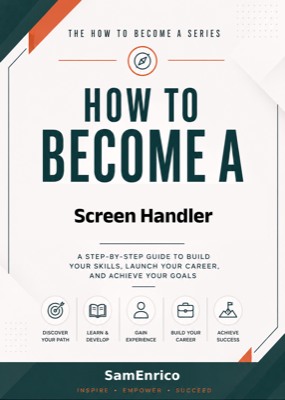
How to Become a Screen Handler eBook
How to Become a Screen Handler
How to Become a Screen Handler
Formats
Free sample
Chapter 1: The Corpse on Page One--The first corpse you will ever encounter as a screenwriter is not a body. It is a script. Your script. Or rather, the version of your script that dies before anyone reads it.I have read over ten thousand screenplays as a studio reader. That is not a brag.
It is a confession. Because for every one script that made me lean forward in my chair, nine thousand nine hundred and ninety-nine made me lean back, check my phone, and reach for the rejection stamp. And here is the thing that still keeps me awake some nights: most of those nine thousand nine hundred and ninety-nine scripts had good ideas buried inside them. They had characters I could have loved. They had moments that could have made me cry.
But I never got to those moments. Because the script killed itself before page ten.This book is called How to Become a Screen Handler. The title is deliberate. It is not a term you will find in any Hollywood handbook. There is no guild for Screen Handlers.
No Oscars. But the professionals who survive in this business—the ones who sell scripts, get staffed, and build actual careers—they all share one thing. They know how to handle a screenplay. They handle the page (formatting, rhythm, white space). They handle the structure (beats, acts, turning points).
They handle the room (pitches, notes, silence). And most importantly, they handle themselves (rejection, burnout, the long silence between yeses).But before you can handle any of that, you have to handle the corpse on page one. You have to understand why most scripts die before they live.The Mistake You Are Making Right Now Let me tell you about a script I read in 2014. The logline was promising: A retired military dog handler must return to Afghanistan to rescue the bomb-sniffing dog he left behind, or live with the guilt forever. I was excited.
I poured coffee. I sat down. I turned to page one.The script opened with a man named Frank. Frank was sitting in a diner. He was drinking coffee.
The waitress asked if he wanted a refill. He said yes. She asked how his day was going. He said fine. The scene went on for three pages.
Three pages of a man drinking coffee in a diner while the waitress asked questions that revealed nothing except that the writer had recently watched a lot of independent films.On page four, Frank left the diner and got into his truck. He drove. The screenplay described the road. The trees. The way the sun hit the windshield.
On page six, he arrived at his house. He walked inside. He sat on a couch. He turned on the television. The television showed a news report about Afghanistan.
Frank turned it off. End of scene.On page eight, Frank went to a grocery store. He bought eggs. He paid with cash. The cashier asked if he wanted a bag.
He said no.On page ten, I stopped reading.Not because the script was bad in a spectacular way. It was bad in the most common way: nothing was happening. The writer had confused situation with story. They had described a man living a life—driving, buying eggs, sitting on couches—without ever establishing what that man wanted and what was in his way.This is the corpse on page one. It is a script that mistakes activity for drama, location for conflict, and backstory for character.The Situation vs.
The Story Here is the single most important distinction you will learn in this book. Write it down. Tape it above your computer.A situation is static. A story is dynamic.A situation describes where a character is and what they are doing. A retired cop living in a small town.
A divorced mother raising two children. A screenwriter drinking coffee in a diner. These are situations. They are photographs. They do not move.A story describes what a character wants and what happens if they fail.
A retired cop must return to the force to save his estranged daughter, or she will die. A divorced mother must win a custody battle against her wealthy ex-husband, or she will lose her children forever. A screenwriter must sell a script in six months, or she will lose her apartment and move back in with her parents.Do you feel the difference? The situation is a noun. The story is a verb.
The situation is a photograph. The story is a bomb with a timer.Most aspiring writers—and I mean ninety-nine out of a hundred—begin with a situation. They have a character they like. A setting they find interesting. A mood they want to evoke.
So they write scenes that establish that situation. The character drinks coffee. The character drives a truck. The character buys eggs. These scenes are not story.
They are wallpaper. And a reader will flip past wallpaper every single time.The professionals, the Screen Handlers, begin with a story. They know their protagonist wants something specific, tangible, and urgent. They know what is standing in the way. And they know what the protagonist will lose if they fail.
That knowledge transforms every scene. The coffee in the diner is no longer just coffee—it is a delay before a confrontation. The drive in the truck is no longer just a drive—it is a ticking clock. The grocery store is no longer just errands—it is a chance encounter with the antagonist.The Character Core: Your Protagonist's Engine Throughout this book, we will use a single unified term for the force that drives your protagonist. I call it the Character Core.Other books use different words.
Some call it the protagonist's flaw. Others call it the wound, the false belief, the ghost, or the spine. I have consolidated all of these into one term because I have seen too many writers get lost in the vocabulary. The Character Core is simple: it is the thing your protagonist believes about themselves or the world that is wrong, and the thing they must confront or change by the end of the story.The Character Core has two parts: the external want and the internal need.The external want is what your protagonist thinks they want. It is concrete, measurable, and story-shaped.
A promotion. A rescue. A revenge. A confession. The external want drives the plot.
It gives your protagonist something to do.The internal need is what your protagonist actually needs, though they would never admit it. To forgive. To trust. To let go. To stop running.
The internal need is the lesson your protagonist resists learning until the very end.The gap between the external want and the internal need is where drama lives. Every scene, every line of dialogue, every decision your protagonist makes should be pulled between these two forces.Consider the retired military dog handler from the script I rejected. The writer had given him an external want (rescue the dog) but no internal need. The character had no false belief to confront, no wound to heal. He just wanted a dog.
That is not a story. That is an errand.Now imagine the same premise with a Character Core. The retired handler…
This is the end of the free sample. Get the eBook to keep going. Buy now
About this book
Details
- Author
- Lattimore Callie
- Publisher
- SamEnrico
- Language
- English
- ISBN
- 9781506054476
- Genre
- Non-Fiction, Informative, Educational
- Released
- 2026-05-02
- Pages (approx.)
- 140
- Available as
- eBook, Paperback, Audiobook

Read better in the ZLOADR app
Your eBooks on your phone or tablet. Sign in with your SamEnrico account and start reading.
More by Lattimore Callie
 Fear Avoidance EducationLattimore Callie$11.99
 IBS Urgency Management Strategies WorkbookLattimore Callie$11.99
 The Reluctant GovernorLattimore Callie$11.99
 Harvard Extension vs LSE Refund PoliciesLattimore Callie$11.99
 The Shot That Changed Everything: The Unlikely Rise of Dirk NowitzkiLattimore Callie$11.99
 Longwang's Lost Pearl: The Dragon King's Forbidden LoveLattimore Callie$11.99
 Street Sweeper OperationLattimore Callie$11.99
 Education Digital Payment OutlookLattimore Callie$12.99
 Microsoft Africa AI PlaybookLattimore Callie$12.99
 Understanding Hydrocephaly Tall Stature Joint LaxityLattimore Callie$17.99
You may also like
 Hong Kong Handover 1997Dunn Johnnie$11.99
 Zumba For Postnatal Recovery CourseNeal Christian$11.99
 Zumba for BeginnersLadner Nikia$11.99
 YouTube Comment Mining GuideHumes Pandora$12.99
 Worry Box MeditationCarlin Rudy$11.99
 Workplace Stress MeditationNguyen Lynn$11.99
 Workplace Stress and Sleep RepairHawley Ivory$11.99
 Workplace Perfectionism CureDelaney Jeffry$11.99
 Workplace Injustice Anger GuideWallen Isabelle$11.99
 Work Addiction and Burnout LinkGreenwood Ester$11.99
 Women in Yoga and WellnessBeattie Galina$11.99
 Women in Stand Up ComedyChun Evangeline$11.99