
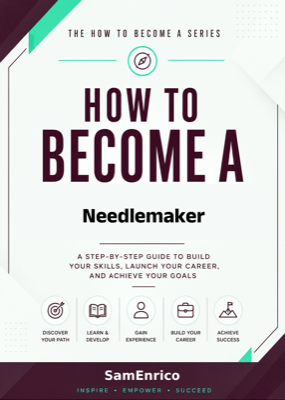
How to Become a Needlemaker eBook
How to Become a Needlemaker
How to Become a Needlemaker
Formats
Free sample
Chapter 1: The Needle Compass--– Before you ever pull a single wire through a drawplate or strike your first punch, you must know which needle wants to be made by your hands. This is not a poetic sentiment but a practical necessity. The universe of needles is vast—far vaster than most people imagine—and each category demands a different combination of tools, skills, materials, and mental endurance. A surgical needle maker operates in a world of medical certifications and micron-level point geometry. A tattooing needle maker lives in the realm of grouped configurations, sterile packaging, and artists who can feel a burr smaller than a human hair.
A darning needle maker serves a small but passionate community of fiber artists who will pay a premium for a smooth eye that never frays their expensive wool. And a felting needle maker must carve microscopic barbs into hardened steel—a skill that borders on the obsessive.This chapter is your compass. It will not tell you which needle to make. That decision belongs to you. But it will draw the complete map of the needle universe, showing you every major territory, the demands of each, the market realities, and the hidden traps that beginners never see coming.
By the end of this chapter, you will have a provisional answer to the most important question you will ask as a beginner: Which needle is mine?And because this book believes in revisiting hard decisions with better information, we will return to this question in Chapter 11. There, after you have learned the full weight of manufacturing difficulty, liability, and true market size, you will re-evaluate your choice. Some of you will double down on your original niche. Others will pivot. Both outcomes are signs of wisdom, not failure.The Hidden Diversity of Needles Let us begin with a simple exercise.
Close your eyes and picture a needle. Most people see the same image: a thin metal shaft, a sharp point at one end, an oval eye at the other. This is the sewing needle of domestic mythology—the one in grandmother’s tomato-shaped pincushion. But that single image obscures a staggering diversity of form and function.In reality, there are over three hundred distinct types of needles in production today, and that number excludes obsolete varieties found only in antique collections or museum drawers. Each type exists because some material, some thread, some tissue, or some artistic technique demands a unique solution.
Leather needles, for example, have triangular or spear points that cut through hide rather than pushing fibers apart. Ballpoint needles, by contrast, have rounded tips that slip between the loops of knitted fabric without breaking individual yarns. A hypodermic needle is essentially a tiny hollow tube ground to a razor-bevel at one end—a completely different manufacturing challenge from a solid sewing needle. And a phonograph needle, now nearly extinct, was never a sewing tool at all but a playback stylus for shellac records.This diversity is your opportunity. Mass production has conquered the middle of the market—the common sewing needle sold in plastic packets of fifty.
But the edges of the market—the specialty needles, the restoration needles, the custom needles for particular machines or techniques—remain wide open for the artisan maker. The question is not whether you can compete with a factory. You cannot, and you should not try. The question is which corner of the needle universe has been abandoned by mass manufacturing and now craves the attention of careful hands.The Complete Taxonomy of Needles Let us now walk through the needle universe systematically. I have organized needles by function, because function determines manufacturing method.
A needle designed to pierce leather has little in common with a needle designed to carry suture through living tissue, even if both are made of steel and share a superficial resemblance.Sewing Needles (Domestic and Industrial)This is the largest family and the one most people think of first. Within sewing needles, there are sharps (general purpose, medium length), betweens (short, for quilting and fine handwork), milliners (long, with round eyes, for hat-making and pleating), and embroidery needles (large eyes for multiple strands of floss). Industrial sewing needles—used in high-speed garment factories—are a different breed entirely. They are hardened to greater brittleness, have more complex eye geometries, and must survive millions of cycles without breaking. The domestic hand-sewing market is crowded but has room for premium artisan needles at 5–5–5–15 each.
The industrial market is virtually closed to individuals because factories buy by the hundred-thousand and demand perfect uniformity.Darning and Mending Needles These needles are long, with large, elongated eyes intended for wool yarn and thicker threads. Their points are usually blunt or ball-tipped because darning pushes yarn through existing fabric rather than creating new punctures. The darning needle market is small but loyal. Mending has become fashionable again—the visible mending movement on social media has created demand for needles that are both functional and aesthetically pleasing. Some artisan darning needles now feature brass or copper eyes as decorative elements.
This niche rewards creativity and visual branding more than extreme precision.Embroidery and Crewel Needles Embroidery needles have sharp points and long, oval eyes designed to accommodate multiple strands of cotton floss or silk thread without fraying. Crewel needles are a subset, used for wool thread on linen. The defining feature of a good embroidery needle is eye smoothness. A rough eye will shred expensive floss within minutes, infuriating the stitcher. This category rewards meticulous hand-filing of the eye interior—a skill you will develop in Chapter 6.
Embroidery needle makers can command 8–8–8–20 per needle for custom sizes or unusual eye shapes.Surgical and Suture Needles This is the most technically demanding category and the most legally regulated. Surgical needles are not sold to the general public; they are sold to hospitals, clinics, and medical supply distributors. You will need ISO 13485 certification (medical device quality management), sterile packaging capabilities, and liability insurance that will make your eyes water. The needles themselves are typically made from 300-series stainless steel, which is more difficult to work than carbon steel. They come in two broad types: round-bodied (for soft tissue like liver or kidney, where cutting must be minimized) and cutting-edge (for skin or tendon, where the needle must slice through tough material).
Surgical needles also have specialized tip geometries: tapercut, reverse cutting, spatula (for eye surgery), and blunt (for friable tissue). This is not a beginner’s niche. But if you have a background in medical device manufacturing or a close partnership with a surgeon, the margins can be substantial—often 2–2–2–10 per needle in volume, with custom needles commanding much more.Hypodermic Needles Hypodermic needles are hollow. That single fact changes everything about their manufacture. You are no longer working with solid wire but with thin-walled tubing.
The point is ground with a multi-bevel geometry that maximizes sharpness while minimizing pain and tissue drag. The interior lumen must be perfectly smooth and free of burrs that could scrape skin cells or bacteria into the injection site. This is precision manufacturing at its most unforgiving. Most hypodermic needles are made by automated grinding lines. There is almost no artisan market.
Unless you have access to medical-grade tubing, a precision grinder, and a cleanroom, avoid this category entirely.Upholstery and Heavy-Duty Needles…
This is the end of the free sample. Get the eBook to keep going. Buy now
About this book
Details
- Author
- Wilder Merissa
- Publisher
- SamEnrico
- Language
- English
- ISBN
- 9781505750140
- Genre
- Non-Fiction, Informative, Educational
- Released
- 2026-05-02
- Pages (approx.)
- 130
- Available as
- eBook, Paperback, Audiobook

Read better in the ZLOADR app
Your eBooks on your phone or tablet. Sign in with your SamEnrico account and start reading.
More by Wilder Merissa
 Cynicism And Depersonalization Recovery HandbookWilder Merissa$11.99
 Vidor Crowd ProcessWilder Merissa$11.99
 Missing Finger Self Esteem PlanWilder Merissa$11.99
 Second Baby Sleep GuideWilder Merissa$11.99
 Navigating Breakup and Separation TalksWilder Merissa$11.99
 Tariq ibn Ziyad: The Sword and the Strait – Conquest of IberiaWilder Merissa$11.99
 System Engineer InfrastructureWilder Merissa$11.99
 PESTLE Analysis Generation GuideWilder Merissa$12.99
 Australia Critical Tech PlanWilder Merissa$12.99
 Understanding Mesenteric PanniculitisWilder Merissa$17.99