
Non-FictionInformativeEducational
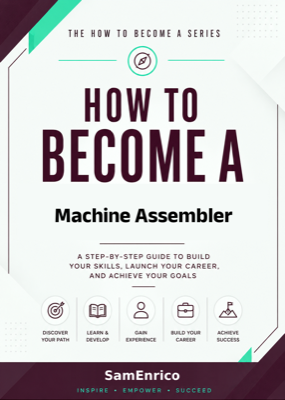
How to Become a Machine Assembler eBook
How to Become a Machine Assembler
How to Become a Machine Assembler
Formats
Free sample
Chapter 1: The $1.7 Million Lie--You have been lied to.Not maliciously, probably. Not by anyone who wished you harm. But lied to nonetheless by guidance counselors who never worked a day on a shop floor, by parents who wanted what was “best” for you, by a society that decided decades ago that a four-year degree was the only path to a respectable life. The lie sounds like this: “If you don’t go to college, you’ll end up working in a factory.”As if working in a factory were a punishment. As if using your hands to build things that save lives, power cities, and explore space were somehow less honorable than sitting in a cubicle updating spreadsheets.
As if a piece of paper from a university—any university—was worth more than the ability to look at a set of blueprints and turn raw metal into a functioning machine that will run for twenty years without failure.This chapter is going to make you uncomfortable. It is going to make you angry. And then it is going to show you exactly how to turn that anger into a career that will out-earn most of your college-bound friends within five years, with zero debt, and with skills that artificial intelligence cannot replicate and offshore labor cannot touch.Welcome to the truth about becoming a machine assembler.The Coffee Shop Test Let us run a quick experiment. Walk into any coffee shop in America on a Tuesday morning. Look at the people hunched over laptops.
Most of them have bachelor’s degrees. Most of them are making between $40,000 and $60,000 per year. Most of them have student loan payments between $200 and $800 per month. Most of them are terrified of layoffs, because their skills are general and their replacements are already being trained for half their salary in a dozen different countries.Now drive to the nearest industrial park. Walk onto the shop floor of any manufacturing facility.
Look at the men and women in steel-toed boots and safety glasses. Most of them have high school diplomas and trade certificates. Most of them are making between $50,000 and $80,000 per year. Most of them have zero student loan debt because they got paid to learn their trade through apprenticeships. Most of them are not worried about layoffs, because their skills are specific and their replacements cannot be trained in Bangalore or Manila.The coffee shop graduates have the prestige.
The shop floor assemblers have the paycheck, the job security, and the dignity of building something real.Which group would you rather join?The $1.7 Million Calculation Let us do the math that nobody tells you in high school.The average cost of a four-year public university in the United States is approximately $108,000 including tuition, fees, room, board, and books over four years. Private universities average nearly $220,000. The average student graduates with $37,000 in debt, but that average conceals a brutal reality: nearly twenty percent of borrowers owe more than $100,000, and six percent owe more than $200,000.Now let us calculate the opportunity cost. A typical college student spends four years earning nothing or working part-time for minimum wage. During those same four years, a machine assembler apprentice earns an average of $35,000 to $45,000 per year while learning.
That is $140,000 to $180,000 of income the college student does not receive.Add the debt. Add the interest. Add the years of payments. A recent study from the Center for Retirement Research found that the average college graduate who borrows will lose approximately $1.7 million in lifetime wealth compared to what they would have had if they had started working and investing immediately after high school. That is not a typo.
$1.7 million. The college premium that economists used to talk about has nearly vanished when you account for debt, delayed earnings, and the rising cost of degrees.The machine assembler who starts at eighteen, completes an apprenticeship by twenty-two, earns journeyman wages, invests fifteen percent of their income, and buys a home instead of renting? That person will likely retire earlier and wealthier than the average college graduate.This book is not anti-education. It is anti-stupid-debt. If you want to become an engineer or a doctor, go to college.
But if you want to build machines, you are about to learn that the path through the shop floor is shorter, cheaper, and more lucrative than the path through the lecture hall.Who Is a Machine Assembler, Really?Let us dismantle the stereotype right now.A machine assembler is not someone who “just puts parts together.” A machine assembler is a precision technician who takes dozens, hundreds, or thousands of individual components and assembles them into complex systems that must function perfectly under extreme conditions. The machine assembler is the final quality checkpoint before a product ships to a customer. The machine assembler is the person who looks at an engineering drawing and says, “This tolerance cannot be achieved with the tooling provided,” saving the company thousands of dollars in rework. The machine assembler is the person who feels a bearing seat incorrectly and stops the line before a catastrophic failure reaches the customer.In aerospace, machine assemblers build jet engines where a single incorrectly torqued bolt can cause a contained engine failure that grounds an entire fleet. In medical devices, assemblers build surgical robots where a misaligned gear can mean the difference between a successful operation and a lawsuit.
In automotive manufacturing, assemblers build electric vehicle drivetrains where a poorly sealed battery pack can cause a fire. In energy, assemblers build wind turbines where a improperly tensioned bolt can bring down a million-dollar blade.These are not simple jobs. These are skilled trades that require hundreds of hours of training, thousands of hours of practice, and a mindset that combines mechanical intuition, mathematical precision, and obsessive attention to detail.The three primary roles in this field represent different career paths with different earning potentials and different daily realities.Mechanical Assemblers work with gears, frames, hydraulics, bearings, belts, chains, and structural components. They spend their days reading mechanical drawings, torquing bolts to precise values, pressing bearings into housings, aligning shafts with dial indicators, and testing mechanical function. This is the most common entry point, with starting salaries between $31,000 and $42,000 and senior salaries between $50,000 and $70,000.Electronic Assemblers work with circuit boards, wiring harnesses, sensors, connectors, and control panels.
They spend their days soldering components, crimping wires, routing harnesses through tight spaces, testing continuity, and troubleshooting electrical faults. This role pays slightly higher than mechanical assembly due to the specialized skills, with starting salaries between $35,000 and $50,000 and senior salaries between $55,000 and $75,000.Electro-Mechanical Assemblers —also called mechatronics technicians—work with both mechanical and electronic systems. They are the most valuable assemblers because they can see the whole machine. They understand how a sensor’s electrical signal translates to a pneumatic cylinder’s mechanical motion. They can troubleshoot a machine that is “acting weird” because they understand both the hardware and the controls.
Starting salaries for electro-mechanical assemblers range from $45,000 to $65,000, and senior specialists with ten years of experience regularly earn $80,000 to $100,000 or more.Which of these three roles interests you most? The answer will shape which chapters of this book you study most intensely.Industry 4.0…
This is the end of the free sample. Get the eBook to keep going. Buy now
About this book
Details
- Author
- Richmond Alexa
- Publisher
- SamEnrico
- Language
- English
- ISBN
- 9781505766035
- Genre
- Non-Fiction, Informative, Educational
- Released
- 2026-06-02
- Pages (approx.)
- 142
- Available as
- eBook, Paperback, Audiobook

Read better in the ZLOADR app
Your eBooks on your phone or tablet. Sign in with your SamEnrico account and start reading.
More by Richmond Alexa
 Total Market Index Fund ApproachRichmond Alexa$11.99
 Zookeeper Emergency StressRichmond Alexa$11.99
 NVC For Community OrganizingRichmond Alexa$11.99
 Mortician Stress ManagementRichmond Alexa$11.99
 The Alchemists of Light: Kepler, Galileo, and the Birth of Modern AstronomyRichmond Alexa$11.99
 How to Produce Bird ToysRichmond Alexa$11.99
 Freemium Grace Period PolicyRichmond Alexa$12.99
 Apprentice ElectricianRichmond Alexa$11.99
You may also like
 Hong Kong Handover 1997Dunn Johnnie$11.99
 Zumba For Postnatal Recovery CourseNeal Christian$11.99
 Zumba for BeginnersLadner Nikia$11.99
 YouTube Comment Mining GuideHumes Pandora$12.99
 Worry Box MeditationCarlin Rudy$11.99
 Workplace Stress MeditationNguyen Lynn$11.99
 Workplace Stress and Sleep RepairHawley Ivory$11.99
 Workplace Perfectionism CureDelaney Jeffry$11.99
 Workplace Injustice Anger GuideWallen Isabelle$11.99
 Work Addiction and Burnout LinkGreenwood Ester$11.99
 Women in Yoga and WellnessBeattie Galina$11.99
 Women in Stand Up ComedyChun Evangeline$11.99