
Non-FictionInformativeEducational
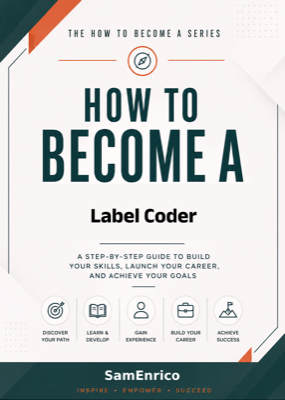
How to Become a Label Coder eBook
How to Become a Label Coder
How to Become a Label Coder
Formats
Free sample
Chapter 1: The Invisible Goldmine...--–- The email arrived at 11:47 PM on a Tuesday. Maria, a 38-year-old former call center supervisor in Detroit, had been laid off six weeks earlier when her company replaced her team with an AI chatbot. She was scrolling through job boards, half-asleep, when she saw a posting that read: “Remote Label Coder – No Experience Required – 25–25–25–45/hour.” She almost deleted it. It sounded fake. But something made her click.The job description was strange.
It talked about “teaching self-driving cars to see,” “helping chatbots understand sarcasm,” and “building the brain of artificial intelligence.” Maria had never written a line of code in her life. She didn’t have a college degree. But she had spent fifteen years listening to angry customers, deciphering what they really meant beneath the yelling, and noting down exactly what went wrong. That skill—attention to detail, pattern recognition, and patience—turned out to be worth more than she ever imagined.Three months later, Maria was making $38 per hour labeling medical transcripts, working from her kitchen table, earning more than she had as a supervisor. She wasn’t a programmer or an engineer.
She was something else entirely. She was a label coder.And she was part of a hidden goldmine that most people don’t even know exists.The Great Misunderstanding: What Most People Get Wrong About AIWhen most people think of artificial intelligence, they imagine robots, complex algorithms, or genius programmers typing arcane code in darkened rooms. Hollywood has trained us to see AI as magical—a brain in a box that simply awakens one day and knows everything. The reality is far less glamorous, far more human, and far more accessible.Here is the truth that tech companies don’t advertise: Artificial intelligence is not smart. Not really.
Every AI system you have ever used—from Google Translate to Chat GPT to the face recognition that unlocks your phone—is essentially a very fast pattern-matching machine. It has seen millions of examples of something (a cat, a sentence, a voice command), and it has learned to guess what comes next based on those examples. But here is the catch: those millions of examples don’t exist in nature. They don’t come pre-packaged. Someone has to create them.That someone is you.The technical term for this process is data annotation, but the industry increasingly calls it label coding.
The name matters because it changes how you think about the work. “Data annotation” sounds like something a librarian would do. “Label coding” sounds like what it actually is: the act of translating raw, messy, chaotic real-world information into clean, structured, machine-readable categories. When you draw a box around a pedestrian in a photo, you are not just clicking a mouse. You are writing a sentence that the AI can understand: “Attention: there is a person at these specific coordinates.” When you transcribe a customer service call, you are not just typing words.
You are telling the AI: “This is what frustration sounds like. This is what a successful resolution sounds like.”Without label coders, the most advanced AI in the world is blind, deaf, and illiterate. It is a newborn infant with a supercomputer attached—incredible potential, zero knowledge. Label coders are the teachers. And teaching pays far better than most people realize.The Numbers That Will Make You Rethink Everything Let’s talk about money.
Not because money is the only reason to do anything, but because the pay scale in this industry is so dramatically misunderstood that it’s worth stating clearly from the beginning.As of 2025, entry-level label coders on platforms like Appen or Clickworker typically earn between 15and15 and 15and25 per hour. That’s the starting point—comparable to retail or food service, but with the crucial difference that you can do it from anywhere, at any time, and you are not on your feet for eight hours. Within six months of consistent work and skill development, most label coders move into the 25to25 to 25to40 per hour range. Specialists—people who focus on medical imaging, autonomous vehicle Li DAR data, or legal document annotation—regularly earn 50to50 to 50to80 per hour. Top-tier quality assurance reviewers and project managers can clear $100,000 annually working remotely for AI companies like Scale AI, Tesla, or Open AI.To put that in perspective: the median hourly wage in the United States is approximately $22.
A label coder with one year of experience in a specialty niche out-earns the average American by a significant margin. And unlike many remote gig economy jobs, label coding offers a genuine career ladder. The person who starts by drawing bounding boxes around cars can become the quality assurance reviewer who checks everyone else’s work. That person can become the project manager who oversees a team of fifty labelers. That person can become the data operations lead who designs labeling workflows for an entire AI company.Maria, the former call center supervisor we met at the beginning of this chapter, followed exactly that path.
She started with simple image annotation—drawing boxes around pedestrians and traffic signs for an autonomous vehicle project. Within four months, her accuracy rate (we will cover what that means in Chapter 7) placed her in the top 5% of all labelers on her platform. She was invited to join a specialist medical imaging team, where she learned to identify and annotate tumors in CT scans. Eighteen months after that desperate late-night job search, she was offered a full-time remote position as a quality assurance lead for a health tech startup. Her starting salary: $82,000 plus benefits.She still does not know how to write code.
She still does not have a college degree. She has something better: a skill that is in desperate demand and a front-row seat to the most important technological transformation in human history.The Brief History You Need to Understand (But Won’t Be Tested On)To understand why label coding matters, you need to understand a little bit about how we got here. Do not worry—there will be no exam at the end of this chapter. But the story is worth telling because it reveals why your future in this field is so secure.Artificial intelligence research began in earnest in the 1950s, but for decades, progress was agonizingly slow. Early AI systems were “rule-based”—programmers would write explicit rules like “if you see a red octagon, it’s a stop sign.” This worked for simple problems but completely failed in the real world.
A stop sign at night? A stop sign partially hidden by a tree branch? A stop sign covered in snow? The rule-based system could not adapt because it had no flexibility. It only knew what it was explicitly told.The breakthrough came in 2012, when a research team led by Geoffrey Hinton won the Image Net competition using a deep neural network—a type of AI that learns from examples rather than rules.
The team fed their network millions of labeled images (there is that word again) and let it figure out the patterns on its own. The result was a system that could recognize objects with unprecedented accuracy. It was not perfect, but…
This is the end of the free sample. Get the eBook to keep going. Buy now
About this book
Details
- Author
- Cardoza Marlys
- Publisher
- SamEnrico
- Language
- English
- ISBN
- 9781505750898
- Genre
- Non-Fiction, Informative, Educational
- Released
- 2026-05-11
- Pages (approx.)
- 150
- Available as
- eBook, Paperback, Audiobook

Read better in the ZLOADR app
Your eBooks on your phone or tablet. Sign in with your SamEnrico account and start reading.
More by Cardoza Marlys
 Morning Workout DemographicsCardoza Marlys$11.99
 Dolphin Swim JoyCardoza Marlys$11.99
 African Union OAU BirthCardoza Marlys$11.99
 Weight Loss Affirmation GuideCardoza Marlys$11.99
 The Gacy Victim Families StatementsCardoza Marlys$11.99
 The Dragon’s Heart: A Ballad of Fire and FleshCardoza Marlys$11.99
 Understanding Müller–barth–menger SyndromeCardoza Marlys$17.99
 Radio OperatorCardoza Marlys$11.99
 AI Video Tools ComparisonCardoza Marlys$12.99
 Remote Manager Emotional IntelligenceCardoza Marlys$12.99
You may also like
 Hong Kong Handover 1997Dunn Johnnie$11.99
 Zumba For Postnatal Recovery CourseNeal Christian$11.99
 Zumba for BeginnersLadner Nikia$11.99
 YouTube Comment Mining GuideHumes Pandora$12.99
 Worry Box MeditationCarlin Rudy$11.99
 Workplace Stress MeditationNguyen Lynn$11.99
 Workplace Stress and Sleep RepairHawley Ivory$11.99
 Workplace Perfectionism CureDelaney Jeffry$11.99
 Workplace Injustice Anger GuideWallen Isabelle$11.99
 Work Addiction and Burnout LinkGreenwood Ester$11.99
 Women in Yoga and WellnessBeattie Galina$11.99
 Women in Stand Up ComedyChun Evangeline$11.99