
Non-FictionInformativeEducational
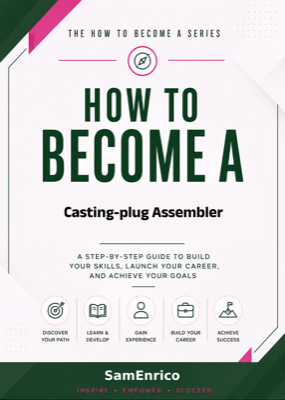
How to Become a Casting-plug Assembler eBook
How to Become a Casting-plug Assembler
by Kuntz Lauri
How to Become a Casting-plug Assembler
Formats
Free sample
Chapter 1: The Invisible Architecture...–- The human eye, unaided, can resolve roughly one-tenth of a millimeter. That is the width of a human hair. The gap between a properly seated casting plug and its refractory metal core is often half that. You cannot see it. You cannot feel it with a gloved finger.
But if that gap exists, a $50,000 turbine blade will emerge from the casting process with a solid bar of metal where a cooling channel should be. The blade will spin at 10,000 revolutions per minute inside a jet engine for perhaps four seconds before it fails catastrophically. The engine will not explode. It will simply stop producing thrust at 35,000 feet. That is the weight of what fits inside a gap you cannot see.This chapter is not about tools or techniques.
It is about seeing the invisible architecture that lives inside every superalloy component that flies, generates power, or saves lives in a hospital. Before you mix your first batch of structural ceramic binder, before you touch a pair of ceramic-tipped tweezers, you must understand what you are actually building, because you will never see the final product. The casting plug you assemble will be destroyed. The ceramic shell will be chipped away. The refractory metal core will be leached out with hot caustic solution.
What remains is a hollow passage inside a metal part—a negative space that has no physical existence but without which the part is useless. You are an architect of nothing, and nothing has never been more important.The Unseen Cathedral Walk into any investment casting foundry that produces aerospace components, and you will see rows of shelled molds that look like ceramic bushes. Each one contains a core package that you assembled. But before that core package existed, an engineer spent two hundred hours designing the cooling network inside a turbine blade. That network is a labyrinth of serpentine passages, shaped like the inside of a medieval cathedral—flying buttresses of metal, ribbed vaults of cooling air, twisting paths that force compressed air from the compressor section to snake through the blade and exit through hundreds of tiny holes along the leading edge.
Every one of those passages begins with a casting plug.The casting plug is the seed of the void. It is a precision ceramic component, typically no larger than a grain of rice to the size of a pencil eraser, that will eventually become an empty space inside solid metal. When molten superalloy is poured around it, the metal cools and solidifies. Then the ceramic plug is chemically dissolved, leaving behind a perfect negative imprint of its geometry. If the plug is misaligned by two hundred microns, the cooling passage shifts.
If the cooling passage shifts, the blade develops a hot spot. If the hot spot exceeds the alloy's temperature limit by fifty degrees Celsius for one second, the grain structure changes. The blade creeps. The blade fails.This is not hyperbole. This is metallurgical fact, documented in every failure analysis report from Pratt & Whitney, Rolls-Royce, and GE Aerospace for the past forty years.
The casting-plug assembler sits at the intersection of design intent and physical reality. No engineer can make up for a plug that was assembled poorly. No quality control inspection can catch a gap that closes under thermal expansion during firing. The assembler's hands are the last human intervention before the part becomes permanent.Three Families of Material, One Unforgiving Physics Before you can assemble anything, you must understand what you are handling. This chapter introduces the three material families that will occupy your workbench for as long as you work in this trade.
They have nothing in common with each other. They hate each other. Your job is to make them cooperate.Refractory Metal Cores (RMCs)The first family is refractory metals. These are not the stainless steel of kitchen knives or the aluminum of soda cans. Refractory metals—molybdenum and niobium being the most common in investment casting—have melting points above 2,600 degrees Celsius.
For context, the surface of Venus is 460 degrees. The interior of a commercial jet engine's combustion chamber reaches 1,700 degrees. RMCs laugh at those temperatures. They are used exactly because they do not melt when superalloys are poured around them.But they have weaknesses that will frustrate you on every single shift.First, oxidation. Molybdenum and niobium begin to oxidize in air at temperatures as low as 300 degrees Celsius.
Leave an unprotected RMC on a workbench overnight, and a thin oxide layer forms. That layer changes the part's dimensions by microns. Those microns are your tolerance. By the time you notice a discolored RMC, it is already scrap. This is why Chapter 3 will cover positive-pressure HEPA filtration and why Chapter 4 introduces oxidation barrier coatings—not structural adhesives, but thin, non-structural layers applied via chemical vapor deposition that prevent atmospheric oxygen from reaching the metal surface.
Never confuse these coatings with the structural ceramic binder covered in Chapter 5. They serve entirely different purposes and are not interchangeable.Second, fragility. An RMC is not a solid block of metal. It is a thin-walled structure, often with wall thicknesses of 0.2 to 0.5 millimeters. It will bend under the weight of a drop of water.
It will crease if you breathe on it too hard. New assemblers routinely destroy their first dozen RMCs simply by picking them up with standard tweezers. This is why the tool crib issues ceramic-tipped tweezers—steel tips would dent the RMC. The rule is simple: if you can feel the RMC flex in your hand, you are applying too much force.Ceramic Cores and Shells The second family is ceramic. Ceramic cores are the positive shapes that will become cooling passages.
They are made from alumina (aluminum oxide), silica (silicon dioxide), or zirconia (zirconium dioxide), sometimes mixed with fugitive binders that burn off during firing. Ceramic shells are the outer molds that contain the entire assembly during the pour.Ceramics have one virtue and one vice. The virtue is compressive strength. A fired ceramic core can withstand the pressure of molten metal flowing at ten meters per second without deforming. The vice is brittleness.
Ceramics have essentially no tensile strength. Pull them, and they snap. Bend them, and they crack. This asymmetry—strong in compression, weak in tension—means you must always support ceramic components from underneath. Never pick up a ceramic core by its edges.
Never allow it to hang unsupported. Every cracked core you produce will be traced back to a moment of impatience.The relationship between ceramics and RMCs is adversarial. Their coefficients of thermal expansion (CTE) are different. A typical ceramic core expands at 5 to 9 parts per million per degree Celsius. Molybdenum expands at 5.2.
Niobium expands at 7.3. At room temperature, these differences are trivial. At 1,600 degrees Celsius during sintering, a CTE mismatch of just 2 ppm/°C produces internal stresses of 50 megapascals—enough to crack either material. This is not a design flaw. It is a physical law.
Your job is not to eliminate CTE mismatch (impossible) but to manage it through controlled ramp rates and support fixtures, as Chapter 7 will teach.Oxidation Barrier Coatings The third family is often overlooked by beginners but will determine whether your…
This is the end of the free sample. Get the eBook to keep going. Buy now
About this book
Details
- Author
- Kuntz Lauri
- Publisher
- SamEnrico
- Language
- English
- ISBN
- 9781505792928
- Genre
- Non-Fiction, Informative, Educational
- Released
- 2026-05-11
- Pages (approx.)
- 137
- Available as
- eBook, Paperback, Audiobook

Read better in the ZLOADR app
Your eBooks on your phone or tablet. Sign in with your SamEnrico account and start reading.
More by Kuntz Lauri
 Hypnotic Confidence BoosterKuntz Lauri$11.99
 The Fibromyalgia Meditation GuideKuntz Lauri$11.99
 Property Tax Relief After MoveKuntz Lauri$11.99
 The Board RelationshipKuntz Lauri$11.99
 Self Esteem Open RelationshipsKuntz Lauri$11.99
 The Lost Voyage of the San Lesmes: A 16th-Century Shipwreck and SurvivalKuntz Lauri$11.99
 The Bone Whisperers of the Silk Road: Lost Secrets of the TaklamakanKuntz Lauri$11.99
 Executive Summary Formulas for Marketing PlansKuntz Lauri$12.99
 Procurement Risk ManagementKuntz Lauri$12.99
 Understanding Exudative Retinopathy Familial, Autosomal DominantKuntz Lauri$17.99
 Oracle EBS DeveloperKuntz Lauri$11.99
You may also like
 Hong Kong Handover 1997Dunn Johnnie$11.99
 Zumba For Postnatal Recovery CourseNeal Christian$11.99
 Zumba for BeginnersLadner Nikia$11.99
 YouTube Comment Mining GuideHumes Pandora$12.99
 Worry Box MeditationCarlin Rudy$11.99
 Workplace Stress MeditationNguyen Lynn$11.99
 Workplace Stress and Sleep RepairHawley Ivory$11.99
 Workplace Perfectionism CureDelaney Jeffry$11.99
 Workplace Injustice Anger GuideWallen Isabelle$11.99
 Work Addiction and Burnout LinkGreenwood Ester$11.99
 Women in Yoga and WellnessBeattie Galina$11.99
 Women in Stand Up ComedyChun Evangeline$11.99