
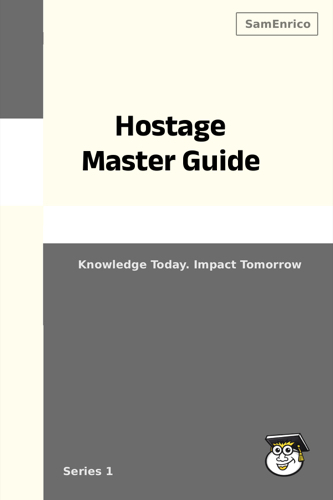
Hostage Master Guide eBook
Complete collection of kidnapping and hostage surv
Complete collection of kidnapping and hostage survival stories.
Formats
Free sample
Chapter 1: The First Sixty Seconds...--The first sound Eli Sharabi heard was not a gunshot. It was his daughter’s scream.October 7th, 2023, began like any other Saturday morning on Kibbutz Be’eri. The air was cool. The sky was pale blue. Eli was drinking coffee when the first rockets painted white scars across the horizon.
He had lived through rockets before. Everyone on the border had. You wait. You listen. You go to the shelter if the sirens don’t stop.
But these sirens did not stop. They multiplied. They became a wall of sound that seemed to come from everywhere at once. Then came the voices—shouting in Arabic, close, inside the perimeter, inside the gates, inside the yard.Eli’s wife Lian was in the kitchen. His two daughters, twenty-year-old Noam and eighteen-year-old Yahav, were still in their pajamas.
They had been laughing about something—Eli would later spend months trying to remember what—when the window shattered. A hand reached through. Then a rifle. Then a man wearing a black balaclava who smelled of diesel and sweat and something Eli could not name until later, in the darkness of a tunnel, when he realized it was the smell of a man who had already killed someone that morning.“Don’t move,” the man said in Hebrew. His accent was Gaza City, sharp and gutteral.
“Don’t move or I kill everyone.”Here is what the survival manuals do not tell you: in the first sixty seconds of an abduction, your body does not cooperate. It betrays you.The scientific term is tonic immobility. It is an ancient neural pathway that evolved over hundreds of millions of years, designed to save you from predators who lose interest in prey that appears dead. A rabbit frozen in tall grass. A mouse playing possum.
A human being, faced with the imminent threat of violent death, whose muscles lock, whose vision tunnels to a point, whose heart races so fast it feels like it might stop, and who cannot move. Not because of cowardice. Because of evolution.Eli Sharabi could not move. He watched the man grab Yahav by the hair. He watched Noam try to run and be tackled to the floor.
He watched Lian raise her hands and say something he could not hear over the ringing in his ears. And in that moment—that single, eternal, sixty-second window—Eli made a decision that he would later describe as the only conscious choice of his entire captivity.“There is no more regular Eli,” he told himself. “From now on, I am Eli the survivor.”This chapter is about that decision. Not the decision to fight or flee—those are binary, simple, the stuff of action movies. This chapter is about the decision that comes before either: the decision to recognize that the person you were before this moment is gone, and that survival requires you to become someone else.The Anatomy of a Snatch: How Abduction Actually Happens Before we can understand how to survive the first sixty seconds, we must first understand what the first sixty seconds actually look like.
Popular culture has lied to you. Movies depict abductions as dramatic—a struggle, a shout, a chase. Real abductions are almost never dramatic in the moment. They are disorienting, chaotic, and often silent.The FBI’s Behavioral Analysis Unit has studied hundreds of kidnappings and hostage-takings across five decades. Their data reveals a consistent pattern: in the vast majority of cases, the victim’s first conscious awareness of being abducted occurs after the abduction has already begun.
You do not see the threat coming. You feel it. A hand over your mouth. A gun pressed to your spine. A voice behind you saying, “Walk or die.”This is not an accident.
Captors who have done this before know that the single greatest risk to their operation is the victim’s scream. A scream attracts attention. Attention brings police. Police bring failure. So experienced captors prioritize the prevention of screaming above almost everything else.
They approach from behind. They cover the mouth. They use the weapon as a promise, not as an opening act.This is why Eli Sharabi’s experience—a window shattering, a rifle appearing, a voice shouting—is actually less common than the alternative. Most victims never see the face of their captor for hours or days. Most victims are blindfolded before they even understand what is happening.The first sixty seconds, therefore, are not what you imagine.
You do not have time to process. You do not have time to weigh options. You have time to do exactly one thing: breathe.The Three-Second Rule: Why Your Body Betrays You and How to Hack It Let us talk about freezing.Tonic immobility is not a choice. It is a reflex. When the amygdala—the brain’s threat detection center—perceives an imminent, inescapable danger, it sends a cascade of neurochemicals that effectively short-circuit the motor cortex.
Your muscles receive the signal to move, but the signal is overwhelmed by a flood of inhibitory neurotransmitters. You are paralyzed not because you are weak but because your brain has decided, in a fraction of a second, that movement will get you killed and stillness might save you.The problem is that this reflex evolved for a world of predators that were not human. A bear might lose interest in a frozen hiker. A lion might walk past a gazelle that has stopped moving. But a human captor with a gun and a plan does not lose interest.
The freeze response, in the context of a kidnapping, is not protective. It is dangerous. It wastes time. And time is the only resource you have.The good news is that the freeze response can be overridden. Not by willpower—willpower is a myth in these moments—but by training.
Military and law enforcement personnel are taught to recognize the onset of tonic immobility and to substitute a conditioned motor response: drop, cover your head, shout a codeword. The shout breaks the freeze. The physical action of dropping gives the brain something to do other than panic.For civilians, the substitute response is simpler. It is three seconds long. It has three steps.Step One: Breathe.
Not deeply—deep breathing requires time you do not have. One sharp inhale through the nose, one sharp exhale through the mouth. This is not calming. It is oxygenating. Your brain needs fuel to override the freeze, and oxygen is that fuel.Step Two: Blink.
Force your eyes to move. Tunnel vision is caused by the ciliary muscles locking in place. Blinking—hard, deliberate, twice—forces those muscles to relax and contract, restoring peripheral vision.Step Three: Name one thing. In your mind, name one object in your field of vision. “Door.” “Floor.” “Shoe.” This simple act of labeling shifts cognitive processing from the amygdala (emotion) to the prefrontal cortex (reason).
The shift is not complete—you will still be terrified—but it is enough to break the paralysis.These three seconds are the difference between a hostage who is present and a hostage who is a passenger. Eli Sharabi did not have this training. What he…
This is the end of the free sample. Get the eBook to keep going. Buy now
About this book
Details
- Author
- Tabor Calandra
- Publisher
- SamEnrico
- Language
- English
- Genre
- Non-Fiction, Biography, Complete
- Released
- 2026-06-06
- Pages (approx.)
- 134
- Available as
- eBook, Audiobook

Read better in the ZLOADR app
Your eBooks on your phone or tablet. Sign in with your SamEnrico account and start reading.
More by Tabor Calandra
 The Team Creative JournalTabor Calandra$11.99
 Law Student Stress HandbookTabor Calandra$11.99
 HGH and Cellular SenescenceTabor Calandra$11.99
 Gestalt Dream WorkTabor Calandra$11.99
 Public Speech Peg SystemTabor Calandra$11.99
 NFL Quarterback Decision TreesTabor Calandra$11.99
 Toxic Shock Syndrome PreventionTabor Calandra$11.99
 Retirement Assets and QCDTabor Calandra$11.99
 The Last Voyage of the SS Andrea Doria: The Unsinkable Ship That SankTabor Calandra$11.99
 The Quantum Alchemists: Black Pioneers Who Unlocked the Secrets of MatterTabor Calandra$11.99
 Inanna and the Forbidden Descent: A Love That Defied the UnderworldTabor Calandra$11.99
 The Dancer's Guide to KozachokTabor Calandra$11.99
You may also like
 Hong Kong Handover 1997Dunn Johnnie$11.99
 Zumba For Postnatal Recovery CourseNeal Christian$11.99
 Zumba for BeginnersLadner Nikia$11.99
 YouTube Comment Mining GuideHumes Pandora$12.99
 Worry Box MeditationCarlin Rudy$11.99
 Workplace Stress MeditationNguyen Lynn$11.99
 Workplace Stress and Sleep RepairHawley Ivory$11.99
 Workplace Perfectionism CureDelaney Jeffry$11.99
 Workplace Injustice Anger GuideWallen Isabelle$11.99
 Work Addiction and Burnout LinkGreenwood Ester$11.99
 Women in Yoga and WellnessBeattie Galina$11.99
 Women in Stand Up ComedyChun Evangeline$11.99