
Non-FictionHealth & WellnessWeight Loss
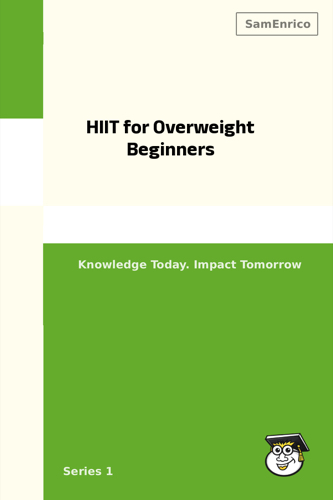
HIIT for Overweight Beginners eBook
Joint-friendly low-impact options like seated or w
Joint-friendly low-impact options like seated or walking intervals.
Formats
Free sample
Chapter 1: The Effort Lie--–- You have been lied to about effort. Not by a malicious trainer or a dishonest fitness influencer. The lie is woven into the very language of high-intensity training. Words like “all-out,” “maximal effort,” and “give it everything you’ve got” sound inspiring on a poster, but for an overweight beginner, they are dangerous instructions. They imply that the only way to succeed is to push until you collapse, to feel like your lungs are on fire, to wake up sore the next day and call that proof of progress.
This chapter dismantles that lie and replaces it with a simpler, safer, and more effective truth: high intensity does not mean high suffering. It means working at the right intensity for your body, right now, which is likely 60 to 70 percent of your maximum—not 100 percent.You will learn the real science of how HIIT works inside an overweight body. You will understand why the afterburn effect, insulin sensitivity, and fat oxidation matter more than how many calories you burn during the workout itself. You will be introduced to two practical tools—Rate of Perceived Exertion and the talk test—that will guide every interval you perform in this 12-week program. And you will see evidence that low-impact, seated, and walking HIIT triggers the same fat-burning hormones as sprinting and jumping, without destroying your joints.
By the end of this chapter, you will trust that working at a 6 or 7 out of 10 is not cheating. It is smart science.The “All-Out” Myth and Why It Hurts Overweight Beginners Walk into any HIIT studio or open any fitness app, and you will hear the same command: “Go all out!” “Maximal effort!” “Leave nothing in the tank!” This language assumes a young, fit, injury-free body that can recover quickly. For an overweight beginner, going all out is not inspiring—it is dangerous. Here is why.When a fitness instructor says “all out,” they mean 100 percent of your maximal heart rate and perceived effort. For a deconditioned person, 100 percent effort creates form breakdown, excessive joint loading, and a spike in blood pressure that can be unsafe.
More importantly, it creates an experience of pure suffering. And suffering is not sustainable. If your first few workouts feel like torture, your brain will learn to avoid exercise. That is not weakness; that is basic human biology. Your amygdala, the part of your brain responsible for threat detection, will flag exercise as a threat.
You will find excuses, skip sessions, and eventually quit—not because you lack willpower, but because your brain is protecting you from what it believes is danger.The science of adherence is clear. A 2019 study in the journal Obesity followed overweight adults starting an exercise program. Those who were told to work at “comfortably hard” (approximately 60–70 percent effort) were three times more likely to still be exercising at 12 weeks compared to those told to work at “maximal effort.” The higher-effort group did burn slightly more calories per session, but they also dropped out at much higher rates. The lower-effort group, by contrast, built consistency. And consistency beats intensity every single time.This book redefines “all-out” for your body.
Your all-out is not the same as a 22-year-old Cross Fitter’s all-out. Your all-out is the point where your breathing becomes noticeably heavier, where you could still speak a few words but not a full sentence, and where you feel challenged but not panicked. For most overweight beginners, that is about 60 to 70 percent of your theoretical maximum heart rate. You will not wear a heart rate monitor to measure this (more on that later), because you have two built-in tools that are more accurate for your body: your own perception and your breath.The Real Science: EPOC, Insulin Sensitivity, and Fat Oxidation To understand why 60–70 percent effort works so well, you need to know what HIIT actually does inside your body. Most people think HIIT works because it burns a lot of calories during the workout.
That is partially true, but it is not the whole story. The real magic happens after you stop exercising.EPOC: The Afterburn Effect EPOC stands for excess post-exercise oxygen consumption. It is the scientific name for the “afterburn effect”—the number of calories your body continues to burn after you have finished working out. Here is how it works. During high-intensity intervals, your body uses oxygen faster than it can replenish it.
You create what scientists call an oxygen deficit. After you stop, your body must work hard to pay back that deficit. It restores oxygen to your blood, clears lactic acid, replenishes energy stores, and repairs muscle tissue. All of these processes require energy. In fact, EPOC can elevate your metabolism for anywhere from 2 to 24 hours after a HIIT session, depending on the intensity and duration.Here is the critical point for you: EPOC is triggered by intensity, not by impact.
Your body does not care if you achieved that intensity by sprinting outdoors or by doing seated knee lifts in your living room. The metabolic signal—the hormonal cascade that tells your body to keep burning fuel—is the same. A 2015 study compared two groups performing HIIT: one group did traditional high-impact sprints, while the other did seated cycling intervals at the same perceived exertion. Both groups had nearly identical EPOC levels. The seated group, however, reported zero joint pain and had perfect adherence over eight weeks.
The sprinting group had a 40 percent dropout rate due to knee and ankle pain.You will achieve the afterburn effect from a chair. That is not a compromise. It is an advantage.Insulin Sensitivity and Fat Oxidation The second major benefit of HIIT is improved insulin sensitivity. Insulin is a hormone that moves sugar from your blood into your cells to be used for energy. When you are overweight or sedentary, your cells can become resistant to insulin.
Your pancreas has to produce more and more insulin to get the job done, leading to high insulin levels, fat storage, and eventually type 2 diabetes.HIIT improves insulin sensitivity rapidly. A 2018 meta-analysis found that just two weeks of HIIT significantly improved insulin sensitivity in overweight adults, even without any weight loss. How does that happen? When you perform high-intensity intervals, your muscles become hungry for glucose. They pull sugar out of your bloodstream more efficiently.
Lower blood sugar means lower insulin, and lower insulin means your body can access stored fat for energy.Fat oxidation is the scientific term for burning fat. HIIT increases fat oxidation both during and after exercise. Importantly, low-impact HIIT has been shown to increase fat oxidation just as much as high-impact HIIT. Your body cannot tell if the intensity came from jumping or from walking fast. It only registers the metabolic demand.Redefining “Intensity” for Your Body This is the most important concept in the entire book.
Read it twice: Intensity is a measure of how hard your cardiovascular system is working. Impact is a measure of how much force your joints absorb. They are not the same thing. You can have very high intensity with zero impact. You can have very low intensity with high impact (walking slowly on a hard surface…
This is the end of the free sample. Get the eBook to keep going. Buy now
About this book
Details
- Author
- Blocker Tosha
- Publisher
- SamEnrico
- Language
- English
- Genre
- Non-Fiction, Health & Wellness, Weight Loss
- Released
- 2026-06-08
- Pages (approx.)
- 147
- Available as
- eBook, Audiobook

Read better in the ZLOADR app
Your eBooks on your phone or tablet. Sign in with your SamEnrico account and start reading.
More by Blocker Tosha
 Child Drowning GriefBlocker Tosha$11.99
 Withdrawal Vital SignsBlocker Tosha$11.99
 Methamphetamine in Rural LGBTQBlocker Tosha$11.99
 Gambling Addiction Support Group DirectoryBlocker Tosha$11.99
 Speaking Up With Confidence HandbookBlocker Tosha$11.99
 Pregnancy Loss and MedicationBlocker Tosha$11.99
 Gambling Addiction And EscapismBlocker Tosha$11.99
 Omar Sharif: The Maestro of Egyptian Cinema’s Golden AgeBlocker Tosha$11.99
 Iron and Thunder: The Battle of the Java Sea (1942)Blocker Tosha$11.99
 How to Start a Meters for Water (non-electronic) Business (Beginners Guide)Blocker Tosha$11.99
 How to Produce Motor Vehicle A/v Players and In-dash SystemsBlocker Tosha$11.99
 Growing AthyriumBlocker Tosha$11.99
You may also like
 Hong Kong Handover 1997Dunn Johnnie$11.99
 Zumba For Postnatal Recovery CourseNeal Christian$11.99
 Zumba for BeginnersLadner Nikia$11.99
 YouTube Comment Mining GuideHumes Pandora$12.99
 Worry Box MeditationCarlin Rudy$11.99
 Workplace Stress MeditationNguyen Lynn$11.99
 Workplace Stress and Sleep RepairHawley Ivory$11.99
 Workplace Perfectionism CureDelaney Jeffry$11.99
 Workplace Injustice Anger GuideWallen Isabelle$11.99
 Work Addiction and Burnout LinkGreenwood Ester$11.99
 Women in Yoga and WellnessBeattie Galina$11.99
 Women in Stand Up ComedyChun Evangeline$11.99