
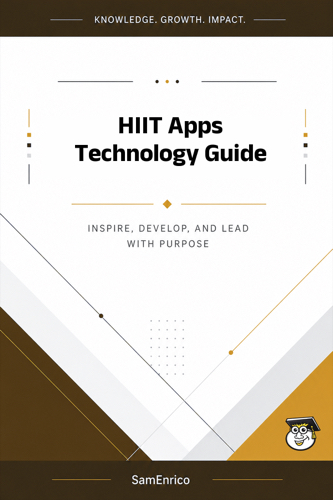
Non-FictionHealth & WellnessFitness Tech
HIIT Apps Technology Guide eBook
Use timer apps, heart rate monitors, and virtual c
by Small Roxie
Use timer apps, heart rate monitors, and virtual classes to structure interval sessions.
Formats
Free sample
Chapter 1: The Digital Cage–- The first time I watched a friend quit his gym membership, he wasn't angry about the monthly fee. He was frustrated because he had just spent forty-five minutes waiting for a squat rack, another fifteen minutes watching someone curl in the only remaining power rack, and then twenty minutes on a treadmill watching real estate commercials on the built-in screen. He had driven twenty minutes to get there, changed clothes, and then essentially paid for the privilege of waiting. The next morning, he tried a "follow-along" HIIT video on You Tube. Seven minutes in, he paused it because he couldn't tell if he was supposed to rest for ten seconds or thirty.
His phone timer was buried under a pile of laundry. He did three more half-hearted burpees, got bored, and quit. "I don't know what I'm doing wrong," he told me. "I'm working hard. I'm sweating.
But nothing changes."That conversation, repeated in various forms across millions of living rooms and gym floors, is the central problem this book solves. Hard work alone is not enough. Sweat is not a metric. Exhaustion is not a training plan. What my friend lacked was not motivation, not effort, not even equipment.
He lacked structure. He was exercising—moving his body, raising his heart rate, burning calories—but he was not training. The difference between exercise and training is the difference between wandering through a forest and following a map. Both involve walking. Only one reliably gets you where you want to go.This book is that map.
Specifically, it is a comprehensive guide to the three tools that transform random exertion into precise, measurable, and progressive high-intensity interval training: timer apps, heart rate monitors, and virtual classes. These three components form what I call the Digital HIIT Ecosystem, and when used correctly, they replace the guesswork, the boredom, and the stalled progress that drive most people away from fitness entirely.But before we dive into the apps, the Bluetooth pairing, and the interval protocols, we need to understand the failure of the alternatives. Why do traditional gyms fail so many people? Why do unstructured home workouts almost always collapse within six weeks? And who exactly is this book for?The Gym Membership Lie The global fitness industry generates nearly one hundred billion dollars annually.
That is not a typo. One hundred billion dollars, and yet the majority of gym memberships go unused. Industry data consistently shows that approximately sixty-seven percent of gym members never actually attend. They pay. They intend.
They do not go. And of the thirty-three percent who do attend, most quit within six months.This is not a failure of willpower. It is a failure of design.Traditional commercial gyms are optimized for one thing: collecting monthly dues from people who hope to become fit but lack the specific knowledge to do so efficiently. The equipment is laid out for maximal capacity, not minimal transition time. The classes are scheduled for convenience, not progressive overload.
The personal trainers, when available, cost more than the membership itself. What you get is a building full of expensive metal that does nothing except sit there while you try to remember what you saw on Instagram yesterday.The deeper problem is structural. A gym does not give you a plan. It gives you options—thousands of options, each one a decision point that drains cognitive energy and increases the likelihood of doing nothing. Research on decision fatigue shows that when faced with too many choices, people default to either the easiest option (the treadmill at a walking pace) or the most familiar option (the same three machines they always use).
Neither produces meaningful adaptation. You can walk on a treadmill for a year and your VO2 max will barely budge. You can do the same lat pulldown every Tuesday and wonder why your back hasn't changed since month two.The gym model also suffers from what behavioral economists call the "sunk cost fallacy." You pay your membership. You feel obligated to go. But obligation is a poor motivator, and eventually the feeling of wasted money is outweighed by the feeling of wasted time.
You stop going. You tell yourself you'll start again next month. Next month becomes next year. The gym keeps your money.This book is not anti-gym. Gyms are useful for certain things: heavy barbells, cable machines, space to move.
But as a complete solution for sustainable fitness, they fail most people most of the time. The alternative—unstructured home workouts—fails even faster.The Chaos of the Living Room When the pandemic forced gyms to close, millions of people suddenly became home exercisers. Yoga mats were sold out for months. Adjustable dumbbells commanded prices higher than used cars. You Tube workout videos racked up billions of views.
And then, within ninety days, most of those people stopped.Why? Because home workouts have their own set of hidden traps.The first trap is what I call the "pause button problem." In a gym, when you finish a set, the equipment is right there. You rest for a prescribed amount of time—forty-five seconds, sixty seconds, whatever—and you go again. At home, your phone is across the room. Your cat is on your mat.
The laundry buzzer goes off. You pause the video, handle the distraction, and then try to resume. Your rest period, which was supposed to be twenty seconds, has become three minutes. Your heart rate has dropped to baseline. You are no longer doing HIIT.
You are doing a series of disconnected efforts separated by long interruptions.The second trap is the "perfectionism loop." Without a timer or a coach, most people either go too hard too early and burn out, or they hold back because they're not sure what's coming next. A typical self-directed HIIT workout looks like this: sprint for what feels like thirty seconds (actually eighteen), rest for what feels like fifteen seconds (actually forty-five), repeat for as long as motivation holds (usually six to eight minutes), then stop because "that was probably enough." The workout is neither high-intensity nor interval-based. It is just random exertion.The third trap is the absence of progression. Your body adapts to stress in about two to four weeks. That means the workout that challenged you last month is now maintenance, not growth.
Without a system for tracking and increasing intensity—either through shorter rests, longer work intervals, more rounds, or greater resistance—you will plateau. Most people interpret this plateau as evidence that HIIT "stopped working." In reality, they stopped progressing because they had no tool to force progression.These traps are not character flaws. They are design flaws in the environment. And they are precisely what the Digital HIIT Ecosystem was built to solve.Defining the Digital HIIT Ecosystem The Digital HIIT Ecosystem consists of three interconnected technologies, each addressing a specific failure point in traditional and unstructured training. Think of them as three legs of a stool.
Remove any one, and the whole structure wobbles.Leg One: Timer Apps (Structure)The timer app replaces guesswork with precision. It tells you exactly when to work, exactly when to rest, and exactly when the…
This is the end of the free sample. Get the eBook to keep going. Buy now
About this book
Details
- Author
- Small Roxie
- Publisher
- SamEnrico
- Language
- English
- Genre
- Non-Fiction, Health & Wellness, Fitness Tech
- Released
- 2026-06-09
- Pages (approx.)
- 135
- Available as
- eBook, Audiobook

Read better in the ZLOADR app
Your eBooks on your phone or tablet. Sign in with your SamEnrico account and start reading.
More by Small Roxie
 Harpsichordist Time Travel MemoirSmall Roxie$11.99
 Emotional Contagion AwarenessSmall Roxie$11.99
 Twelve Step Amends Making GuideSmall Roxie$11.99
 The Feudal Pyramid Structure GuideSmall Roxie$11.99
 The Fall of Funan: The Khmer Empire's First Collapse (550 AD)Small Roxie$11.99
 How to Start a Blood Banks Business (Beginners Guide)Small Roxie$11.99
 Early Churn Intervention GuideSmall Roxie$12.99
 API Free to Paid ConversionSmall Roxie$12.99
 The Breeder's Guide to Jersey Buff TurkeysSmall Roxie$11.99
 Home-Based Craft BusinessSmall Roxie$11.99
You may also like
 Hong Kong Handover 1997Dunn Johnnie$11.99
 Zumba For Postnatal Recovery CourseNeal Christian$11.99
 Zumba for BeginnersLadner Nikia$11.99
 YouTube Comment Mining GuideHumes Pandora$12.99
 Worry Box MeditationCarlin Rudy$11.99
 Workplace Stress MeditationNguyen Lynn$11.99
 Workplace Stress and Sleep RepairHawley Ivory$11.99
 Workplace Perfectionism CureDelaney Jeffry$11.99
 Workplace Injustice Anger GuideWallen Isabelle$11.99
 Work Addiction and Burnout LinkGreenwood Ester$11.99
 Women in Yoga and WellnessBeattie Galina$11.99
 Women in Stand Up ComedyChun Evangeline$11.99