
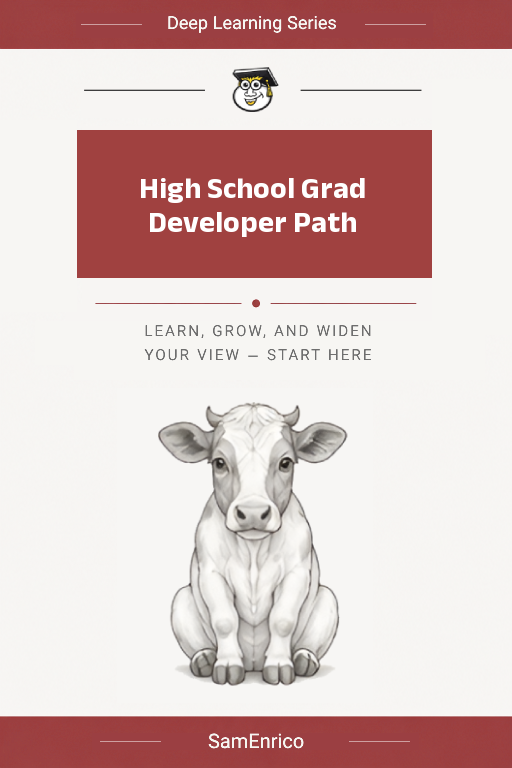
High School Grad Developer Path eBook
Guide for teenagers choosing between university de
by Bohn Ebonie
Guide for teenagers choosing between university degree or bootcamp after graduation. Long-term planning advice.
Formats
Free sample
Chapter 1: The Fork You Didn't See Coming--You are standing at a fork in the road, but here is the first lie adults have told you: there are only two paths. College or no college. Degree or bootcamp. Safe or risky. They have been feeding you this binary choice since middle school, and you have swallowed it like medicine—bitter, but necessary.
Except it is not a binary choice. It never was.The real fork has three prongs, and almost no one explains the third one because the third one does not make anyone money. Colleges make money when you enroll. Bootcamps make money when you sign up. Loan providers make money when you borrow.
But the third path—the one where you learn deliberately, spend almost nothing, and emerge with a portfolio instead of a diploma—that path has no marketing budget. No glossy viewbooks. No alumni network sending you shiny brochures. Just results.This book exists because that third path is real, and it is viable, and it might be right for you. Or maybe it is not.
Maybe you are a Theory Lover who will thrive in a four-year computer science program, surrounded by professors who dream in binary and peers who argue about garbage collection at parties. Or maybe you are a Hybrid who wants the middle ground: a two-year associate degree, a handful of certifications, and a job by age twenty. The point is not which path you choose. The point is that you choose with your eyes open, having done the math, having tested your own psychology, and having rejected the fear that adults use to sell you things.This chapter is called The Fork You Did Not See Coming because the real decision is not college versus bootcamp. The real decision is between three fundamentally different ways of learning and working, and most teenagers never even hear about the third option until they are already $40,000 in debt.Let us fix that right now.The Myth of the Two-Path World Walk into any high school guidance counselor's office and ask, "What should I do after graduation?" You will hear some version of the same script: "If you have good grades and your family can afford it, go to a four-year university.
If you want to save money and learn a specific trade, consider community college or a trade school. If you are really daring, look into coding bootcamps."Notice what is missing? The option where you teach yourself, build a portfolio, and start earning money before your friends finish their sophomore year of college. That option exists, but guidance counselors do not mention it because they are evaluated on college acceptance rates. Bootcamps do not mention the self-taught path because they want your fifteen thousand dollars.
Parents do not mention it because they are terrified you will end up living in their basement playing video games until you are thirty.The two-path world is a lie sold to you by people who profit from your fear. And here is the proof: according to the 2023 Stack Overflow Developer Survey, nearly twenty-five percent of professional developers have no degree at all. Not an associate degree. Not a bootcamp certificate. Nothing beyond a high school diploma.
And they are employed. They are building the same software as their degreed colleagues. They are getting promoted. They are leading teams.Does that mean you should skip college? Not necessarily.
Twenty-five percent is not fifty-one percent. Most developers still have degrees. But the existence of that twenty-five percent proves that the two-path world is a fiction. There is a third path, and it is crowded.The question is not whether the third path exists. The question is whether it fits you.The Three Archetypes: Which One Are You?Before you can choose a path, you need to know what kind of learner and worker you are.
The following three archetypes are drawn from interviews with hundreds of developers, both degreed and self-taught, as well as research into learning psychology and career outcomes. There is no "best" archetype. There is only fit.Archetype One: The Theory Lover You are the kid who loved math class not because it was easy but because it was elegant. You enjoyed the moment when a concept clicked—when you understood why the quadratic formula worked, not just how to use it. You are drawn to abstraction.
You like knowing the history of things. When you encounter a problem, your first instinct is to understand the underlying system, not just fix the surface issue.In a coding context, you are the person who will spend an afternoon reading about how garbage collection works in different programming languages, even though you could have just written a delete statement and moved on. You are not being inefficient; you are being curious. That curiosity is a superpower, but it is also a liability in fast-paced environments where the goal is to ship software, not understand it perfectly.Best fit for you: A four-year computer science degree. You will thrive in an environment that rewards theoretical depth, gives you time to explore fundamentals, and surrounds you with professors who share your love for abstraction.
Bootcamps will frustrate you because they move too fast and skip the "why." Self-taught will tempt you to go down endless rabbit holes without finishing anything.Red flags you are a Theory Lover: You have been told you "overthink things." You struggle to stop researching and start building. You get annoyed when people say "it works, ship it" without understanding why it works.Archetype Two: The Builder You are the kid who took apart the remote control to see how it worked. You learned to ride a bike by getting on and falling off, not by reading a manual. You get a rush from making things—whether that is a skateboard ramp, a Tik Tok edit, or a simple website. You hate exams not because you are lazy but because they feel abstract and disconnected from real outcomes.In a coding context, you are the person who will build a functioning app with messy code, deploy it, and then iterate based on user feedback.
You learn by doing. Tutorials bore you after the first ten minutes. You would rather break something and fix it than read documentation for an hour.Best fit for you: Bootcamp or self-taught. You need to ship constantly. A four-year degree will feel painfully slow, and you will be tempted to skip lectures to work on side projects (which might actually be a good strategy, as Chapter 3 will explain).
Bootcamps give you structure and deadlines without four years of theory. Self-taught works if you have the discipline to set your own deadlines.Red flags you are a Builder: You have started many projects and finished few (but the ones you finished gave you immense satisfaction). You hate being told "learn this first, build later." You have a low tolerance for abstract lectures.Archetype Three: The Hybrid You are pragmatic. You want the credential because you know it opens doors, but you do not want to spend four years and six figures getting it. You are willing to learn theory, but only as much as necessary…
This is the end of the free sample. Get the eBook to keep going. Buy now
About this book
Details
- Author
- Bohn Ebonie
- Publisher
- SamEnrico
- Language
- English
- Genre
- Non-Fiction, Career Education, Youth Guide
- Released
- 2026-06-01
- Pages (approx.)
- 154
- Available as
- eBook, Audiobook

Read better in the ZLOADR app
Your eBooks on your phone or tablet. Sign in with your SamEnrico account and start reading.
More by Bohn Ebonie
 Self Talk For OptimismBohn Ebonie$11.99
 Titanic's Sister Ships ArchaeologyBohn Ebonie$11.99
 Cooperative Tax Obligations GuideBohn Ebonie$11.99
 Walking Meditation for WritersBohn Ebonie$11.99
 Assertiveness for Real Estate AgentsBohn Ebonie$11.99
 The Oracle’s Gambit: A Spy’s Game in the Temple of DelphiBohn Ebonie$11.99
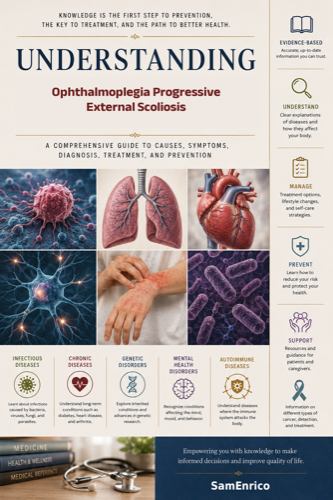 Understanding Ophthalmoplegia Progressive External ScoliosisBohn Ebonie$17.99
 IT Business AnalystBohn Ebonie$11.99
 How to Become a Shale Planer OperatorBohn Ebonie$11.99
 Hospitality and Travel Pricing GuideBohn Ebonie$12.99