
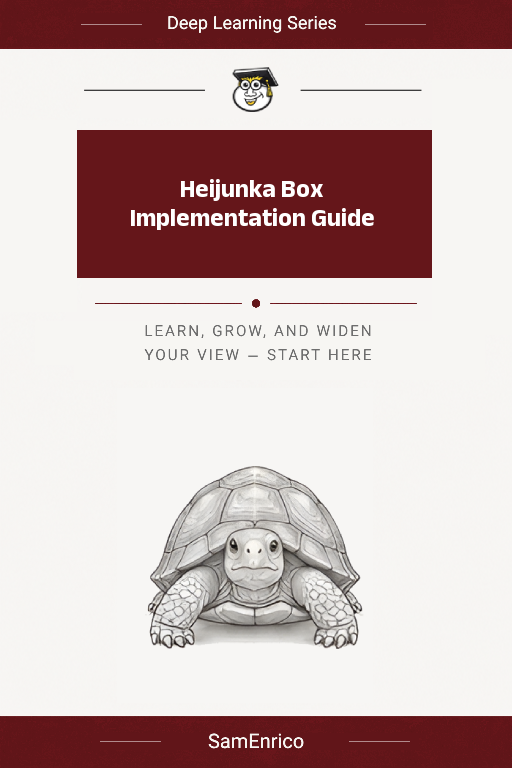
Non-FictionOperational Efficiency ManualVisual Management
Heijunka Box Implementation Guide eBook
Builds and deploys heijunka (leveling) boxes to vi
by New Delma
Builds and deploys heijunka (leveling) boxes to visualize production mix and volume, enabling leveled pull from upstream processes.
Formats
Free sample
Chapter 1: The Tortoise's Revenge--–- Jack Reynolds had been a plant manager for seventeen years, and in that time, he had learned exactly one thing about production scheduling: it was a lie. Every morning at 7:45, the ERP system spit out a beautifully formatted schedule. Every morning at 8:15, his production supervisor, Maria, handed it back to him with red ink bleeding across the page like a wound. "We're behind on the Smith order," she would say. Or: "The Jones order is ahead of schedule but we're missing the raw material." Or, most frequently: "The changeover took three hours instead of forty-five minutes, so nothing after 10 AM is possible."Jack had tried everything.
He had installed a new ERP system at a cost of $2.3 million. He had hired a scheduling consultant who spoke in acronyms—MRP, MES, APS—and left behind a three-ring binder that nobody ever opened. He had doubled his finished goods inventory to "protect the customer," which only meant that his warehouse now overflowed with parts nobody wanted while the parts everybody wanted were perpetually out of stock.His problem, though he did not know it yet, was not a scheduling problem. It was a leveling problem. And the solution was not more software or more inventory or more consultants.
The solution was a wooden box with some slots cut into it, a stack of cards, and a fundamental shift in how he thought about production.The Day Everything Changed On a Tuesday in October, Jack visited a supplier in Kentucky. The supplier made brake calipers for the same automotive customers Jack served. Their plant was smaller than his, older, and their equipment looked like it had been purchased when Reagan was president. Yet their on-time delivery was 99.7 percent. Their inventory turns were 24 per year—Jack's were 6.
Their lead time was four days. Jack's was six weeks.At lunch, Jack asked the plant manager, a woman named Elena who had worked there for twenty-two years, what software they used.Elena laughed. "Software? We use a box."She led him to the production floor. Hanging on the wall between the stamping press and the assembly line was a simple wooden grid.
It had eight rows running vertically and twenty-four columns running horizontally. Each slot in the grid was just big enough to hold a laminated card. The rows were labeled with part numbers. The columns were labeled with times: 7:00, 7:20, 7:40, and so on, all the way to 3:00."This is our Heijunka box," Elena said. "Every morning, the Water Spider—that's our material handler—loads cards into the slots according to our leveled production plan.
The press operator takes cards from the leftmost column every twenty minutes, makes exactly what the card says, and pulls the card through the box. When the card reaches the end of its row, that triggers a new batch of cards to be printed."Jack stared at the box. It was absurdly simple. There was no computer screen, no network connection, no predictive algorithm. There was a box, some cards, and a schedule written on a whiteboard."And this works?" he asked.Elena smiled.
"It works so well that our customers stopped doing audits of our plant two years ago. They said we were boring."Jack flew home that night with a new obsession.The Three Enemies of Flow To understand why Jack's plant was failing and why Elena's was succeeding, we must first understand the three enemies of lean production. Taiichi Ohno, the legendary Toyota engineer who developed the Toyota Production System, identified these enemies as Muda, Mura, and Muri. Most Western managers have heard of Muda—waste. They have attended the seminars, watched the videos, and conducted the value stream maps.
They have eliminated seven kinds of waste: overproduction, waiting, transportation, overprocessing, inventory, motion, and defects.And yet their plants still struggle.The reason is that they have been attacking the wrong enemy. Muda is the visible enemy, the one you can see and measure and chart. But Muda is a symptom, not a root cause. The root cause is Mura—unevenness. And Mura, in turn, creates Muri—overburden on people and equipment.Let us examine each enemy in turn.Muda: The Visible Waste Muda is anything that consumes resources without creating value for the customer.
The classic seven forms of Muda, identified by Ohno and refined over decades, are:Overproduction: Making more than the customer needs, or making it earlier than needed. This is the worst form of waste because it hides all the others.Waiting: People or equipment idle while they wait for materials, instructions, or previous processes to complete.Transportation: Moving products or materials between locations—necessary but never value-adding.Overprocessing: Doing more work than the customer requires, such as tighter tolerances, extra finishing steps, or redundant inspections.Inventory: Raw materials, work-in-progress, or finished goods that are not actively being processed.Motion: Unnecessary movement of people, such as walking, reaching, bending, or searching for tools.Defects: Work that must be scrapped or reworked, consuming additional resources without creating value.Every lean practitioner knows these seven wastes. Every plant has conducted "waste walks" where teams walk the floor with clipboards, identifying examples of each waste. And every plant has discovered that even after eliminating hundreds of waste examples, the underlying chaos remains.This is because Muda is the smoke, not the fire.Mura: The Hidden Enemy Mura is unevenness. It is the fluctuation in demand, in cycle times, in quality, in material availability, in everything.
Mura is the reason that your Monday is chaotic and your Friday is slow. Mura is the reason that your star operator produces 120 parts per hour at 8 AM and 60 parts per hour at 2 PM. Mura is the reason that your inventory levels oscillate wildly, peaking on Wednesdays and bottoming out on Fridays.Mura is dangerous because it creates Muda. When demand is uneven, you overproduce during slow periods (Muda #1) and expedite during busy periods (Muda #2-7 combined). When cycle times are uneven, you create waiting (Muda #2) and motion (Muda #6) as operators look for work.
When quality is uneven, you create defects (Muda #7) and overprocessing (Muda #4) as inspectors try to catch the defects before they reach the customer.Eliminating Muda without eliminating Mura is like bailing water from a sinking boat while ignoring the hole in the hull. You can work all day, every day, and never make progress.Muri: The Overburden Muri is overburden—pushing people or equipment beyond their natural limits. When demand is uneven (Mura), you inevitably push your team to work faster during peak periods (Muri). They run machines at unsafe speeds. They skip quality checks.
They work through breaks and stay late. And then, during slow periods, they are exhausted and demoralized.Muri damages your most important assets: your people and your equipment. Overburdened operators make mistakes, injure themselves, and burn out. Overburdened machines break down more frequently, require more maintenance, and have shorter lifespans.The three enemies form a deadly cycle: Mura creates Muri, Muri creates Muda, and Muda makes Mura worse by hiding the true nature of the problem. Breaking this cycle requires attacking Mura at its source.The Tortoise and the Hare Revisited Taiichi Ohno famously illustrated the difference between Mura and Muda with…
This is the end of the free sample. Get the eBook to keep going. Buy now
About this book
Details
- Author
- New Delma
- Publisher
- SamEnrico
- Language
- English
- Genre
- Non-Fiction, Operational Efficiency Manual, Visual Management
- Released
- 2026-05-30
- Pages (approx.)
- 151
- Available as
- eBook, Audiobook

Read better in the ZLOADR app
Your eBooks on your phone or tablet. Sign in with your SamEnrico account and start reading.
More by New Delma
 The Resentment Reset For CaregiversNew Delma$11.99
 Walking Meditation In Heat HandbookNew Delma$11.99
 Forgiveness for AbandonmentNew Delma$11.99
 Labeling and Mislabeling AngerNew Delma$11.99
 Rebel Leadership Council StudyNew Delma$11.99
 The Serpent's Gambit: Kali and the Dance of DestructionNew Delma$11.99
 Vice President of CommunicationsNew Delma$11.99
 Understanding Oculo Cerebro Osseous SyndromeNew Delma$17.99
 German University for Ukrainian StudentsNew Delma$12.99
 How to Become a Turning-machine OperatorNew Delma$11.99
You may also like
 Hong Kong Handover 1997Dunn Johnnie$11.99
 Zumba For Postnatal Recovery CourseNeal Christian$11.99
 Zumba for BeginnersLadner Nikia$11.99
 YouTube Comment Mining GuideHumes Pandora$12.99
 Worry Box MeditationCarlin Rudy$11.99
 Workplace Stress MeditationNguyen Lynn$11.99
 Workplace Stress and Sleep RepairHawley Ivory$11.99
 Workplace Perfectionism CureDelaney Jeffry$11.99
 Workplace Injustice Anger GuideWallen Isabelle$11.99
 Work Addiction and Burnout LinkGreenwood Ester$11.99
 Women in Yoga and WellnessBeattie Galina$11.99
 Women in Stand Up ComedyChun Evangeline$11.99