
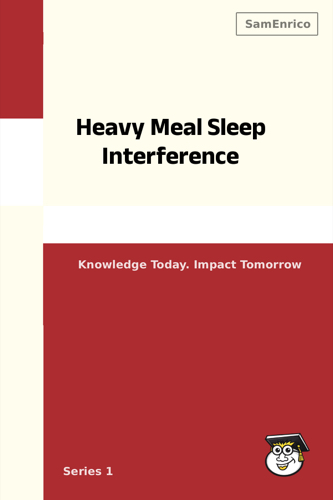
Non-FictionHealth & WellnessMeal Timing
Heavy Meal Sleep Interference eBook
Finish eating three hours before bedtime.
by Gunn Carrol
Finish eating three hours before bedtime.
Formats
Free sample
Chapter 1: The Midnight Heist--The alarm clock on your nightstand reads 2:47 AM. You have been staring at it for approximately thirty-seven minutes, though it feels like three hours. Your heart is pounding not with fear but with a vague, nameless urgency, as if you have just narrowly avoided a car accident. Your mouth is dry. Your sheets are damp with sweat.
And somewhere deep in your abdomen, a slow, churning discomfort radiates outward like ripples in a pond.You run through the usual suspects. Did you have caffeine after 2:00 PM? No. Did you drink alcohol? A glass of wine with dinner, but that was hours ago.
Did you check work emails before bed? Yes, but only briefly. Is it anxiety? You don't feel anxious. You were sound asleep two hours ago.
What changed?Nothing changed. That is the problem.You did not wake up because of stress, or a nightmare, or a passing car with loud music. You woke up because of what you ate at 8:30 PM. Specifically, you woke up because your dinner is still in your stomach, and your stomach is staging a quiet rebellion against your digestive system. The pounding heart, the sweating, the churning discomfort, the inexplicable wakefulness—these are not psychological symptoms.
They are physiological events. They have biological causes. And they were set in motion the moment you swallowed your last bite of that late-evening meal.This chapter is about the single most important concept in this entire book: the fundamental mismatch between the human digestive system and the modern dinner schedule. You will learn why your body wants you to stop eating long before you actually do. You will learn about the hidden clock inside your gut that operates on a schedule completely at odds with your social life.
And you will learn, for the first time, the biological mechanism behind that 2:47 AM wakeup that has been stealing your sleep for months or years.Let us begin with a journey inside your own body.The Hidden Clock You Never Knew You Had Every cell in your body contains a clock. This is not a metaphor. It is a literal biological mechanism—a feedback loop of proteins that rise and fall with predictable twenty-four-hour rhythms. The master clock resides in a tiny cluster of neurons called the suprachiasmatic nucleus, buried deep in your brain's hypothalamus. This master clock synchronizes the peripheral clocks in your liver, your pancreas, your heart, and crucially for this book, your gut.Your gut has a clock.
It has a schedule. And that schedule does not care about your work hours, your social obligations, or your craving for late-night pizza.During daylight hours, your digestive system operates at peak efficiency. Your stomach produces hydrochloric acid at optimal levels. Your pancreas releases digestive enzymes in precise, timed bursts. Your small intestine waves its fingerlike villi to absorb nutrients.
Your gut bacteria—the trillions of microorganisms that live in your colon—are active, metabolizing fiber and producing beneficial short-chain fatty acids. Everything works. You can eat a large meal at 1:00 PM, and by 4:00 PM, most of it has left your stomach and moved into your small intestine.But as the sun sets, something remarkable happens. Your master clock sends a signal to your gut: shift change.Your stomach begins to produce less acid. Your pancreas slows its enzyme production.
The rhythmic contractions that move food from your stomach to your small intestine—a process called gastric motility—slow down dramatically. Your gut bacteria change their metabolism, shifting from fermentation to a more quiescent state. Your entire digestive system is preparing for sleep, even if you are still awake and scrolling through your phone.This is the circadian rhythm of digestion. It evolved over hundreds of millions of years, long before the invention of electricity, long before the nine-to-five workday, long before restaurants that serve dinner at 9:00 PM. For the vast majority of human evolutionary history, eating after dark was rare.
Fire provided light, but it did not provide food after sunset. Humans ate during daylight. They digested during daylight. And when darkness fell, their digestive systems shut down for the night.Your digestive system still follows this ancient schedule. The problem is that your behavior does not.The Fifty Percent Problem Let us talk about numbers, because numbers are honest.
When researchers measure gastric motility—the speed at which your stomach empties its contents into your small intestine—they find a striking circadian variation. During the day, a typical mixed meal (protein, carbohydrates, fat) leaves your stomach at a rate of approximately two to three hours for complete emptying. This is why you can eat lunch at noon and feel hungry again by 3:00 or 4:00 PM.But at night, something different happens. Starting around 9:00 PM in a typical circadian rhythm, gastric motility slows by an estimated twenty to forty percent. Some individuals experience even greater slowing.
The exact percentage varies based on genetics, age, meal composition, and individual circadian chronotype, but the direction is universal: your stomach empties more slowly at night than it does during the day.What does twenty to forty percent mean in practical terms? It means that a meal that would leave your stomach in three hours during the day may take four to five hours at night. It means that the pasta you ate at 8:30 PM is still sitting in your stomach at 12:30 AM. It means that when you lie down to sleep at 11:00 PM, you are lying down with a stomach that is still actively digesting.This is the fifty percent problem, though the exact number matters less than the principle: your digestive system slows down at night, and no amount of willpower or discipline can override this biological fact. You cannot speed up your nighttime gastric motility by wishing it were faster.
You cannot compensate by eating smaller bites, chewing more thoroughly, or drinking more water. The slowdown is hormonal. It is regulated by melatonin, the same hormone that makes you feel sleepy. Your body cannot simultaneously produce high levels of melatonin (to help you sleep) and maintain daytime gastric motility (to digest your food). These two states are biologically incompatible.The Conflicting Signal Imagine you are the manager of a busy warehouse.
During the day, your staff is active: forklifts moving pallets, workers sorting packages, trucks loading and unloading. This is digestion. Then evening comes. You send most of your staff home. You turn off the forklifts.
You dim the lights. You switch the warehouse into maintenance mode: cleaning, repairing, preparing for the next day.Now imagine that at 10:00 PM, a fully loaded semi-truck arrives with a thousand new packages. What do you do? You have no staff. You have no forklifts.
The lights are off. You cannot simply ignore the truck—the packages must go somewhere. So you call your staff back to work. You restart the forklifts. You turn the lights back on.
You shift from maintenance mode back to active processing mode.This is exactly what happens when you eat a heavy meal late at night. Your gut has shifted into its nighttime housekeeping mode. Cellular repair processes are active. Waste clearance mechanisms are running. Memory consolidation is underway.
Then you introduce a large bolus of food, and your gut has no choice but to sound the alarm: wake…
This is the end of the free sample. Get the eBook to keep going. Buy now
About this book
Details
- Author
- Gunn Carrol
- Publisher
- SamEnrico
- Language
- English
- Genre
- Non-Fiction, Health & Wellness, Meal Timing
- Released
- 2026-06-07
- Pages (approx.)
- 150
- Available as
- eBook, Audiobook

Read better in the ZLOADR app
Your eBooks on your phone or tablet. Sign in with your SamEnrico account and start reading.
More by Gunn Carrol
 Elevator Small Talk GuideGunn Carrol$11.99
 Email Delay Send GuideGunn Carrol$11.99
 Blue Zone Fermented Foods GuideGunn Carrol$11.99
 The Budget Meal Planning GuideGunn Carrol$11.99
 Ipsus: The Day the Diadochi ShatteredGunn Carrol$11.99
 Understanding Willems–de Vries SyndromeGunn Carrol$17.99
 Ghana Startup Community GuideGunn Carrol$12.99
 Founder Leave of Absence PlanGunn Carrol$12.99
 How to Start a Fish Paste Business (Beginners Guide)Gunn Carrol$11.99
 Wardite MiningGunn Carrol$11.99
You may also like
 Hong Kong Handover 1997Dunn Johnnie$11.99
 Zumba For Postnatal Recovery CourseNeal Christian$11.99
 Zumba for BeginnersLadner Nikia$11.99
 YouTube Comment Mining GuideHumes Pandora$12.99
 Worry Box MeditationCarlin Rudy$11.99
 Workplace Stress MeditationNguyen Lynn$11.99
 Workplace Stress and Sleep RepairHawley Ivory$11.99
 Workplace Perfectionism CureDelaney Jeffry$11.99
 Workplace Injustice Anger GuideWallen Isabelle$11.99
 Work Addiction and Burnout LinkGreenwood Ester$11.99
 Women in Yoga and WellnessBeattie Galina$11.99
 Women in Stand Up ComedyChun Evangeline$11.99