
Non-FictionInformativeEducational
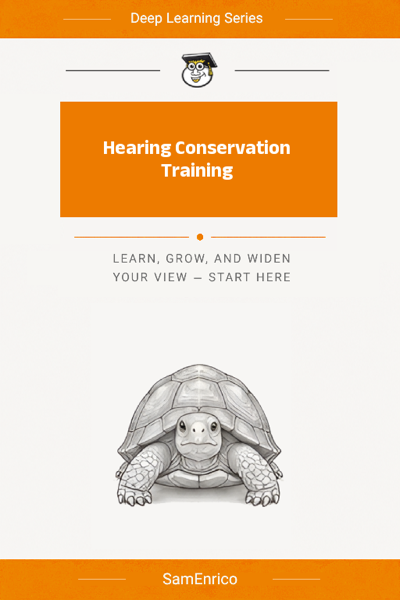
Hearing Conservation Training eBook
A Coursebook on Hearing Conservation Training
by Kolb Jacki
A Coursebook on Hearing Conservation Training
Formats
Free sample
Chapter 1: The Silent Epidemic--–- The first sound you lose is usually a voice you love. Not the roar of a chainsaw or the shriek of a jet engine – those you notice. What you don't notice is your daughter's question from across the dinner table, your wife's comment while walking behind you, your grandchild's whisper. By the time you realize you're saying "What?" three times per conversation, the damage has been done for years. This is the cruelest trick of noise-induced hearing loss: it steals from you gradually, quietly, and without asking permission.
By the time you notice the silence, the sounds you've lost are gone forever.Imagine for a moment that you could see your hearing. Picture it as a lush green hillside covered in tall, delicate grass. Each blade represents one of the roughly fifteen thousand hair cells inside each of your cochleas – the tiny sensory receptors that translate vibrations into the sounds of your life. Now imagine that every time you walk through that field without protection, you crush a few blades underfoot. The first few times, you don't notice.
The field still looks green. But after a thousand walks, bare patches appear. After ten thousand walks, the hillside is scarred with dirt. This is precisely what happens inside your ears, except hair cells – unlike grass – never grow back.This chapter exists because you, or someone you care about, is walking through that field right now. Whether you are a safety manager trying to protect five hundred workers, a trainer struggling to keep a room of roughnecks awake through another annual refresher, or an individual who has noticed that restaurants are getting "mumbly" lately – this book is for you.
You are about to learn why hearing conservation is not a compliance exercise but a preservation of connection, and why the world's best hearing conservation programs succeed or fail based on one factor above all others: culture.The Shocking Numbers That Should Keep You Awake at Night Let us start with the scope of the problem, because most people – including most safety professionals – drastically underestimate how common noise-induced hearing loss really is. According to the Centers for Disease Control and Prevention (CDC), approximately twenty-two million American workers are exposed to hazardous noise on the job each year. That is more than the entire population of Florida, working every day with their hearing at risk. Of those twenty-two million, the National Institute for Occupational Safety and Health (NIOSH) estimates that over twenty percent – nearly five million workers – will develop significant hearing loss as a direct result of their employment.But these numbers, as staggering as they are, only count people whose hearing loss has become measurable on an audiogram. They do not count the millions more who have experienced temporary threshold shift – that muffled, cotton-in-the-ears feeling after a loud shift – and mistakenly believed they had "gotten used to the noise." They do not count the young workers in their twenties who already show early notches at four thousand hertz but are still years away from noticing any difficulty in conversation.
By the time a worker fails a hearing test badly enough to trigger a standard threshold shift, they have already lost a detectable amount of their hearing permanently.Consider the economics. The National Institute for Deafness and Other Communication Disorders (NIDCD) estimates that the lifetime cost of hearing loss for a single individual – including lost wages, medical treatment, and assistive devices – exceeds three hundred thousand dollars. For employers, the Bureau of Labor Statistics reports that the median workers' compensation claim for hearing loss is higher than claims for all other occupational diseases combined, with an average settlement exceeding forty thousand dollars per affected worker. These figures do not include the hidden costs: increased error rates, communication breakdowns leading to safety incidents, early retirement of skilled workers, and the quiet erosion of workplace morale when workers feel that no one cares if they go deaf.A 2018 study published in the Journal of Occupational and Environmental Medicine followed ten thousand manufacturing workers over a five-year period. Those with uncorrected hearing loss – meaning they did not use hearing protection and their employers did not provide effective conservation programs – had a forty percent higher rate of non-auditory workplace injuries, including falls, burns, and equipment-related accidents.
Why? Because hearing is not just about hearing. Hearing is about situational awareness. A worker who cannot hear a warning shout, a backing truck, or a change in machine pitch is a worker at risk for injuries that have nothing to do with their ears.Perhaps most disturbingly, hearing loss is accelerating among younger workers. NIOSH data shows that workers under age thirty-five are developing measurable noise-induced hearing loss at rates twenty percent higher than the same age group did twenty years ago.
The culprits are not just workplace noise. Young workers bring non-occupational exposures with them to the job: concerts, headphones at maximum volume, recreational shooting, and power tools used at home. By the time they enter the workforce, many already have early damage that makes them more susceptible to further loss. They are walking into your factory or construction site with fewer hair cells than their fathers had at the same age.Real-World Costs That Spreadsheets Cannot Capture Numbers are cold. Let me warm them with stories – real cases drawn from safety literature, legal records, and interviews with hearing conservation professionals.
While the names have been changed, every one of these incidents is documented and verified.The Case of the Retired Assembly Worker: James worked for twenty-eight years at an automotive parts plant in Ohio. He wore hearing protection "most of the time" – typically foam earplugs that his employer provided in a vending machine. He was never fit-tested. No one ever checked whether his earplugs were too small for his ear canals, which they were. When James retired at age sixty-two, his audiogram showed a sixty-decibel loss at four thousand hertz in his left ear and fifty-five decibels in his right.
He could not hear his wife's voice unless she stood directly in front of him and faced him. He could not enjoy music, watch television without captions, or use a telephone without a specialized amplifier. James filed a workers' compensation claim, which his employer fought for two years before settling for one hundred forty thousand dollars. The plant manager later testified that they had never considered field fit-testing because "the foam plugs were cheap and the OSHA paperwork looked fine." James now lives alone; his wife passed away two years ago, and he says the hardest part is that he cannot remember the sound of her laugh.The Case of the Construction Foreman: Maria was a thirty-nine-year-old foreman on a commercial construction site in Texas. She wore earmuffs while using a jackhammer but removed them for "quick cuts" with a concrete saw – thirty seconds here, a minute there – because the earmuffs made communication with her crew difficult.
Over a six-year period, those quick cuts added up to hundreds of hours of unprotected exposure to noise levels exceeding one hundred ten decibels. Her baseline audiogram at age thirty-three was normal. Her annual audiogram at age thirty-nine showed a standard threshold shift of eighteen decibels at four…
This is the end of the free sample. Get the eBook to keep going. Buy now
About this book
Details
- Author
- Kolb Jacki
- Publisher
- SamEnrico
- Language
- English
- Genre
- Non-Fiction, Informative, Educational
- Released
- 2026-05-04
- Pages (approx.)
- 159
- Available as
- eBook, Audiobook

Read better in the ZLOADR app
Your eBooks on your phone or tablet. Sign in with your SamEnrico account and start reading.
More by Kolb Jacki
 Fiverr Seller Plus ProgramKolb Jacki$11.99
 Racial Minority Childhood Self Worth CourseKolb Jacki$11.99
 Anger in Marriage HandbookKolb Jacki$11.99
 The Brazilian Digital Nomad Visa GuideKolb Jacki$11.99
 Healthcare Anger De escalationKolb Jacki$11.99
 Understanding Lymphangiectasies Lymphoedema Type Hennekam TypeKolb Jacki$17.99
 Executive Summary For ReportsKolb Jacki$12.99
 LatAm Agtech Precision GuideKolb Jacki$12.99
 How to Become a Laser-beam-machine OperatorKolb Jacki$11.99
You may also like
 Hong Kong Handover 1997Dunn Johnnie$11.99
 Zumba For Postnatal Recovery CourseNeal Christian$11.99
 Zumba for BeginnersLadner Nikia$11.99
 YouTube Comment Mining GuideHumes Pandora$12.99
 Worry Box MeditationCarlin Rudy$11.99
 Workplace Stress MeditationNguyen Lynn$11.99
 Workplace Stress and Sleep RepairHawley Ivory$11.99
 Workplace Perfectionism CureDelaney Jeffry$11.99
 Workplace Injustice Anger GuideWallen Isabelle$11.99
 Work Addiction and Burnout LinkGreenwood Ester$11.99
 Women in Yoga and WellnessBeattie Galina$11.99
 Women in Stand Up ComedyChun Evangeline$11.99