
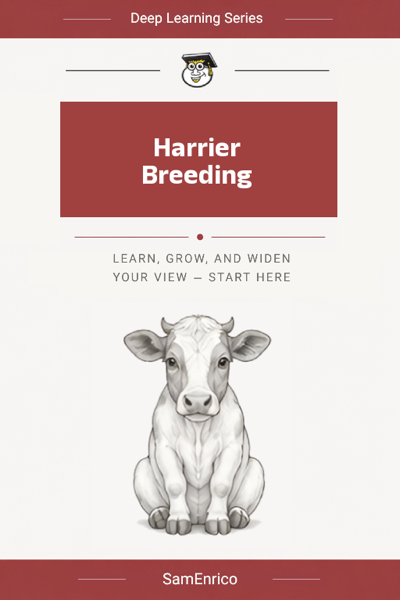
Non-FictionInformativeEducational
Harrier Breeding eBook
A Coursebook on Harrier Breeding
A Coursebook on Harrier Breeding
Formats
Free sample
Chapter 1: The Split Inheritance...--–- The word "Harrier" is a liar. Not by intention, but by accident of language. In the world of breeding, it promises unity but delivers duality. To say "I breed Harriers" is to confess nothing at all, because you might be describing a kennel of baying hounds tearing across an English moor after a hare, or you might be describing a mews of circling raptors ghosting over a North American marsh. These two creatures share no recent common ancestor, no overlapping habitat, no compatible diet, and no mutual understanding.
One is mammalian, grounded, and pack-addicted. The other is avian, airborne, and polygynous. Yet both answer to the same name. This book is not a confession of confusion—it is a map through it.For the first-time breeder, the confusion begins innocently. You search for "Harrier breeding guides" online.
You find a forum discussing whelping boxes and hip dysplasia scores. You find another discussing artificial incubation and humidity fluctuations. Both seem authoritative. Both use the same word with absolute confidence. You begin to suspect you have misunderstood something fundamental, and you have.
The term "Harrier" is a homonym in the world of animal husbandry—one sound, two entirely separate biological realities.This chapter exists to resolve that ambiguity before you invest a single dollar in equipment, before you build a single enclosure, before you acquire a single animal. By the end of this chapter, you will know exactly which Harrier you intend to breed. You will understand why the canine and avian versions are never to be confused, and you will be equipped to evaluate which path aligns with your land, your resources, your experience level, and your ethical commitments. The split inheritance of the Harrier is not a problem to be solved—it is a choice to be made.For the advanced breeder—perhaps someone who has worked with one type of Harrier for years—this chapter serves a different purpose. You may encounter the other Harrier in conservation work, in cross-disciplinary research, or in conversation with colleagues.
You need to understand the other world without reading two entire separate books. This chapter gives you the comparative framework in a single sitting. By the time you finish, you will be able to speak intelligently about both Harriers, even if you only work with one.Let us begin with the simplest truth: the canine Harrier and the avian Harrier share nothing except a name and a heritage of human partnership. That heritage, however, is precisely what makes both worth breeding—and precisely what makes confusion dangerous.The Canine Harrier: A Hound by Any Other Name The canine Harrier is a medium-sized scent hound, historically bred in England for the specific purpose of hunting hare. Not rabbit, as regional misnomers would have it, but hare—the faster, larger, more endurance-demanding quarry.
Standing 19 to 21 inches at the withers and weighing between 45 and 65 pounds, the Harrier occupies the middle ground between the smaller Beagle and the larger Foxhound. This is not a coincidence of breeding but a deliberate functional niche: the Harrier was meant to run all day at a steady pace, not to sprint for an hour like a Foxhound nor to scramble into burrows like a Beagle.The breed's history is debated, which is itself a clue to its antiquity. Some sources trace the Holcombe Harriers to the 11th century, making the breed one of the oldest scent hounds in existence. What is not debated is that by the 18th century, Harrier packs were well established in England, with each region developing slightly different lines suited to local terrain. The West Country Harriers, from the hilly landscapes of Devon and Cornwall, tended to be larger and more rugged.
The East Anglian Harriers, from the flat fens and fields, were more compact and refined in movement. Both were unmistakably Harriers: square-bodied, pendant-eared, and possessed of a nose that could follow a cold trail for hours.The temperament of the canine Harrier is inseparable from its function. This is a pack animal in the most literal sense. A Harrier isolated from other dogs does not simply become lonely—it becomes psychologically distressed. Excessive vocalization, destructiveness, separation anxiety, and even self-harm have been documented in Harriers kept as single pets without canine companionship.
The breed's vocal repertoire is extensive: the howl for long-distance location, the bay for hot pursuit, and the distinctive "cry" that Harrier enthusiasts describe as musical. These are not behavioral problems to be trained away; they are essential expressions of the breed's identity.Prey drive in the canine Harrier is intense and specific. Unlike herding breeds, which have modified predatory sequences (stalk-chase-grab without the kill), the Harrier's predatory sequence is complete and unfiltered. When a Harrier catches the scent of a hare, or even a small mammal like a cat or rabbit, the olfactory system overrides virtually all other sensory processing. This is not stubbornness—it is neurobiology.
The Harrier's olfactory bulb is proportionally larger than in non-scent breeds, and its activation suppresses auditory processing. A Harrier on a trail literally cannot hear you calling. This is why off-leash exercise in unsecured areas is dangerous for the dog and legally problematic for the owner.For the potential breeder, the canine Harrier presents specific challenges and rewards. The rewards include a dog of remarkable endurance, steady temperament with humans (when properly socialized), and a deep historical legacy. The challenges include the absolute necessity of pack housing, the difficulty of recall training, the need for escape-proof fencing (extending at least 18 inches below ground), and the breed's relative rarity, which limits the gene pool.
Kennel Club recognition varies by country: the breed is fully recognized in the United Kingdom and Australia, while in the United States it is recognized only as a separate breed by the United Kennel Club (UKC), with the American Kennel Club (AKC) classifying it in the Hound Group but with fewer registered individuals than many other hound breeds.The Avian Harrier: The Gray Ghost of the Marshes The avian Harrier belongs to the genus Circus, a name derived from the Greek kirkos (circle) and referring to the bird's distinctive flight pattern: low, slow, circling over marshes and grasslands as it hunts. Unlike the canine Harrier, the avian Harrier is not a single breed but a genus containing approximately 16 species worldwide. The three most relevant to captive breeding programs are the Hen Harrier (Circus cyaneus, found across Eurasia), the Northern Harrier (Circus hudsonius, North America), and Montagu's Harrier (Circus pygargus, Europe). These species are similar enough in breeding requirements that techniques developed for one translate well to the others, but different enough that a breeder must know exactly which species they hold.The most striking feature of the avian Harrier is sexual dimorphism—the dramatic difference in appearance between males and females. The adult male is pale grey above and white below, with black wingtips that create a ghost-like appearance in flight.
This has earned him the nickname "Gray Ghost" among falconers and birdwatchers. The female, by contrast, is mottled brown with a streaked breast and a distinctive white rump patch. This difference is not decorative; it is functional. The female's brown plumage provides camouflage while she…
This is the end of the free sample. Get the eBook to keep going. Buy now
About this book
Details
- Author
- Pettigrew Dennis
- Publisher
- SamEnrico
- Language
- English
- Genre
- Non-Fiction, Informative, Educational
- Released
- 2026-05-04
- Pages (approx.)
- 126
- Available as
- eBook, Audiobook

Read better in the ZLOADR app
Your eBooks on your phone or tablet. Sign in with your SamEnrico account and start reading.
More by Pettigrew Dennis
 Volunteer Service LongevityPettigrew Dennis$11.99
 Military Breath TechniquePettigrew Dennis$11.99
 Montego Bay BPO GuidePettigrew Dennis$11.99
 Morning Flow RitualsPettigrew Dennis$11.99
 The Vanishing of the Silk Road Merchant: A Family's Dark LegacyPettigrew Dennis$11.99
 How to Produce Cake BoardsPettigrew Dennis$11.99
 Health Insurance Mandate for Small EmployersPettigrew Dennis$12.99
 How to Become a Sack-department SupervisorPettigrew Dennis$11.99
You may also like
 Hong Kong Handover 1997Dunn Johnnie$11.99
 Zumba For Postnatal Recovery CourseNeal Christian$11.99
 Zumba for BeginnersLadner Nikia$11.99
 YouTube Comment Mining GuideHumes Pandora$12.99
 Worry Box MeditationCarlin Rudy$11.99
 Workplace Stress MeditationNguyen Lynn$11.99
 Workplace Stress and Sleep RepairHawley Ivory$11.99
 Workplace Perfectionism CureDelaney Jeffry$11.99
 Workplace Injustice Anger GuideWallen Isabelle$11.99
 Work Addiction and Burnout LinkGreenwood Ester$11.99
 Women in Yoga and WellnessBeattie Galina$11.99
 Women in Stand Up ComedyChun Evangeline$11.99