
Non-FictionInformativeEducational
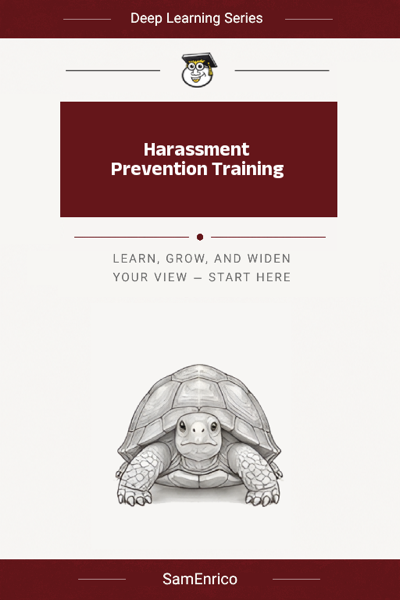
Harassment Prevention Training eBook
A Coursebook on Harassment Prevention Training
A Coursebook on Harassment Prevention Training
Formats
Free sample
Chapter 1: The Broken Shield...--Imagine you are an HR director at a mid-sized technology firm. You have done everything right. You have a twenty-page anti-harassment policy signed by every employee. You require annual online training with a 98% completion rate. You post posters in the breakroom reminding employees of the zero-tolerance policy.
One afternoon, an employee walks into your office and hands you a complaint. For eighteen months, she has been subjected to unwanted sexual comments, demeaning jokes about her gender, and increasingly aggressive behavior from a senior vice president. She never reported it earlier because that vice president controls promotions. When you pull her training records, you see she completed the annual module just six weeks before her first incident. The vice president completed his, too.
He even passed the quiz with a perfect score.You have a policy. You have training. You have posters. And yet, harassment happened for eighteen months before anyone spoke up.This is not a failure of compliance. It is a failure of design.For nearly three decades, the dominant approach to harassment prevention in American workplaces has been what critics call "check-the-box" training.
It emerged from a well-intentioned legal framework, but it has congealed into a ritual that prioritizes documentation over behavior, completion over comprehension, and liability defense over cultural change. The result is an expensive, widespread system that does not work as intended and, in some cases, may even make problems worse.This chapter dismantles the common but flawed approach to harassment prevention as a mere legal formality. We begin with two landmark U.S. Supreme Court cases that unintentionally created the very system this book seeks to replace. We then examine the affirmative defense—the legal loophole that incentivizes superficial training—and why simply having a policy does not shield an employer from liability.
From there, we build a business case for change, demonstrating that harassment directly damages employee retention, brand reputation, and productivity, incurring hidden costs far beyond legal settlements. Drawing on adult learning theory and behavioral psychology, we argue that passive, one-size-fits-all lectures fail to change behavior because they do not engage learners or practice real-world skills. Finally, we redefine success: the goal is not "training completed" but a measurable "culture changed," where every employee understands their role in maintaining respect.This chapter does not pretend that training alone can solve harassment. It argues instead that most current training is designed to fail, and that a complete rethinking is required before any meaningful progress can occur.The Legal Origins of a Broken System To understand why check-the-box training persists, we must understand the legal environment that created it. In 1998, the United States Supreme Court decided two cases that fundamentally reshaped employer liability for workplace harassment: Burlington Industries, Inc.
v. Ellerth and Faragher v. City of Boca Raton. Both cases involved supervisors who created hostile work environments, and both raised a critical question: When is an employer automatically liable for a supervisor's harassment, and when can the employer avoid liability?The Court's answer created what lawyers call the Ellerth/Faragher affirmative defense. Under this defense, an employer may avoid liability for a supervisor's harassment if two conditions are met.
First, the employer must have exercised reasonable care to prevent and correct promptly any sexually harassing behavior. Second, the plaintiff employee must have unreasonably failed to take advantage of any preventive or corrective opportunities provided by the employer or to avoid harm otherwise.On its face, this defense seems balanced. It encourages employers to create prevention systems while also encouraging employees to use those systems. But in practice, the defense created an unintended incentive structure that prioritized paperwork over people.Here is what happened. Corporate lawyers read Ellerth and Faragher and recognized that the easiest way to satisfy the first prong—reasonable care to prevent and correct—was to create a paper trail.
A written policy. A complaint procedure. Annual training. If an employer could produce evidence of these artifacts, courts were likely to find that the employer had exercised reasonable care, regardless of whether the training actually changed behavior. The second prong—whether the employee unreasonably failed to report—then became the battleground.
Employers would argue that if the employee had not used the reporting system, the employee was partly at fault.The logic is seductive but flawed. It assumes that all reporting systems are equally accessible, that employees know how to use them, and that employees trust them. It assumes that training once a year on a computer screen equips an employee to recognize and report harassment in real time. It assumes that a policy document on an internal server is the same as a living culture of respect.None of these assumptions hold.The Affirmative Defense as a Trap The Ellerth/Faragher affirmative defense has become a trap for both employers and employees. For employers, it creates the illusion of safety.
A company that has a policy and annual training may believe it has done enough, even when harassment continues unchecked. This belief is dangerous because it discourages deeper investment in cultural change. Why spend resources on ongoing coaching, manager training, climate surveys, and bystander intervention programs when a two-hour online module satisfies the legal standard?For employees, the defense creates a barrier to reporting. Many employees understand—implicitly or explicitly—that if they report harassment after a delay, the employer may use that delay against them. The employee who waits eighteen months because she fears retaliation hears, in depositions and legal briefs, that she "unreasonably failed to take advantage of reporting opportunities." The system designed to protect her becomes a weapon to blame her.Consider the research.
A 2018 study by the Equal Employment Opportunity Commission (EEOC) found that three out of four employees who experienced workplace harassment never filed a formal complaint. The most common reasons were fear of retaliation, belief that nothing would change, and concern that they would not be believed. These are not irrational fears. Retaliation is the most common claim filed with the EEOC, surpassing even race and sex discrimination. And when employees do report, they often face disbelief, minimization, or worse.The Ellerth/Faragher defense did not create these problems, but it cemented a compliance mindset that prioritizes legal defensibility over human dignity.
And that mindset is the root cause of check-the-box training.What Check-the-Box Training Looks Like You have probably experienced check-the-box training. It takes many forms, but it shares common features. The training is delivered online or in a large group lecture. It lasts between one and three hours. It consists largely of videos, slides, and multiple-choice quizzes.
It defines harassment in abstract legal terms. It lists prohibited behaviors without explaining how those behaviors actually appear in real workplaces. It tells employees what not to do but rarely teaches them what to do instead. It is mandatory, annual, and identical for all employees regardless of role, risk level, or prior knowledge.The content is often the same year after year. Employees click through screens, answer questions until they get the right answers, and close the browser.
Learning retention studies show that within 72 hours of passive instruction, learners forget approximately 70% of the information presented. Within 30 days, that number rises…
This is the end of the free sample. Get the eBook to keep going. Buy now
About this book
Details
- Author
- Ricks Sterling
- Publisher
- SamEnrico
- Language
- English
- Genre
- Non-Fiction, Informative, Educational
- Released
- 2026-05-04
- Pages (approx.)
- 159
- Available as
- eBook, Audiobook

Read better in the ZLOADR app
Your eBooks on your phone or tablet. Sign in with your SamEnrico account and start reading.
More by Ricks Sterling
 Nonprofit Business Planning WorkbookRicks Sterling$11.99
 The Cave of CandlesRicks Sterling$11.99
 The Lifespan Genetic PredictorRicks Sterling$11.99
 Paleo Family Meals CookbookRicks Sterling$11.99
 Grieving While Parenting Your KidsRicks Sterling$11.99
 The Frozen Code: Neanderthal Numbers and the Birth of MathematicsRicks Sterling$11.99
 Anansi's Lyrical Web: The Spider’s Trickster BalladsRicks Sterling$11.99
 Meg Whitman Cash Marketplace ManualRicks Sterling$12.99
 Together for SustainabilityRicks Sterling$12.99
 Understanding Gingival FibrosisRicks Sterling$17.99
 How to Start a Castor Sugar Business (Beginners Guide)Ricks Sterling$11.99
You may also like
 Hong Kong Handover 1997Dunn Johnnie$11.99
 Zumba For Postnatal Recovery CourseNeal Christian$11.99
 Zumba for BeginnersLadner Nikia$11.99
 YouTube Comment Mining GuideHumes Pandora$12.99
 Worry Box MeditationCarlin Rudy$11.99
 Workplace Stress MeditationNguyen Lynn$11.99
 Workplace Stress and Sleep RepairHawley Ivory$11.99
 Workplace Perfectionism CureDelaney Jeffry$11.99
 Workplace Injustice Anger GuideWallen Isabelle$11.99
 Work Addiction and Burnout LinkGreenwood Ester$11.99
 Women in Yoga and WellnessBeattie Galina$11.99
 Women in Stand Up ComedyChun Evangeline$11.99