
Non-FictionSelf-HelpPassive Aggression
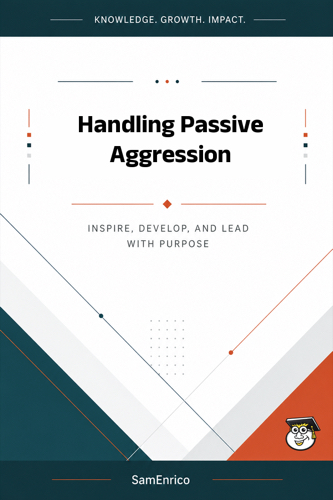
Handling Passive Aggression eBook
Assertive responses to subtle digs, silent treatme
Assertive responses to subtle digs, silent treatment, and backhanded comments.
Formats
Free sample
Chapter 1: The Quiet Warfare...--–- You didn’t lose your temper. You didn’t say anything cruel. You simply asked your partner to help with the dishes, or reminded your coworker about the deadline they missed, or told your parent that you wouldn’t be visiting for the holidays. And then it happened. The temperature in the room dropped.
A door closed a little too softly. A text message went unanswered for twelve hours. A comment landed like a paper cut: “Well, some of us aren’t perfect.” Or worse, nothing at all. Just silence.You have just entered the quiet war.Passive aggression is the most exhausting form of human conflict because it is designed to look like nothing is happening. There is no screaming, no fist raised, no direct insult you can point to and say, “That was wrong.” Instead, there is a slow leak of hostility disguised as forgetfulness, helpfulness, politeness, or victimhood.
And when you finally react—when you raise your voice, cry, or walk away—you become the problem. “See?” they seem to say. “You’re the emotional one. I was just fine.”If you are reading this book, you already know this dance. You have felt the unique frustration of being subtly punished for asking for something reasonable.
You have been on the receiving end of a comment that seemed polite on the surface but left you feeling small. You have spent hours replaying a conversation in your head, trying to figure out if you were wrong, or if they were wrong, or if you are just too sensitive. Let me stop you right there. You are not too sensitive. You have been gaslit into believing that your emotional responses are the problem when, in fact, they are the evidence that you are being emotionally manipulated.This chapter is not a set of tactics.
That comes later. This chapter is about recognition. You cannot win a war you do not know you are in. And the quiet war is uniquely difficult to identify because it wears the costume of civility. The silent treatment is presented as “needing space.” The backhanded compliment is presented as “just being honest.” The procrastination is presented as “being busy.” The tears are presented as genuine hurt.
The joke at your expense is presented as “you can’t take a joke.” By the time you realize you are under attack, you are already exhausted, confused, and questioning your own reality.Let me tell you about Maria. She was a project manager at a mid-sized marketing firm. She had a team member named David who never directly opposed her. He would smile, nod, and say “sounds good” in every meeting. But deadlines would come and go with no work from David.
When asked, he would say, “Oh, I didn’t realize that was urgent. You didn’t seem that serious about it.” Or, “I would have finished it, but I wasn’t sure you really wanted it done that way.” Or, most devastatingly, “I’m sorry, I just have so much on my plate. I guess I can’t do everything.” Maria spent months wondering if she was a bad manager. She asked other colleagues if she was unclear. She started over-explaining every task, which exhausted her and annoyed her other team members.
Finally, after six months of this, David submitted a project that was deliberately sabotaged—data moved to the wrong columns, graphics misaligned, the entire thing unusable. When Maria asked what happened, David said, with complete innocence, “I followed your instructions exactly. I don’t know what you want from me.” Maria cried in the bathroom that day. Not because of the project. Because she realized she had been in a war for six months and had only just found out.David was not a bad person, necessarily.
He may not have even been conscious of what he was doing. But he was a passive-aggressive combatant. And Maria was losing.This book exists because millions of Marias are losing the quiet war every day. They are losing it at work, at home, with their parents, with their spouses, with their friends, and with themselves. And the standard advice—“just ignore it,” “be the bigger person,” “communicate more clearly”—is not just unhelpful.
It is harmful. It tells the victim to try harder while letting the perpetrator off the hook.Let me be clear about what this book is and what it is not. This book is not about diagnosing personality disorders. It does not matter if the person using passive aggression against you is a narcissist, has a personality disorder, or is just having a bad decade. The label does not change your response.
This book is also not about making you a nicer person. Niceness is what got you into this mess. This book is about making you a more strategic person. You will learn to recognize tactics, respond with precision, protect your mental health, and—when necessary—walk away.This book is based on a synthesis of the ten best-selling books on assertiveness, interpersonal communication, and psychological manipulation. These include classic works like When I Say No, I Feel Guilty and People Skills, as well as modern bestsellers like Crucial Conversations and Set Boundaries, Find Peace.
The techniques you will learn are not experimental or untested. They have been used by millions of people in thousands of real-world situations. They work. But they only work if you understand the fundamental truth that underpins every strategy in this book.That fundamental truth is this: Passive aggression is a behavioral strategy, not a personality defect.When you believe that someone is “just a passive-aggressive person,” you give them a permanent excuse. You tell yourself, “They can’t help it.
That’s just how they are.” This belief leads you to tolerate behavior that you would never tolerate from anyone else. It makes you feel sorry for them. It makes you try to fix them. And most dangerously, it makes you stay in relationships that are slowly destroying your peace of mind.But when you understand that passive aggression is a strategy—a set of behaviors that someone uses because those behaviors have worked for them in the past—everything changes. A strategy can be countered.
A strategy can be outmaneuvered. A strategy loses its power when it stops producing the desired result. The person using passive aggression does not need therapy (though they might). They need to discover that their usual tactics no longer work on you. And that is exactly what this book will teach you to do.Let me give you a preview of what is coming.
In the chapters ahead, you will learn to recognize the six specific faces of hidden hostility: The Ghost (silent treatment), The Saboteur (procrastination and “forgetting”), The Backhander (backhanded compliments), The Victim (tears and martyrdom), The Joker (hostility disguised as humor), and The Gaslighter (denying reality). You will learn why even smart, emotionally intelligent people fall into the trap of overreacting or freezing. You will learn the 5-Second Pause, a physiological interrupt that shifts your brain from reactive to strategic. You will learn specific scripts for every tactic, from the…
This is the end of the free sample. Get the eBook to keep going. Buy now
About this book
Details
- Author
- Begley Yuriko
- Publisher
- SamEnrico
- Language
- English
- Genre
- Non-Fiction, Self-Help, Passive Aggression
- Released
- 2026-06-07
- Pages (approx.)
- 144
- Available as
- eBook, Audiobook

Read better in the ZLOADR app
Your eBooks on your phone or tablet. Sign in with your SamEnrico account and start reading.
More by Begley Yuriko
 Twitter Pinned Tweet PressureBegley Yuriko$11.99
 Legacy Letters Recovery Writing CourseBegley Yuriko$11.99
 Self Directed Exposure GuideBegley Yuriko$11.99
 OKR Goal Setting Framework GuideBegley Yuriko$11.99
 The Last Broadcast of the Phantom RadioBegley Yuriko$11.99
 Understanding Inhalant Abuse, Aliphatic HydrocarbonsBegley Yuriko$17.99
 Inflation Anxiety ToolkitBegley Yuriko$12.99
 Cash vs Digital Spending GuideBegley Yuriko$12.99
 How to Become a Chip TunerBegley Yuriko$11.99
 Clinical Data AssociateBegley Yuriko$11.99
You may also like
 Hong Kong Handover 1997Dunn Johnnie$11.99
 Zumba For Postnatal Recovery CourseNeal Christian$11.99
 Zumba for BeginnersLadner Nikia$11.99
 YouTube Comment Mining GuideHumes Pandora$12.99
 Worry Box MeditationCarlin Rudy$11.99
 Workplace Stress MeditationNguyen Lynn$11.99
 Workplace Stress and Sleep RepairHawley Ivory$11.99
 Workplace Perfectionism CureDelaney Jeffry$11.99
 Workplace Injustice Anger GuideWallen Isabelle$11.99
 Work Addiction and Burnout LinkGreenwood Ester$11.99
 Women in Yoga and WellnessBeattie Galina$11.99
 Women in Stand Up ComedyChun Evangeline$11.99